

By Craig Stephen
Auckland FC players Francis de Vries and Nando Pijnaker are vying to join All Whites legend Frank van Hattum as FIFA World Cup stars with Dutch heritage.
Van Hattum famously played all three games at the 1982 World Cup finals in Spain, after ousting first-choice keeper Richard Wilson.
De Vries calls the left-back position his own as he has shown outstanding form for Auckland FC to reclaim a place in the All Whites set-up, while Pijnaker, who was born in Brummen in the Netherlands, has battled injuries to reclaim his spot in the side.
Main photo: Auckland FC duo Nando Pijnaker (centre) and Francis de Vries (right), with teammate Dan Hall. Photo: Shane Wenzlick / Phototek.
Forwards Oskar van Hattum (South Island United) and Andre de Jong (Orlando Pirates) have also played in national colours in recent years.
They extend a Dutch-All Whites history that goes back decades.
They were so numerous in the 1950s and 1960s that Dutch people in Auckland had their own ‘national’ team to support in a quadrangular tournament that also featured teams representing England, New Zealand, and the entire world, in the guise of ‘The Rest’.
Those early Dutch sides contained New Zealand internationalists Frits and Klaas Poelman and Theo van der Broek.
Inside left Hans Kaiser of Pt Chevalier would grace the International Tournament for a decade.
The squad for the inaugural championship in 1956 included several players who had been based in the Dutch East Indies and left when the country became Indonesia in the late 1940s. Frits Poelman played for the Dutch military team in the archipelago, while Gerald Textor was also based there.
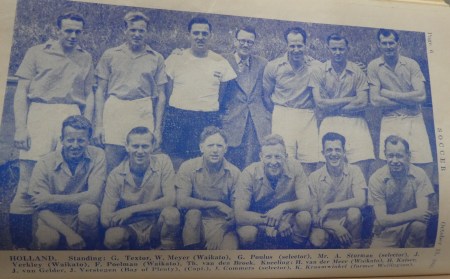 The 1956 ‘Holland’ side for the Home Internationals. Among them are numerous Auckland, Waikato and Bay of Plenty representatives including Hans Kaiser, Jack Gommers and Frits Poelman.
The likes of Willem Meyer (Haarlem) and Jack Gommers (Tilburg) had played for pro or semi-pro sides in the Netherlands before moving to a country they would know as Nieuw-Zeeland.
Winger Karel Kraamwinkel played several times for the famous Ajax Amsterdam between 1939 and 1941 and, at 35, was the team’s most senior member.
The Netherlands — naturally wearing the orange tops of the mother country — had made an excellent start to that inaugural event, defeating the hosts 4-2 in their opening match at Blandford Park.
They were backed by a large contingent of supporters who chanted Dutch songs throughout the game.
Gommers played a blinder upfront and worked in tandem with Meyer for what was described as “one of the best goals seen at the park in years”. However, they were then beaten 4-1 by The Rest in the final.
The weather seemed to afflict them more than their foes. The waterlogged pitch, the Auckland Star noted, handicapped the “taller and heavier Dutchmen” and hindered their ability to play their natural long-passing game.
The 1950s also saw Bill Westerveld picked for New Zealand — incredibly, one of three countries he represented. Westerveld was born in the town of Venlo near the Dutch border with Germany and played for the youth team of local club VVV Venlo.
The midfielder was good enough to represent the Netherlands at the 1948 FIFA youth tournament in England. Though the Dutch team wouldn’t bloom at the senior level for a couple more decades, their youth side was formidable at the time and reached the tournament final, where they were defeated by England.
Aged 18, Westerveld packed his bags for Dunedin, where he got a job as a butcher and played for, and captained, Mornington FC. He was spotted by a Dunedin-based selector and received a call-up for the national team that toured Australia in the winter of 1954, playing in the three tests against the Aussies.
The Kiwis overcame the hosts 2-1 in the first game at the Melbourne Showgrounds with a magnificent performance. Soon after, Westerveld ditched the South Island for Victoria, where he played for the state and national sides against Stanley Matthews’ Blackpool in 1958.
The Dutch have a long connection with New Zealand, going back to the 17th century when explorer Abel Tasman sighted the islands. But it wasn’t until the 20th century that Dutch people started to settle in New Zealand in significant numbers, particularly after the Second World War and following Indonesia’s independence in 1949.
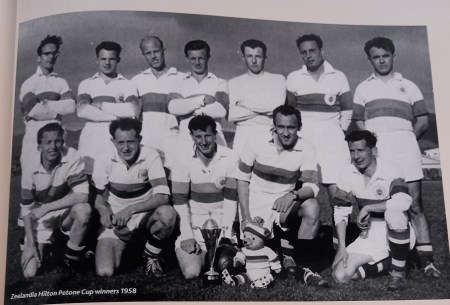 Hilton Petone Cup winners of 1958, Zealandia.
In Christchurch, the Dutch community formed Neerlandia FC (now Hornby United); in Dunedin, they were behind Continental FC, which played in the national colours of Holland before being renamed St Kilda FC. There was also a Palmerston North Dutch Club.
In Wellington, the Dutch community created Zealandia in February 1954, who played in the Netherlands flag colours of white strips with blue and red hoops. They tore through the district leagues to reach the Wellington Division One in the late 1950s and shocked Miramar Rangers in the final of the 1959 Hilton Petone Cup. But with the team struggling in Division One and player numbers dropping, the club renamed itself Wellington United to appeal to the wider community.
In 1967, they merged with Diamond FC to become Wellington Diamond United. Following more mergers and unmergers, that entity is back to being Wellington United and all its teams wear the famous orange strips of Holland to this day.
Dutch players were predominant in many provincial teams, including the aforementioned Poelman brothers of Waikato and Arie van Rooyen of Canterbury, a starter for New Zealand against the crack Costa Rican side Deportivo Saprissa in 1959.
In the late 1960s, a bright new talent emerged in the shape of teenager Bill de Graaf, who came to New Zealand in 1965 while he was on the books of one of the two clubs that would soon merge into FC Twente of Enschede. He initially joined Papatoetoe and made such a quick impression that he was called up to the Auckland provincial side while only 16.
The striker was part of the national team that made its foray into the World Cup, playing in the two ties against Israel in September 1969, and would go on to play 22 times for New Zealand until 1981.
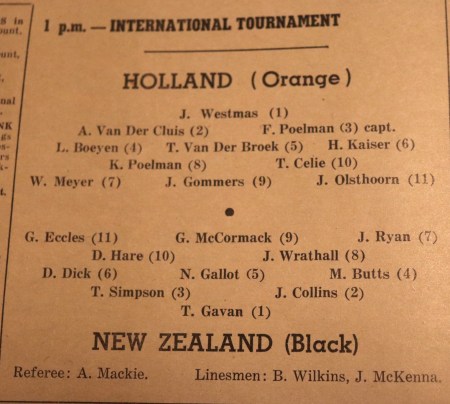 The Dutch team that played New Zealand in the 1958 International Tournament in Auckland
One man who has appeared in the World Cup finals is Frank van Hattum who played in all three games at the 1982 finals. The goalkeeper’s family moved out to New Zealand in the 1950s and he was born in New Plymouth in 1958. He later recalled that Dutch was still spoken at home and among friends until his father’s decision to become a New Zealander with Dutch traditions rather than a Dutchman living in New Zealand. Frank’s nephew Oskar now plays for South Island United, after a spell in the League of Ireland.
The last of Frank van Hattum’s 21 All Whites caps came in 1986. By then, striker Fred de Jong was firmly established in the national set-up after making his international debut two years earlier.
New Zealand has Johan Cruyff and total voetball to thank for converting the young de Jong from rugby to football. The 10-year-old woke up with his family to watch the 1974 final on a black and white television set to cheer on Holland against the host nation, Germany.
The Dutch were overwhelming favourites that day, but despite scoring before a German player had even got a touch of the ball, they somehow fashioned a way to lose 2-1.
Yet, for de Jong, that 1974 tournament, and especially the Dutch master Cruyff, was the catalyst for him to persuade his father to let him switch to football before the start of the next season.
Fred followed his family line back to the Netherlands in the early 90s and secured a contract with Eredivisie side Fortuna Sittard, for whom he played 53 times over three seasons.
De Jong’s son Andre has followed his father into the national team. He has made 11 appearances for New Zealand at full international level, scoring twice. He was last called up to the All Whites for the November 2025 internationals against Colombia and Ecuador, after an absence of three years from the national squad.
These are only the tip of the iceberg — or, if you prefer, the toe of the clog — of Dutch-heritage players excelling in this country.
Craig Stephen
Craig Stephen writes about football for a number of publications. He is the author of Bombs and Boots, a book that tells how New Zealand football came of age in the 1960s and 1970s.
This story was first published on February 11, 2025.