
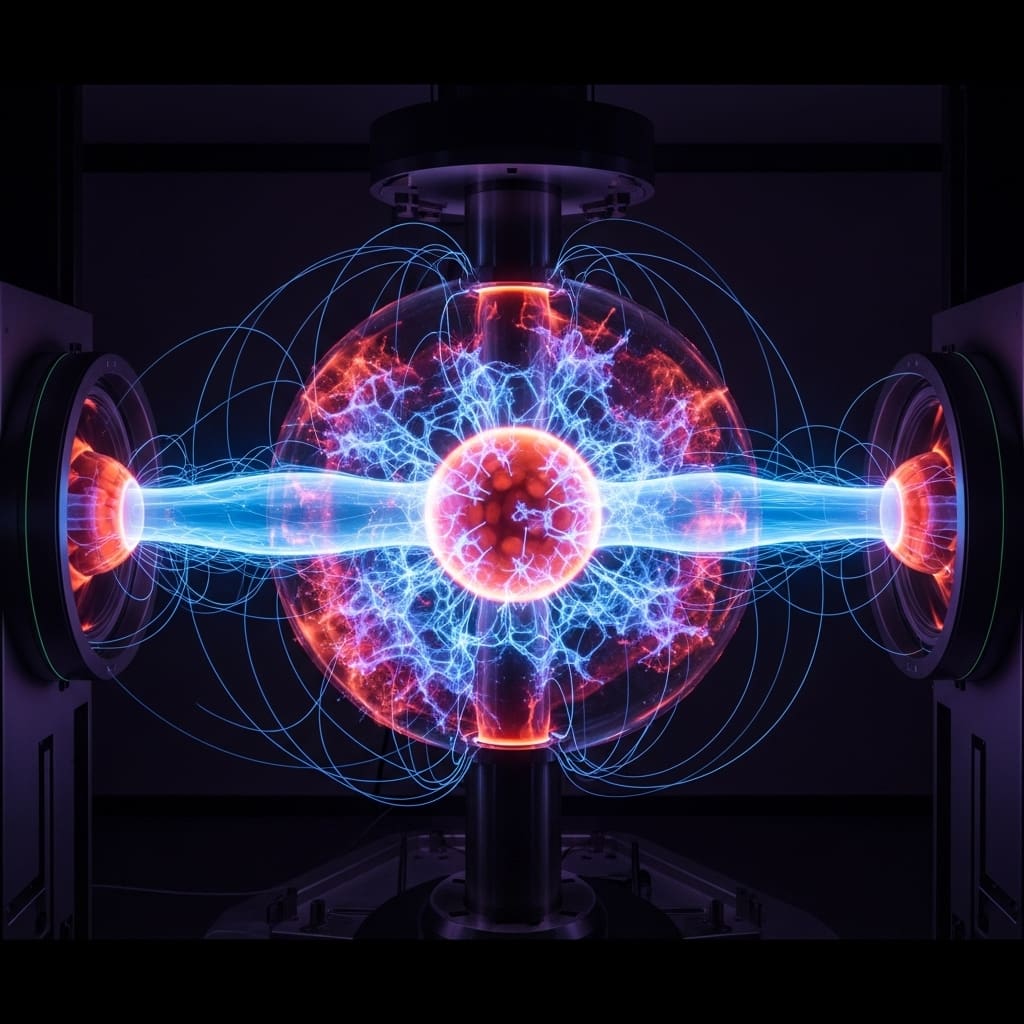
Scientists are increasingly focused on understanding collisionless Larmor coupling, a key process governing momentum transfer in both laboratory and astrophysical plasmas. Lucas Rovige, Robert S Dorst, and Ari Le, all from the University of California, Los Angeles, alongside Carmen G Constantin, Haiping Zhang, and David J Larson et al., present findings from a laboratory experiment investigating this coupling and its role in plasma blob formation. Their work, conducted on the Large Plasma Device at UCLA, details how a laser-driven plasma expands into a magnetized environment, leading to the observed self-focusing and creation of a diamagnetic cavity. Crucially, Doppler spectroscopy provides direct evidence of ion energization through Larmor coupling, offering valuable insight into the kinetic-scale physics of blob formation and the behaviour of plasmas in complex magnetic fields.
Laboratory observation of collisionless Larmor coupling and plasma blob formation reveals key insights into magnetic reconnection processes
Scientists have directly observed the self-organization of plasma under conditions mirroring those found in space and astrophysical environments. The high-repetition rate of the experiment was crucial, allowing for detailed spatial and temporal scans of plasma evolution via Doppler spectroscopy, alongside measurements of magnetic and electrostatic fields, and emitted radiation from both debris and background ions using filtered imaging techniques.
Observations reveal the self-focusing of the laser-produced plasma and the subsequent formation of a secondary diamagnetic cavity, specifically a blob composed of background ions. These simulations offer further insight into the kinetic-scale physics governing blob formation and the significant role of ambient plasma density.
This research reproduces space-like conditions characterized by a super-Alfvénic flow, where the debris velocity exceeds the Alfvén speed in the ambient plasma, and a magnetically dominated regime with low plasma pressure relative to magnetic field strength. In this regime, momentum transfer is expected to occur via large-scale electric fields, specifically the Larmor electric field arising from ion currents transverse to the magnetic field.
Observations from space missions have previously documented similar plasma blob formation following artificial ion cloud releases, demonstrating their ability to transport across field lines, and this work provides a crucial laboratory analogue to further understand these phenomena. The experiment achieved a background plasma density of up to 5x 1013cm−3, offering new insights into the influence of density on the blob formation process and validating theoretical predictions regarding Larmor coupling.
LAPD diagnostics for laser-driven plasma flow and ion energisation are crucial for fusion research
Doppler spectroscopy and filtered imaging underpinned the laboratory investigation of Larmor coupling and subsequent plasma blob formation. The experimental setup, illustrated in a schematic, involved directing a laser onto a target within the LAPD, generating a super-Alfvénic plasma flow in an 800 Gauss magnetic field.
Filtered imaging, utilising both B·dot and emissive probes, captured the spatial distribution and temporal evolution of plasma emissions. These probes were coupled to a spectrometer for detailed spectral analysis of the emitted radiation. A key methodological innovation was the implementation of a high-repetition rate system, allowing for rapid data acquisition and comprehensive scans of the plasma parameters.
This enabled the observation of self-focusing within the laser-produced plasma and the formation of a secondary diamagnetic cavity, indicative of a blob composed of background ions. Numerical simulations corroborated these experimental observations, offering further insight into the kinetic-scale physics governing blob formation and the influence of ambient plasma density. The work aimed to replicate space-like conditions with a super-Alfvénic flow, where the debris velocity exceeded the Alfvén speed in the ambient plasma, and a magnetically dominated regime with low plasma beta.
Temporal evolution of He+ ion transverse velocities in laser-produced plasma is investigated via optical emission spectroscopy
Observations of the laser-produced plasma reveal a transverse velocity of 45 ±25km/s for excited He+ ions at 600ns and x=6cm, corresponding to the position of the developing blob. Spectral analysis demonstrates that 50% of these ions exceed a velocity of 75km/s, indicating substantial energization within the plasma.
Subsequent measurements at 1400ns show a shift towards blueshifted emission, signifying a decrease in the average transverse velocity and the onset of ion motion in the opposite direction. Detailed Doppler spectroscopy of the 468.6nm He+ emission line, a marker of collisionless energization, characterizes the transverse velocity distribution of background ions.
The peak of the emission spectrum initially experiences a redshift of 0.07nm, corresponding to the 45km/s transverse velocity. Following this, the emission shifts back towards lower wavelengths, and eventually becomes blueshifted, demonstrating a dynamic change in ion momentum. Measurements of the positive transverse velocity at half-maximum, V+50%, and negative transverse velocity at half-maximum, V−50%, further quantify this behavior over time.
The formation of a secondary diamagnetic cavity is spatially correlated with the emergence of a large blob of excited He+ ions at the upper edge of the laser-produced plasma, though these structures remain distinct. Filtered imaging using a bandpass filter at 468.6nm with a 0.5nm bandwidth, captured with a 50ns exposure time, visualizes the He+ emission. Complementary imaging at 227nm, utilizing a 10nm bandwidth and 4ns exposure time, reveals the associated carbon emission.
Larmor coupling drives blob formation and ion energization in magnetized plasmas, ultimately impacting transport rates
Observations confirm collisionless Larmor coupling as a key process in the formation of plasma blobs and the energization of ions in magnetically dominated plasmas. Doppler spectroscopy directly reveals that these background ions are energized through collisionless Larmor coupling, initially exhibiting redshifted emission indicative of upward acceleration, which then evolves to blueshifted emission consistent with gyromotion.
Detailed spatial and temporal scans, enabled by a high-repetition rate laser, characterize the ion dynamics and support interpretations from accompanying numerical simulations. These simulations successfully reproduce the observed diamagnetic cavity, collimated debris, and energized background ions, providing further insight into the kinetic physics of blob formation.
The authors acknowledge some discrepancies between experiment and simulation, potentially arising from simplified initial conditions in the simulations and their two-dimensional geometry. Future research may focus on refining these simulations with more realistic velocity distributions and exploring three-dimensional effects. These findings provide a comprehensive experimental characterization of Larmor coupling, complementing previous studies and advancing understanding of plasma behaviour in astrophysical and laboratory settings.
👉 More information
🗞 Collisionless Larmor Coupling and Blob Formation in a Laser-Plasma Expanding into a Magnetized Ambient Plasma
🧠 ArXiv: https://arxiv.org/abs/2602.03494