
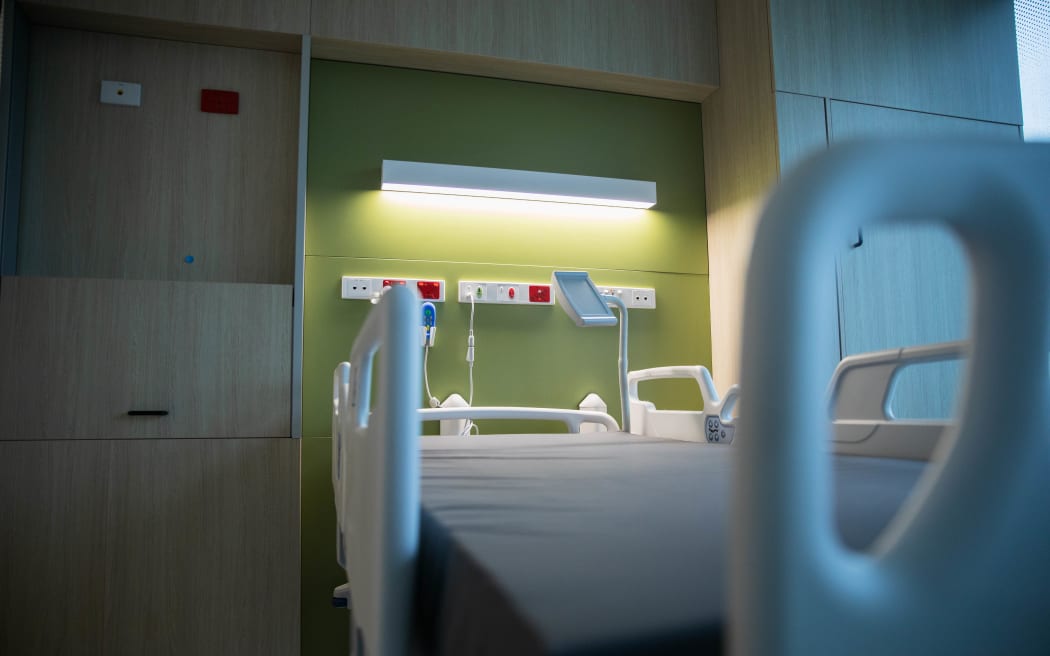
Nearly half of all New Zealand women with ovarian cancer are being diagnosed in emergency departments across the country.
Photo: RNZ / Samuel Rillstone
A new report says there are big gaps in New Zealand awareness, treatment and support for ovarian cancer which is the least survivable women’s cancer and takes one woman’s life every two days.
The Ovarian Cancer Foundation released new research at Parliament on Wednesday which found significant gaps in New Zealand’s awareness, diagnosis, treatment, support, research and clinical trials for ovarian cancer.
The report titled State of Ovarian Cancer Report – Aotearoa New Zealand 2025 said that there are an average of 306 new diagnoses each year and that one woman dies of the disease every 48 hours.
The foundation’s general manager, Liz Pennington, told Midday Report that there was a lack of awareness and understanding of the signs and symptoms of ovarian.
“We know that in New Zealand for example, nearly half of all women are actually being diagnosed with ovarian cancer in emergency departments across Aotearoa and we certainly know that when women are attending Accident and Emergency they’re attending because obviously they’re in pain or the presenting really acutely.”
That was a significantly higher rate of women being diagnosed in A and E than in Australia, where the rate was 21 to 28 percent, she said.

Crosses representing ovarian cancer deaths on the steps of Parliament after a petition with more than 7000 signatures, calling for national diagnostic guidelines to be developed for ovarian cancer was presented there on 16 March 2021.
Photo: RNZ / Dom Thomas
New Zealand had a very low level of research funding into ovarian cancer when compared with comparable companies, she said.
“When it comes to access to things like clinical trials currently in New Zealand women can only access five, again if we look across the Tasman in Australia women can access 44.”
Another issue is problems with accessing ultrasound for New Zealand women which meant that diagnosis was often significantly delayed, with women being encouraged to pay to go privately when and if they could, she said.
“And we’ve got 30 percent of women dying in that first year from the diagnosis that I talked about and a five year survival rate of only 42.8 percent, so a really significant issue needing significant investment and a plan of action really.”
A woman who went to the GP in Australia with potential symptoms of ovarian cancer such as bloating, feeling full without having eaten a lot and changes to bowel or bladder habits would be treated differently from one in New Zealand, she said.
“In Australia the pathway would be pelvic exam, so you know a feel of her tummy and things, a discussion and then she can be sent for both a blood test and a scan, here in New Zealand that’s not the case.”
In New Zealand, the woman may be sent for the blood test which is called CA125 and then after that she would be likely to have to revisit the GP where there could be problems getting an appointment and then she might be sent for an ultrasound, she said.
“But the large majority of GPs were telling us in the survey that access to ultrasound was difficult and that it was one of the key factors delaying diagnosis – so that’s something that needs to change.”
Three new treatments for ovarian cancer had been released in New Zealand in the last five years which had reduced the gap with Australia, she said.
But if those treatments were not funded then patients and their families had to resort to things like crowd funding or mortgaging their houses to pay for it, she said.
The report urges health decision-makers to implement the following actions:
Add ovarian cancer symptoms education to the national cervical screening programme and clarify that screening does not detect other gynaecological cancers
Amend Health Pathways to allow GPs to refer symptomatic women for an ultrasound at their first GP visit
Identify people at higher genetic risk before they get ovarian cancer
Address gynae-oncology specialist shortages
Prioritise ovarian cancer clinical trials
Increase funding and focus on ovarian cancer by the Health Research Council
Address data gaps and make accurate, real-time data more accessible across the health system
Improve medicines access and investment
Include people with lived experience, their whānau and patient advocacy groups in service design, policy and research
Sign up for Ngā Pitopito Kōrero, a daily newsletter curated by our editors and delivered straight to your inbox every weekday.