
While most western countries are split by deep urban-rural political divides, New Zealand’s biggest city votes almost exactly like the rest of the population. What makes Auckland so oddly normal?
As political parties plan their campaign strategies for New Zealand’s 2026 general election, to be held on November 7, all eyes are focused on the same place: Auckland. New Zealand’s biggest city is home to 1.8 million people, more than a third of the country’s population.
With that many voters, it should be no surprise that Auckland is at the top of politicians’ minds. And yet, it’s an internationally rare phenomenon for a country’s largest city to be its most politically significant. The US presidential election is decided by mid-sized towns in Pennsylvania, not New York City.
The reason is that big cities usually aren’t very reflective of the average voter. The urban-rural political divide is one of the most significant demographic changes of the 21st century; cities are getting more progressive and left-wing, rural areas are becoming more right-wing and nationalistic.
Auckland is different from the rest of the country in many ways; it’s richer, younger, and far more ethnically diverse. And yet it votes almost exact exactly the same. In the 2023 election, the party vote results in Auckland were consistent with the overall election results, with the biggest difference being a five-point over-performance by National.
Labour’s poor result in the 2023 election has been interpreted as a backlash by Aucklanders against the government that kept them in lockdown for too long, but the data shows Aucklanders acted in line with everyone else. If you go back to the last “normal” pre-Covid election in 2017, you get a similar result. Auckland’s vote is close to the overall party vote, with both National and Labour slightly over-performing.
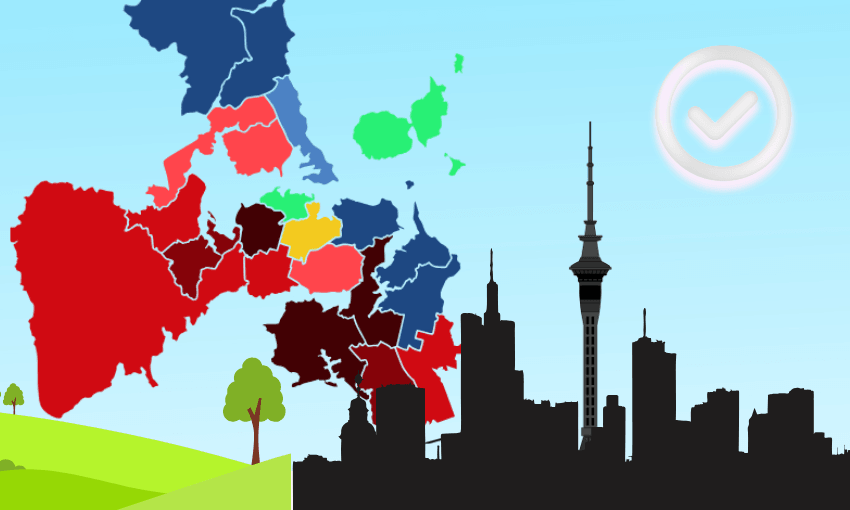
New Zealand still has pockets of polarisation. Wellington and Dunedin tend to vote left, Invercargill and New Plymouth vote right. This is the case within Auckland too. National does well in the north and east, Labour is strong in the south and west. The Auckland Central electorate, currently represented by Green Party co-leader Chlöe Swarbrick, was won by National’s Nikki Kaye four times from 2008 to 2017. Before that, it was held by Labour almost uninterrupted for 90 years. Right next door is Pakuranga, arguably National’s safest seat.
How did this happen? What made Auckland’s politics so abnormally normal?
History
While Wellington, Christchurch and Dunedin were the result of centrally planned master visions, Auckland’s growth was more of a free-for-all hodgepodge of ideas driven by private developers rather than bureaucrats. It has primarily been a commercial centre, not a government town. These factors may have helped to create a city culture that values free enterprise and classical liberalism. But given that more than 40% of Aucklanders were born overseas, the decisions of city planners in the 1840s probably aren’t the leading factor.
Zoning
In the second half of the 20th century many cities, particularly in the US, experienced the phenomena known as “white flight“. The rise of car ownership made it possible to live further from city centres, and many wealthy (and mostly white) residents moved to the outer suburbs to escape urban areas they perceived as dangerous or unhealthy. It became a self-fulfilling prophecy: inner cities were increasingly stigmatised, investment drained away, and populations became poorer and disproportionately black, to the point where, in the US, “urban” is often used as shorthand for black. (Until 2017, the Aotearoa Music Awards had a category called Best Urban/Hip Hop Album, but there was no requirement that it be recorded in a city.)
Auckland, despite its suburban sprawl, never experienced white flight in quite the same way. If anything, the pattern ran in reverse. Waves of gentrification and rising house prices pushed poorer residents further from the city centre. Inner suburbs like Ponsonby and Grey Lynn shifted from working-class, brown communities into some of the city’s wealthiest and whitest neighbourhoods. Māori and Pasifika populations increasingly concentrated in South Auckland.
 Villas in Ponsonby (Photo: Getty Images)
That trend was reinforced by planning rules in many inner suburbs, which wrapped themselves in heritage and “character” protections that limited denser, cheaper forms of housing. The effect was an informal price floor: if you couldn’t afford an existing villa, you couldn’t buy a house in that neighbourhood. The result is that many of the wealthiest suburbs, where National and Act do well, sit close to the city centre.
In cities that experienced white flight, conservative parties lost their foothold in the central city neighbourhoods and focused their efforts elsewhere. Auckland’s geographic wealth distribution meant that never happened to National.
Party origins
Both major parties see Auckland as core to their political identity. Labour always had a connection to central Auckland because of the workers at the wharves, factories and rail yards.
National, by contrast, was born from a merger of two conservative traditions: Reform, which represented farmers, and United, which spoke for middle- and upper-class urban professionals and business owners.
That founding compromise still defines the party today. National functions as a largely cohesive coalition of urban classical liberals and rural conservatives. In many countries, right-wing parties have recently leaned into populist politics that resonate in rural areas but prove politically toxic in cities. National’s internal balance of power has limited that drift, helping the party maintain a comparatively strong brand in urban Auckland.
MMP
The introduction of MMP in 1996 upended political strategy in New Zealand. Under first past the post, elections are often decided by a handful of swing seats, so parties concentrate their money, time and volunteers where races are closest. Safe seats are largely ignored, and areas a party can’t realistically win are all but abandoned. This leads to deeper political divides.
You can see the extreme version of this overseas. In New York City, Republicans are so electorally marginal that in 2025 their mayoral candidate, Curtis Sliwa, won his primary unopposed and then secured just 7% of the vote in the general election.
MMP removes the power of the swing seat. Every party vote counts, no matter where it is cast. Rather than shuttling between marginal electorates, party leaders can instead focus on places with the largest concentrations of voters. In practice, that usually means Auckland. Party leaders spend much of their time there, focusing their campaigns and policy thinking on Auckland voters. As a result, the city’s concerns increasingly shape national politics. Already, the line between local and national politics is getting blurry; decisions about the city’s suburban residential zoning are apparently now being made around the cabinet table.
Auckland’s status as the New Zealand’s premier political background has become entrenched by MMP, and the trend is set to continue. Auckland is growing, and national politics will continue to tilt gently in its direction. The strange thing isn’t that Auckland has so much influence. It’s that it does so quietly, by being so relentlessly normal.