
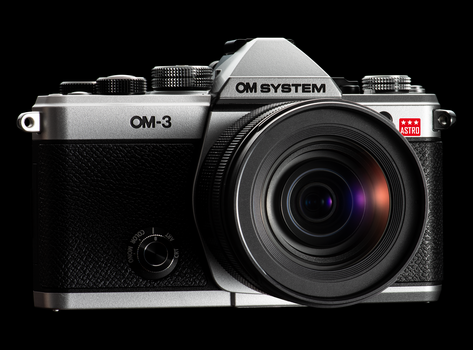
OM Digital Solutions has announced the OM SYSTEM OM-3 ASTRO, a dedicated astrophotography version of the OM SYSTEM OM-3 built to better capture red emission nebulae. The company says the camera is compliant with the Micro Four Thirds System standard and will be sold on a made-to-order basis, with availability planned for March 2026.
The core change versus a standard OM-3 is optical: OM Digital Solutions adjusted the infrared cut filter in front of the image sensor. The company says the filter is tuned to achieve approximately 100 percent transmission of Hα wavelengths, which are important for rendering the red light emitted by many nebulae. As a tradeoff, OM notes the camera will produce a strong red tint and is not recommended for non-astrophotography applications.
Beyond the filter change, OM positions the OM-3 ASTRO as a computational-photography-forward tool for night sky work. The announcement emphasizes High Res Shot for stacking-style results in a single capture sequence, along with Starry Sky AF for autofocus on stars and Live Composite for building star trails with a live preview. OM also highlights preset custom modes (C1 through C3) aimed at common astrophotography use cases, including stacking-oriented workflows and handheld starry landscape shooting.
OM is also introducing two internal body mount filters designed to sit between the mount and the sensor, so the effect remains even when swapping lenses. OM specifically notes this approach can be useful when front-mounted filters are difficult or impractical, such as with some fisheye and wide angle lenses. The two accessories are the BMF-LPC01 Body Mount Light Pollution Suppression Filter and the BMF-SE01 Body Mount Soft Filter. OM says the light pollution filter is intended to reduce contamination from artificial lighting, while the soft filter is meant to bloom brighter stars to make them appear more prominent and emphasize color.
Key SpecsSensor: 20.4-megapixel 4/3 stacked back-illuminated Live MOSSensor filter: Dedicated IR cut filter in front of the sensor, tuned for approximately 100 percent Hα transmissionProcessor: TruePic X dual quad core processorDust reduction: Supersonic Wave Filter (SSWF)Image stabilization: 5-axis image stabilization, up to 7.5 shutter speed steps compensationAutofocus system: High-speed imager autofocus using imager phase detection and contrast detection in combinationAutofocus points: 1,053 cross-type phase detection pointsViewfinder: OLED electronic viewfinder, approximately 2.36 million dotsRear monitor: 3.0-inch vari-angle LCD touchscreenWeather sealing: Dust, splash, and freezeproof; IP53 ratedComputational and capture features:Live ND (2 / 4 / 8 / 16)Starry Sky AFLive CompositeFocus stackingFocus bracketingHigh Res Shot (handheld and tripod)Custom modes (recommended for astrophotography shooting mode):C1: Stacking for astrophotographyC2: Stacking for starry landscapeC3: Handheld shooting for starry landscapePower: USB Power Delivery support (USB power supply from compatible devices)Dimensions: approximately 139.3 mm (W) x 88.9 mm (H) x 45.8 mm (D)Weight: 413 g (body only)Box contents: Body, CB-USB13 USB cable, shoulder strap, instruction manual, warranty card, BLX-1 lithium-ion batteryPricing and Availability
Why It Matters
Most dedicated astrophotography shooters eventually run into the same limitation with general-purpose digital cameras: emission nebulae often look muted because standard filter stacks reduce the wavelengths that make those subjects pop. OM’s approach here is to ship a factory-tuned body rather than asking users to modify a camera aftermarket, while still keeping the system within the Micro Four Thirds ecosystem.
Just as important, the OM-3 ASTRO is trying to reduce friction in common night workflows. High Res Shot is positioned as a way to generate a single composite result from 12 frames (approximately 50 million pixels) while correcting star motion when used on a tripod, and even compensating for some tracking errors when used on an equatorial mount. Pair that with Starry Sky AF for focusing and Live Composite for star trails, and the camera is clearly aimed at creators who want more of the process handled in-camera, with fewer steps before they get to editing.
For creators who already own Micro Four Thirds glass—especially fast primes and longer lenses like the M.ZUIKO DIGITAL ED 75mm F1.8—the OM-3 ASTRO is positioned as a specialized second body for night work, rather than a replacement for a general-purpose camera.
In short, the OM SYSTEM OM-3 ASTRO is a niche product with a clear technical goal: improve emission-nebula capture by changing the sensor filter stack, then lean on computational features and optional internal filters to broaden what can be done in the field with minimal extra gear.