
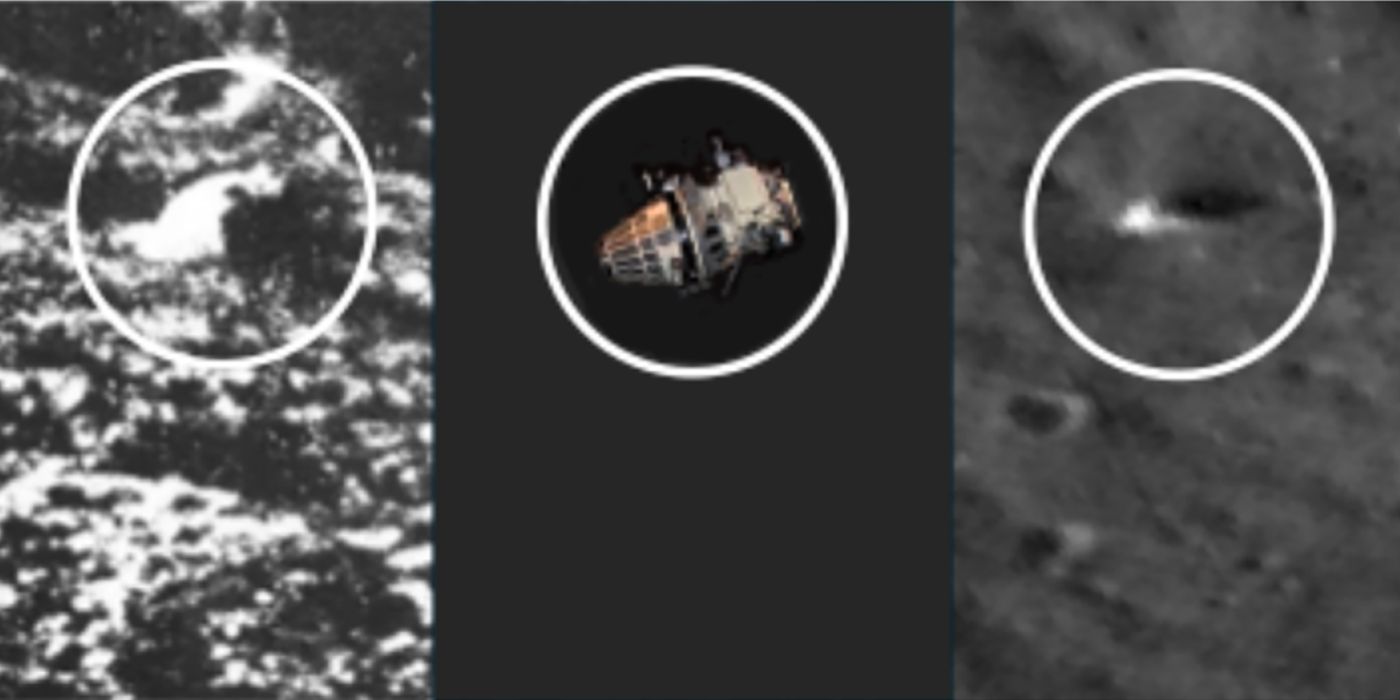
Luna 9 was the first spacecraft to soft-land on the Moon, sending the first images from the lunar surface to Earth. The Luna 9 landing was on February 3, 1966, 60 years ago. Despite the mission’s success, its exact landing spot remained a mystery. Now, a new analysis may have solved it.
A study led by SETI Institute affiliate scientist Lewis Pinault, published in npj Space Exploration, describes how researchers used AI machine learning to identify a potential landing site for Luna 9. By beginning to automate the detection of faint human-made objects in vast NASA Lunar Reconnaissance Orbiter image datasets, AI enabled the researchers to quickly and efficiently analyze very large data tiles using only light-weight computing resources.
The team trained the YOLO-ETA model (You Only Look Once – Extraterrestrial Artefact) with images from Apollo landing sites, teaching it to detect features that could have been caused by a spacecraft, such as shapes, shadows, and disturbed ground. They then applied the model to a 5-by-5-kilometer area around Luna 9’s possible landing site. The algorithm consistently found object clusters in these images, even when lighting changed, demonstrating its ability to identify artificial artifacts.
Researchers compared the site with Luna 9’s original surface photos, noting that the terrain and horizon potentially match the flat vistas seen in 1966, supporting the site as the likely landing spot.
“Robotic and human activities on the Moon are now set to dramatically escalate, and yet we’ve had no systematic catalogue or means of cataloguing our artefacts and debris,” said Pinault. “Safe siting, appropriate zoning of activities, and preservation of historical and scientific areas of interest can be greatly aided by AI computer vision and machine learning, from the macro scale right down to the behavior and distribution of dust-sized particles and potential contaminants in the lunar regolith. There is a SETI interest here too – as our own technologies accelerate to pack more and more capabilities – including machine intelligence – into even the smallest of objects, searching our own neighborhood for their traces at every scale begins to make practical sense. With 4 billion years of stable history collecting particles from across the Galaxy, the Moon becomes an attractive target for searching for artefacts of every scale, both human, and potentially, extraterrestrial.
We designed YOLO-ETA to be a lightweight computing resource for edge cases, helping make orbital, fly-by, and on-site regolith analyses increasingly mobile and autonomous, not only contributing to space exploration science, safety and best practices but also opening the whole of our Solar System backyard to the search for extraterrestrial artefacts. As a first test we focused our search on locating the ‘missing’ Luna 9 – how elegant if using our new tools we’ve found humanity’s own first artifact to successfully land on another celestial body.”
Further work continues on the AI model, and planned passes over the area by Chandrayaan-2 may soon help confirm the finding. In all cases these results show how AI tools, such as machine learning systems for pattern and object detection, can effectively identify and document space artifacts, thereby helping recover lost chapters of space history. By highlighting the crucial role of efficient, deployable machine learning in documenting lunar human artifacts, the paper supports a task that becomes increasingly important as human activity increases in the Artemis era, while opening a new door in the pursuit of SETI.