
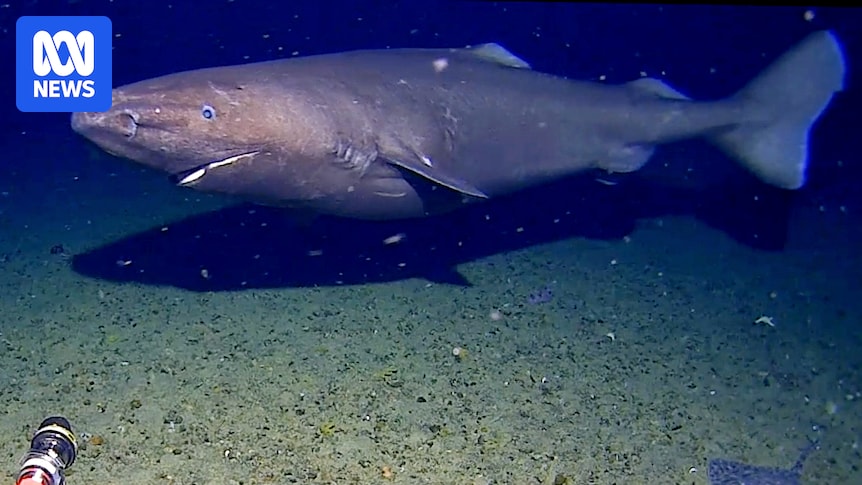
A shark has been captured on video in the Southern Ocean for the first time, according to Australian researchers.
Sharks have been around for hundreds of millions of years and can be found in nearly every corner of the world’s oceans.
While sharks are often spotted in bycatch in sub-Antarctic fisheries, the closer you get to the South Pole, where temperatures can plunge to below freezing, the less likely it is to encounter one.
Of the 500 plus shark species found globally, only five have been seen in the body of water that encircles Antarctica, the Southern Ocean.
That is why oceanographer Jessica Kolbusz, from the Minderoo-UWA Deep-Sea Research Centre, was surprised by what she saw near the South Shetland Islands, off the Antarctic Peninsula, last year.
What appeared to be a slow-moving member of the sleeper shark family briefly moved across footage taken by a baited camera, 490 metres beneath the surface.
“It was surprising since this is the first footage obtained of a somniosidae [sleeper shark] or any elasmobranch [shark or ray] in situ in the Southern Ocean,” Dr Kolbusz said.
Dr Kolbusz said it was serendipitous to capture footage of a sleeper shark anywhere.
The exact species could not be determined from the footage because of the physical similarities in the sleeper shark family.
Dr Kolbusz said tests for DNA in the water from the trip were yet to be examined.
Peter Kyne, a Charles Darwin University adjunct conservation biologist who was not part of the expedition, said the footage was “really cool” and a significant record of what might be a Southern sleeper shark (Somniosus antarcticus).
“The Southern sleeper shark is the most southerly occurring shark species but this I believe is the first record of it — and any shark — in Antarctica itself,” he said.
“It is well known from the sub-Antarctic area — Macquarie Island, Heard and McDonald Islands.”
What are sleeper sharks?
Sleeper sharks are large sharks with mottled skin and small fins that dwell in the ocean from the surface to thousands of metres deep.
There are several species of sleeper sharks, including the extremely long-lived Greenland shark (Somniosus microcephalus), which is believed to live to about 400 years and is found in the northern hemisphere.
Two similar-looking species are believed to live in the southern hemisphere, the Southern sleeper shark and the Pacific sleeper shark (Somniosus pacificus).
The Southern sleeper shark was first identified from a sketch of a washed-up specimen on Macquarie Island in 1913, as part of a scientific mission to Sub-Antarctic islands and the Antarctic led by Sir Douglas Mawson.
Not much is known about the species, with most of our knowledge coming from rare collections as fisheries bycatch.
Stomachs of the Southern sleeper shark have often been found to contain remains of colossal squid (Mesonychoteuthis hamiltoni) — the world’s heaviest invertebrate.
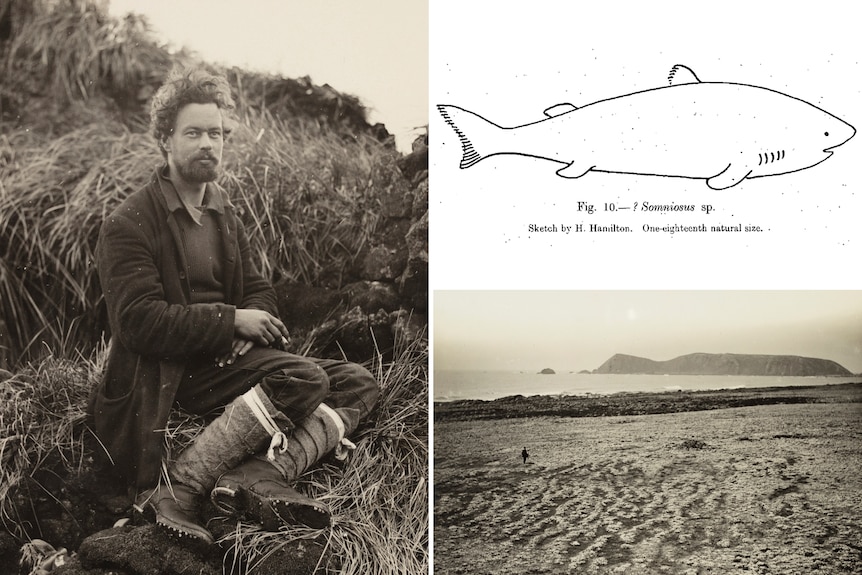
New Zealand biologist Harold Hamilton sketched a washed-up sleeper shark on Macquarie Island in 1913 as part of the Australasian Antarctic Expedition led by Sir Douglas Mawson. (Supplied: Mitchell Library, State Library of New South Wales/Australian Antarctic Division)
Southern sleepers were thought to be limited to the southern hemisphere while Pacific sleepers were restricted to the north Pacific.
But it is unclear whether the Southern sleeper shark and Pacific sleeper shark are separate species. A 2023 genetic study in the Pacific Ocean suggested the two sharks were the same species.
It is not known whether that is the case in other places where the Southern sleeper is thought to be found.
Research scientist Erwan Saulnier, from the Falkland Islands fisheries department, is leading a project in collaboration with several international institutions that will hopefully fill this knowledge gap.
“Genetic analyses are scheduled to begin in mid-2026 and will include, for the first time, the two missing pieces of the puzzle: genetic data from the South Atlantic and Indian Oceans,” Dr Saulnier said.
“Tissue samples have been collected at sea by fisheries observers or scientists from sleeper sharks caught either as bycatch in commercial fisheries or during targeted research surveys.”
Why aren’t there many sharks in Antarctica?
The high salt content of the oceans around Antarctica and the Arctic means water temperature can drop below the usual freezing point to about -2 degrees Celsius.
This is simply too cold for most creatures, which would simply freeze.
While we do not know the extremities of temperatures tolerated by Southern or Pacific sleeper sharks, Greenland sharks have been found in -2C water.
The presence of the compound trimethylamine N-oxide and urea in Greenland shark muscle is believed to act like a natural antifreeze.
The sleeper shark from the new footage was filmed in waters that were about 1.27C.
Whether this shark may be able to populate more Antarctic waters as the ocean warms from climate change is unclear.
“With the rate of warming and the likely wide-ranging thermal tolerance of the species, it’s most likely their distribution would stay consistent,” Dr Kolbusz said.
“In saying this, we don’t know their exact distribution so it is hard to conclusively say.”