
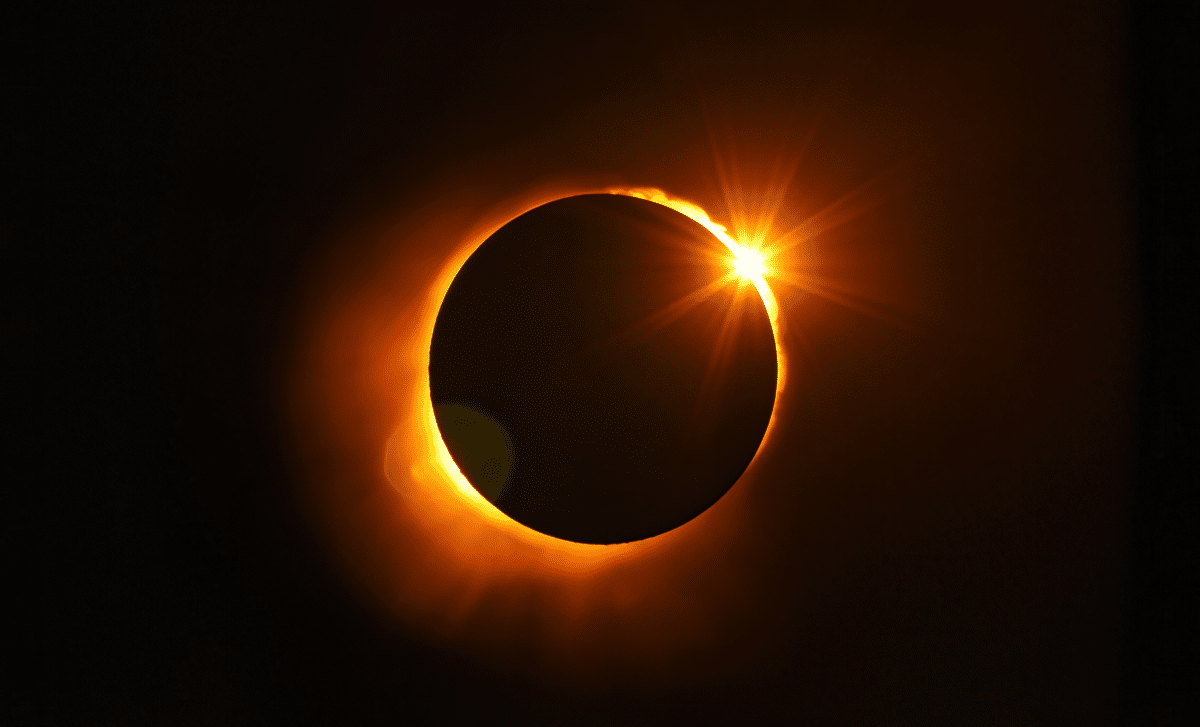
On February 17, 2026, a rare and dramatic annular solar eclipse, often referred to as the “ring of fire,” will sweep across the icy expanse of Antarctica. While the path of totality is confined to the southernmost continent, partial views will be visible from parts of southern South America and southern Africa. This celestial phenomenon promises to be a stunning sight for skywatchers, and while North America will miss out, the event also sets the stage for the start of cultural celebrations, including Chinese New Year and Ramadan. This article is based on a detailed feature from Forbes that outlines the eclipse and its significance.
What Is An Annular Solar Eclipse?
An annular solar eclipse is a fascinating astronomical event where the moon passes directly in front of the sun, but because it is farther away from Earth than usual, it appears smaller in size. This causes the sun’s outer edges to remain visible, creating a bright “ring of fire” around the moon’s silhouette. Unlike a total solar eclipse, which can plunge parts of Earth into sudden darkness, an annular eclipse presents a subtler yet striking spectacle. As the moon moves across the sun’s face, it blocks 96% of the sun’s disk, leaving a thin band of sunlight to shine through, visible for a few moments, up to 2 minutes and 20 seconds.
This contrast between darkness and light is what makes the event so dramatic. However, while the experience is stunning, it’s important to note that it is only safe to view this eclipse with proper eclipse glasses, as direct observation without protection can cause permanent eye damage.
The Path of Annularity: Antarctica and Beyond
The February 17, 2026 annular eclipse will be visible along a narrow path that stretches primarily over the icy landscapes of Antarctica, where it will create a breathtaking visual for those stationed at remote research facilities. These include the Concordia Station, a French-Italian research outpost on the Dome C Plateau, and Mirny Station, a Russian research base on the Davis Sea coast. According to Forbes, the eclipse will occur during the southern hemisphere’s summer, a time when both stations host small research teams of around 50 to 200 people, depending on the station.
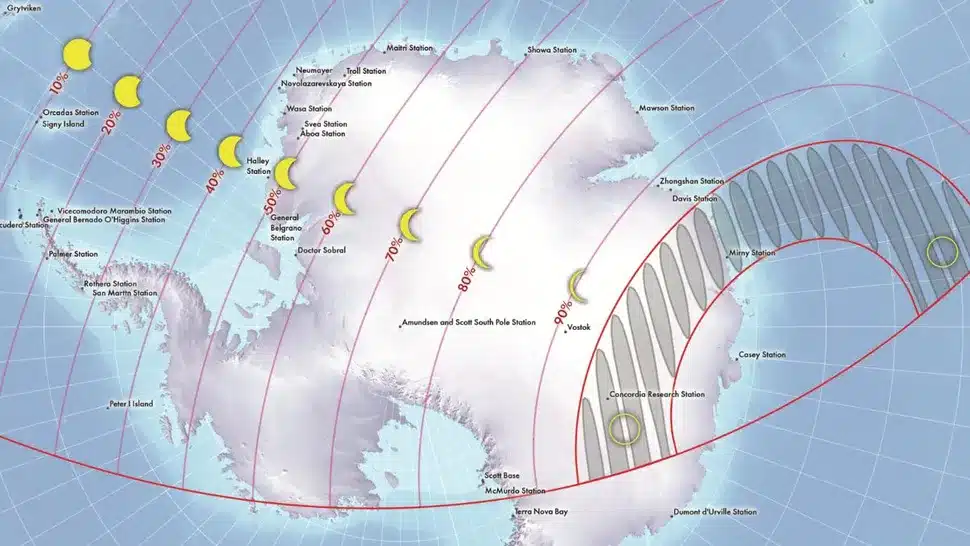 The path of the annular solar eclipse on Feb. 17, 2026. Image credit: Michael Zeiler/EclipseAtlas.com
The path of the eclipse will be up to 472 miles wide, and while most of the event’s dramatic annularity will be visible only to a few researchers in Antarctica, partial phases of the eclipse will be observable from the southernmost parts of Chile and Argentina. Additionally, certain regions in South Africa will also get a glimpse of the partial eclipse. While not as striking as the full annular eclipse, this partial view will still be a rare and exciting celestial event for millions of people.
Partial Eclipse and Its Reach: Southern South America and Africa
While the annular eclipse will be visible only in Antarctica, those in parts of southern South America and southern Africa will be able to witness a partial eclipse. In South America, the eclipse will be visible shortly after sunrise, with southern Chile and Argentina positioned to get a stunning view of the partial phase. The eclipse’s path will extend over a considerable area, offering a unique opportunity for skywatchers to observe the phenomenon, albeit not in its complete form.
In South Africa, the eclipse will also be partially visible, with observers in the southern regions able to witness the moon obscuring part of the sun. Despite the eclipse’s totality being confined to Antarctica, the partial eclipse will still offer an exciting opportunity for those in the right locations to experience this rare event.
A Cosmic Reminder: Cultural Significance of the Eclipse
The February 2026 eclipse is not only a spectacle for astronomers, but it also holds cultural significance for millions of people around the world. The new moon that marks the event also signals the beginning of several important cultural milestones. For example, the Chinese New Year, which begins on February 17, will usher in the Year of the Fire Horse, a zodiac sign known for its boldness and dynamism. The eclipse’s timing aligns perfectly with this major celebration in Chinese culture, adding a layer of cosmic significance to the festivities.
Additionally, the eclipse coincides with the start of Ramadan, a sacred month in Islam. The emergence of a crescent moon on February 18 will signal the beginning of this period of fasting and reflection. For many, the eclipse will serve as a reminder of the deep connections between celestial events and human culture, bridging science with spiritual traditions.
When and Where to View the Eclipse Safely
For those lucky enough to be in the path of the annular eclipse, it is important to follow safety guidelines when viewing the event. Eclipse glasses are the only approved method for safely watching the eclipse, as regular sunglasses do not provide enough protection. It’s also recommended that viewers use a pinhole projector or other indirect methods of viewing to prevent eye damage. The event will begin at 07:01 UTC, and skywatchers will have a brief but unforgettable moment to witness the eclipse’s full glory, which will last for up to 2 minutes and 20 seconds.
For those in areas where the partial eclipse is visible, the same safety measures should be followed. The moon’s gradual movement across the sun’s face can be just as fascinating, even though the dramatic “ring of fire” will not be visible.
Future Annular Eclipses to Look Forward To
If you miss the 2026 annular eclipse, there are still several more chances to witness this awe-inspiring phenomenon. The next major annular eclipse after February 2026 will occur on February 6, 2027, and will be visible in Chile, Argentina, Brazil, and parts of West Africa. For skywatchers in Ecuador, Peru, and Brazil, another exciting opportunity will arise on January 26, 2028. And by June 1, 2030, those in Algeria, Tunisia, Greece, Turkey, China, and Japan will be treated to another spectacular ring of fire.
These upcoming eclipses offer more chances for people to experience this awe-inspiring event, making it an ongoing opportunity for stargazers and astronomy enthusiasts worldwide.