

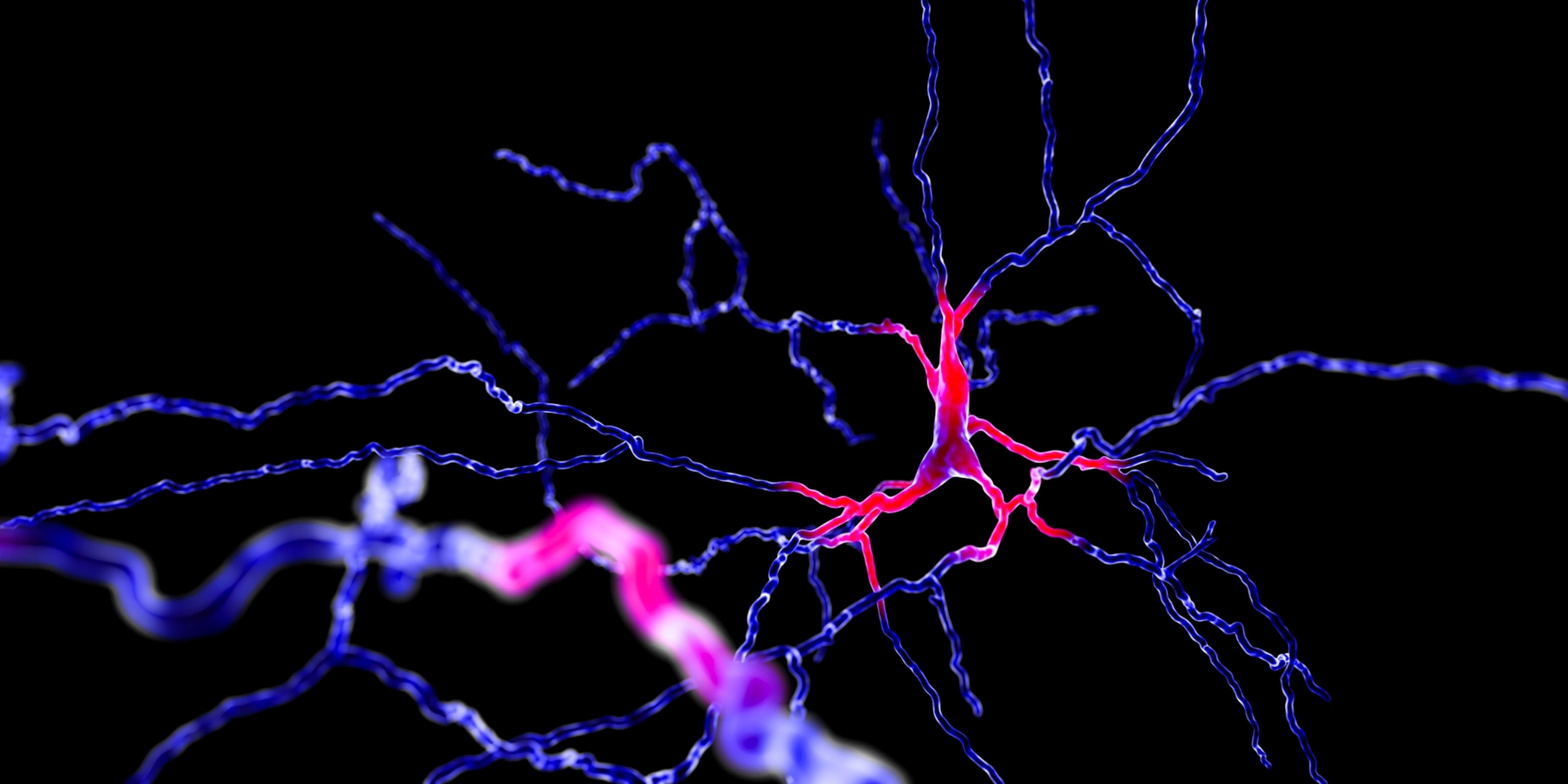
A computer illustration of dopaminergic neuron, specialized brain cells that synthesize and release the neurotransmitter dopamine. Dopamine is a key factor of love at first sight, as it activates the brain’s reward system, creating intense feelings of pleasure and euphoria.
KATERYNA KON, SCIENCE PHOTO LIBRARY
Why are we able to fall so fast?
The ability to experience love at first sight rests on a cognitive skill you might not even realize you have: Humans are incredibly good at quickly assessing other people. “In less than seven seconds, we can form impressions that are actually fairly accurate,” says Wendi Gardner, a social psychologist at Northwestern University.
By that, she means “they’re accurate in terms of they’re likely to be widely shared by other members of our culture.” The human brain can’t really instantly know someone’s character—that takes time. But our brains can rapidly process physical cues in others to form an impression that, right or wrong, is shared by the masses and could make us fall fast, especially if someone is attractive.
Our brains interpret nonverbal signals like symmetry and smiling to form a positive impression of a person. We may not be conscious of it, but our brain is taking it all in and doing quick calculations to determine attractiveness. “We don’t even need to hear what they’re saying, we just need to see the way they’re behaving, signals about their face, physical attractiveness, the way they dress, and their nonverbal signals like eye contact and smiling,” Gardner says.
In short, “we are total suckers for physical attraction,” she says. “People talk about ‘Oh, I don’t pay attention to anyone’s appearance,’” Gardner says. “You can think that all you want, and I promise that you are wrong…there is no human on Earth who is a visual perceiver who isn’t noticing these things.”
But instant love isn’t just for the most physically attractive among us—other types of connection can be foundational for relationships. It’s a psychological idea called I-sharing, but it’s more commonly understood as the moment when strangers “click.” First introduced two decades ago, I-sharing is fleeting belief that you are experiencing the same subjective reality as another person in the moment. This psychological phenomenon builds an instant connection by temporarily erasing feelings of existential loneliness, making us feel understood and increasing affection and trust. Research in the Journal of Social and Personal Relationships shows that it does, and that these shared moments are associated with greater romantic satisfaction.
Gardner also explains it through this example: “If you’ve ever been to a coffee shop, and something funny happens, whether it’s maybe what someone’s wearing, or the music, or the way someone laughs, or something that is just charming and endearing,” she says. “And you look up with a little smile, and you see someone else across the coffee shop also is looking up with a smile, and then your eyes meet. That’s enough.”