
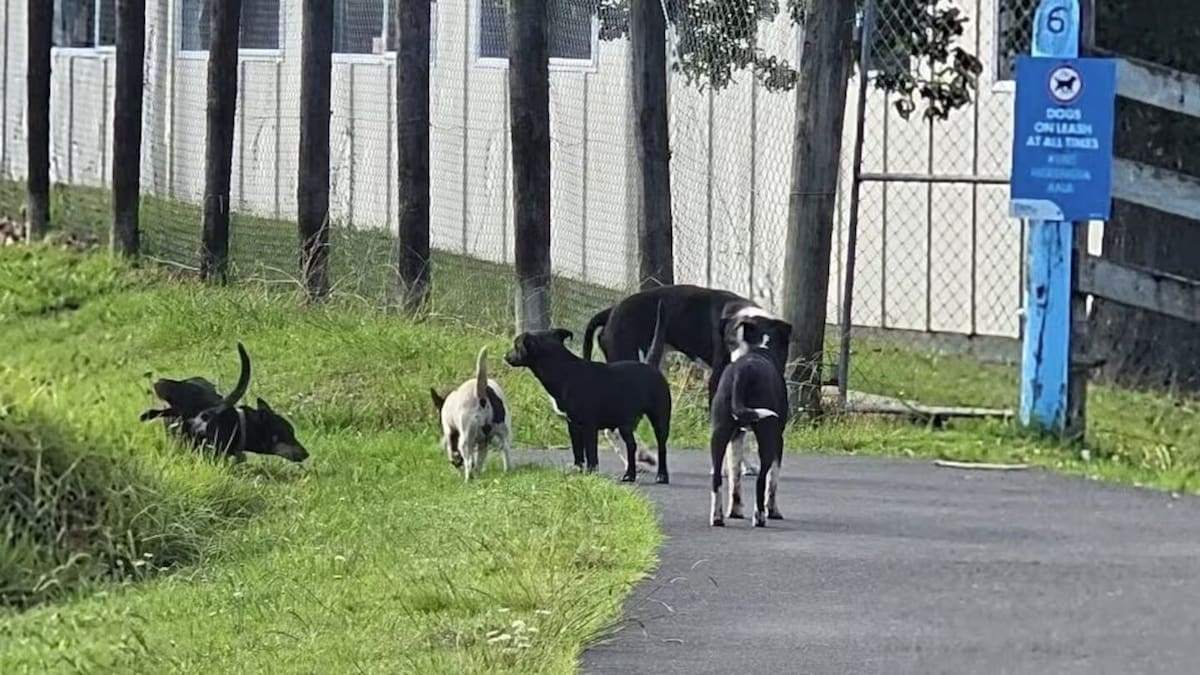
In a statement, Far North District Council’s Hilary Sumpter said it had received 1087 reports of roaming dogs across the district at large during the past financial year, with 396 impounded.
Biddle said many parents in Ahipara were scared to let their children walk to school on their own, and some residents had taken to arming themselves.
“This is the first time we’ve kind of seen that pack mentality kind of take effect, but my girls have been chased previously by dogs, people now walk around our community with weapons, with sticks, because they’re too scared to kind of go walking without one.
“There’s a school at the end of Ahipara that a lot of the tamariki go to, parents don’t let them walk or ride to school because of fear of all these dogs.”
Biddle said it wasn’t fair for residents to feel unsafe.
“This can’t be out of our control. This can’t be a situation in which we are kind of prisoners [in] our own community and can’t just go for a walk or let our kids experience the outdoors.
“This isn’t an anti-dog thing. This is just anti-irresponsible owners, people that choose to have dogs but don’t choose the responsibility of what comes with owning the dog.”
He criticised the council for what he viewed as a reactive approach.
“When I called the council about these dogs, they said, ‘yeah, we’re aware of these dogs.’ So if you’re aware of these dogs, what is it that you’re waiting for? What is currently happening is just not good enough for our community,” Biddle said.
“I’m just scared that the worst-case scenario is that this thing getting mauled is not a dog and it’s one of our tamariki or our kaumātua or whoever it might be, because that is where I see this going.”
Sumpter said the council was taking proactive actions to prevent future issues.
“The council is currently working with the SPCA on a programme to provide dog de-sexing services in high-need communities,” she said.
“We are also actively following up on lapsed registrations. About 800 infringements have been issued district-wide in the last two weeks for non-registration. Getting more dogs registered and on record means we can identify owners when their dogs are picked up. More infringements will be issued in coming weeks.”