
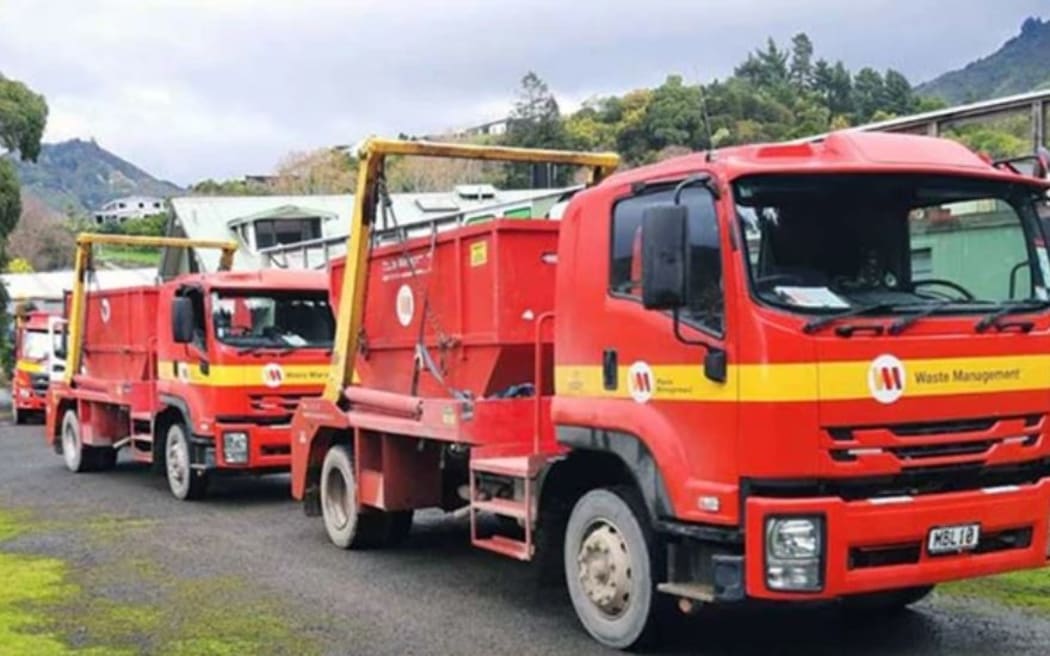
Waste Management NZ thinks a recent landfill blaze could have been caused by a lithium battery.
Photo: Waste Management
A major waste company is calling on more retailers to take back used batteries as it investigates whether one is to blame for a landfill blaze that lasted several hours.
Several fire crews responded to the fire at the Tirohia Landfill and Energy Park near Paeroa at about 11.30am on Wednesday.
WM (Waste Management) New Zealand thinks it could have been a lithium battery.
“We have a big compactor that operates on the site that crushes down the waste that obviously went over something that caused a fire to break out in the waste pile,” managing direct Evan Maehl said.
“The waste pale is not large, we only have a small footprint open each day but the fire then took hold because there was a lot of flammable materials that it could jump onto,” he said.
The company has had people on watch overnight in case there were any hot spots that reignited.
“It probably burned for about four or four-and-a-half hours, it was not out of control at any stage but there was obviously smoke and it was visible,” he said.
“It was one of those things that we are unfortunately well drilled in.”
The company said it may have been a gas canister, but that similar fires had been caused by lithium batteries.
Maehl said there had been 20 confirmed battery fires across WM New Zealand’s sites over the last 12 months.
“Ten at our landfills, six on trucks which is quite scary and four in our transfer stations,” he said.
Maehl said a recent example was on an Auckland motorway last month on a truck the company runs for Auckland Council.
“We had to eject its load on the southwestern motorway because the driver spotted flames and smoke, so that was in a recycling truck heading to a recycling facility so it could have been a much worse result had it got to the recycling centre and it was dropped off there,” Maehl said.
The message, he said, was to keep the batteries out of household rubbish and recycling.
It was here that retailers had “skin in the game”, he said.
“It’d be great if they could jump on board and take them back so they could be segregated in their own special waste stream so they can be looked after.
“I’ve seen, like at Bunnings, they’ve got a take-back bin right outside the front door when I was there on the weekend,” he said.
Maehl acknowledged simply throwing the batteries away was convenient for people.
“But there could be downstream consequences too, like a recycling truck – and they’re [worth] half a million dollars each, or much worse would be a transfer station or recycling station,” he said.
“We’ve had two in the last year, we’ve had two recycling centres that burnt which is a big impact on the infrastructure of a city or a town.”
What’s the problem with lithium batteries?
Maehl said the issue was when the outer shell of a battery cracked and they were exposed to the air.
“You could Google it or Youtube it and you can see how quickly they react with oxygen,” he said.
“They ignite really quickly to a very high flash point.”
The problem was then compounded if they were surrounded by the likes of cardboard, paper or plastic.
“If there’s material around them then that will carry on the fire,” Maehl said.
His company had put flame and heat detection equipment in its trucks so loads could be ejected quickly if a fire erupted.
“It’s the same in all of our transfer stations and recycling facilities, we’ve now got flame detection cameras and heat detection cameras,” he said.
“Because sometimes they smoulder away under a pile of cardboard, you can’t see it.”
“This wasn’t really a thing if you go back 15 years ago when I started in the industry, but it is now.”
Last year Auckland Council urged for the batteries to be disposed of properly after a devastating fire at the Abilities Group recycling plant on the North Shore.
The plant burnt to the ground and destroyed essential equipment.
The organisation employed and supported more than 100 disabled people.
Sign up for Ngā Pitopito Kōrero, a daily newsletter curated by our editors and delivered straight to your inbox every weekday.