
Chinese researchers have uncovered a vibrant ecosystem 10 kilometers beneath the Pacific Ocean, shattering long-held assumptions about life in extreme depths. What they found was far from the barren, lifeless seafloor that scientists once expected at these crushing depths.
For years, the deep-sea ecosystems of the Pacific, especially in deep trenches, were a mystery. Scientists believed that only microorganisms could survive in such extreme conditions. But this new find changes everything. The discovery, made in the Kuril-Kamchatka Trench, one of the deepest parts of the ocean at over 10,500 meters, shows that life can flourish in ways we never imagined.
An Ocean Journey Off the Beaten Path
A study published in Nature reveals a groundbreaking discovery by a team of Chinese scientists who ventured into the depths of the Kuril-Kamchatka Trench aboard a manned submersible. Their initial expectations were low, anticipating only a few microorganisms in the harsh environment, where light and pressure are nearly nonexistent. However, what they encountered was far more remarkable than they could have imagined.
Their expedition aboard the Fendouzhe submersible uncovered a vibrant ecosystem of tube worms, mollusks, and sea cucumbers, some stretching over a foot in length.
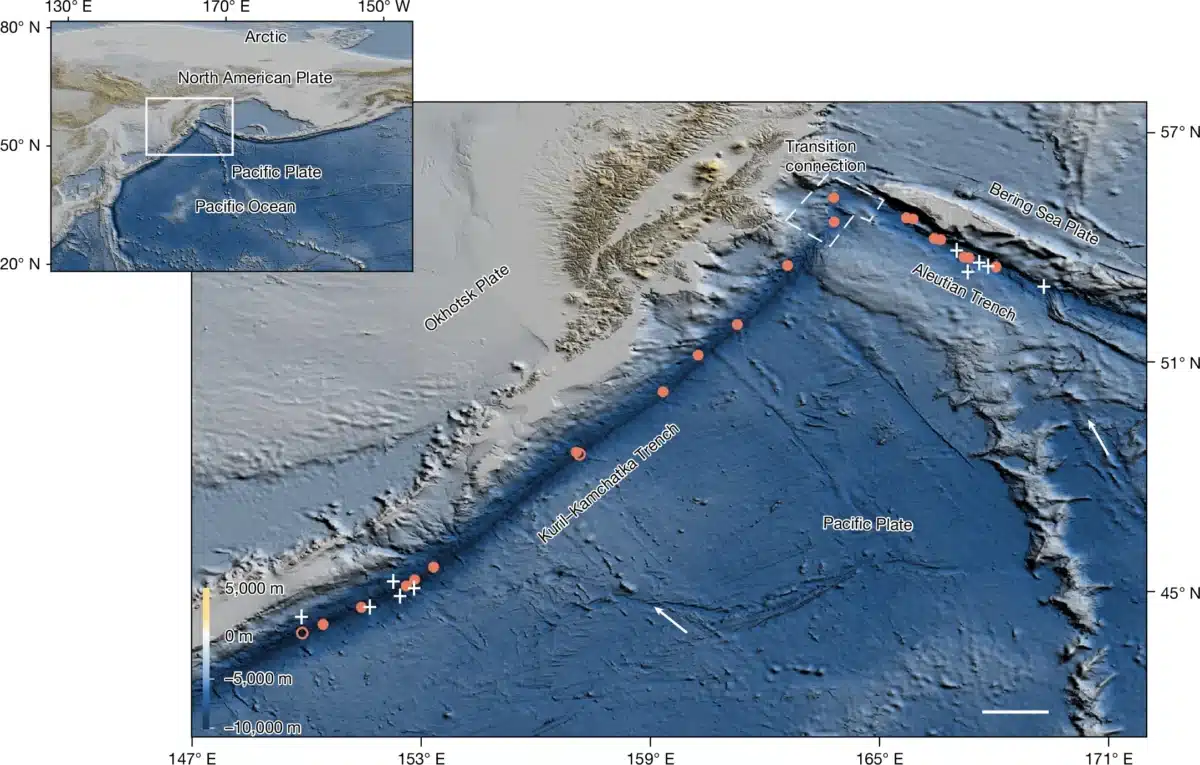 A map showing the position of the Kuril-Kamchatka Trench and the western Aleutian Trench. Credit: Nature
These creatures were thriving in an area where the pressure is over 1,000 times that of sea level, a place previously thought to be devoid of life. The key to survival in this extreme environment lies in a process called chemosynthesis.
“These communities are sustained by hydrogen sulfide-rich and methane-rich fluids that are transported along faults traversing deep sediment layers in trenches, where methane is produced microbially from deposited organic matter,” wrote the authors.
The Chemistry of Life in the Abyss
The creatures living in the deep-sea trenches do not depend on sunlight at all. Instead, they rely on chemosynthesis, a process where bacteria use chemicals like methane and hydrogen sulfide leaking from the ocean floor to generate energy. This remarkable adaptation allows life to flourish in complete darkness and under crushing pressure, where sunlight can never penetrate.
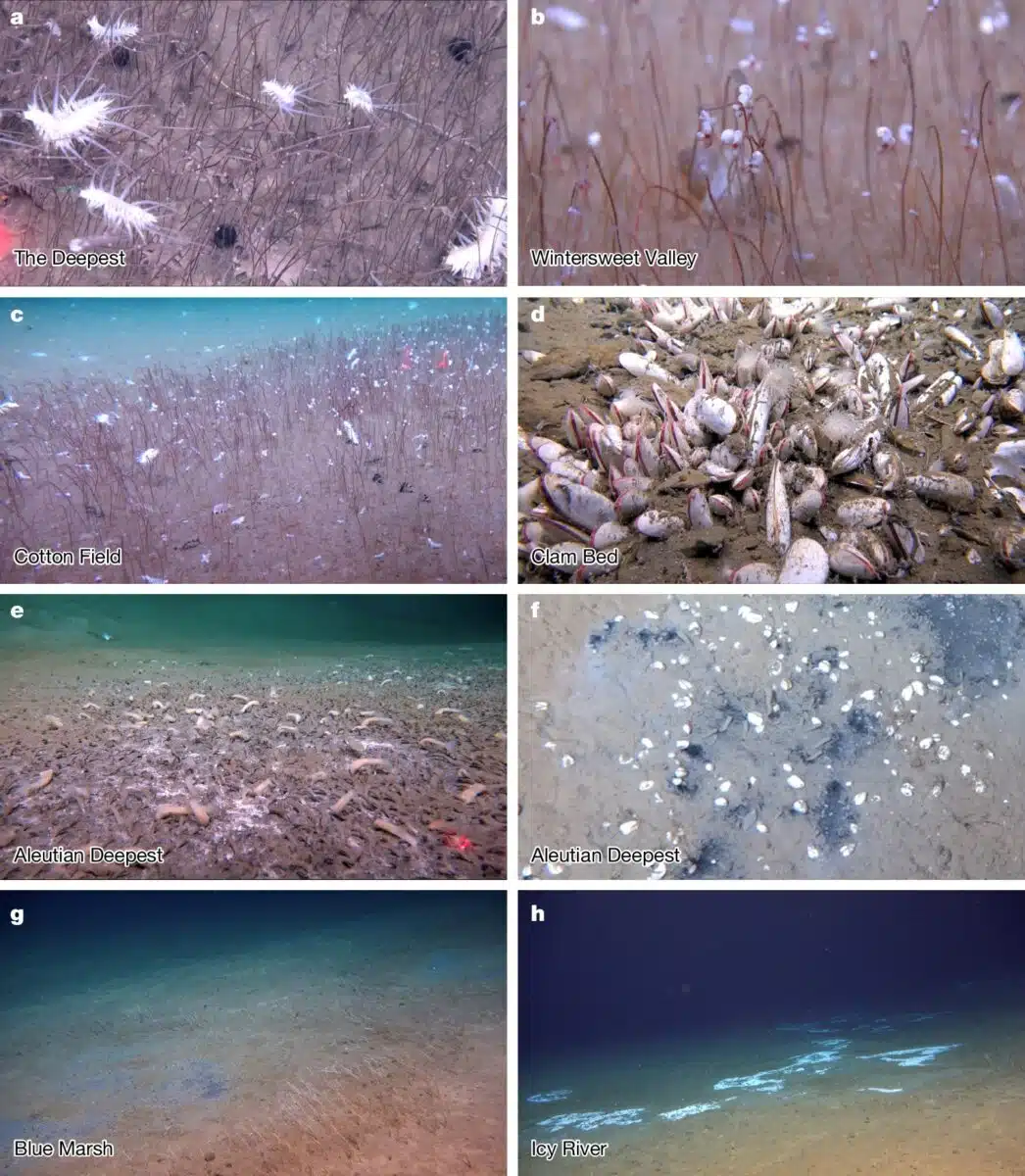 Cold-seep fauna in the Kuril-Kamchatka and western Aleutian Trenches. Credit: Nature
In the study, the researchers explain that these deep-sea ecosystems provide valuable insight into how life could exist in other extreme environments, such as the subsurface oceans of distant moons like Europa or Enceladus. These moons, which orbit Jupiter and Saturn respectively, have environments that are similarly hostile to life as we know it, yet they also harbor conditions that could allow life to exist in ways that mirror the processes discovered in the Kuril-Kamchatka Trench.
As deep-sea mining for rare minerals gains momentum, experts are growing increasingly concerned about the impact on these delicate ecosystems. According to the researchers, mining the ocean floor could cause lasting damage to these unique communities that we’re only starting to learn about. These deep-sea ecosystems, thriving without sunlight and relying on the ocean’s chemicals, are among the oldest and most isolated biological systems on Earth.