
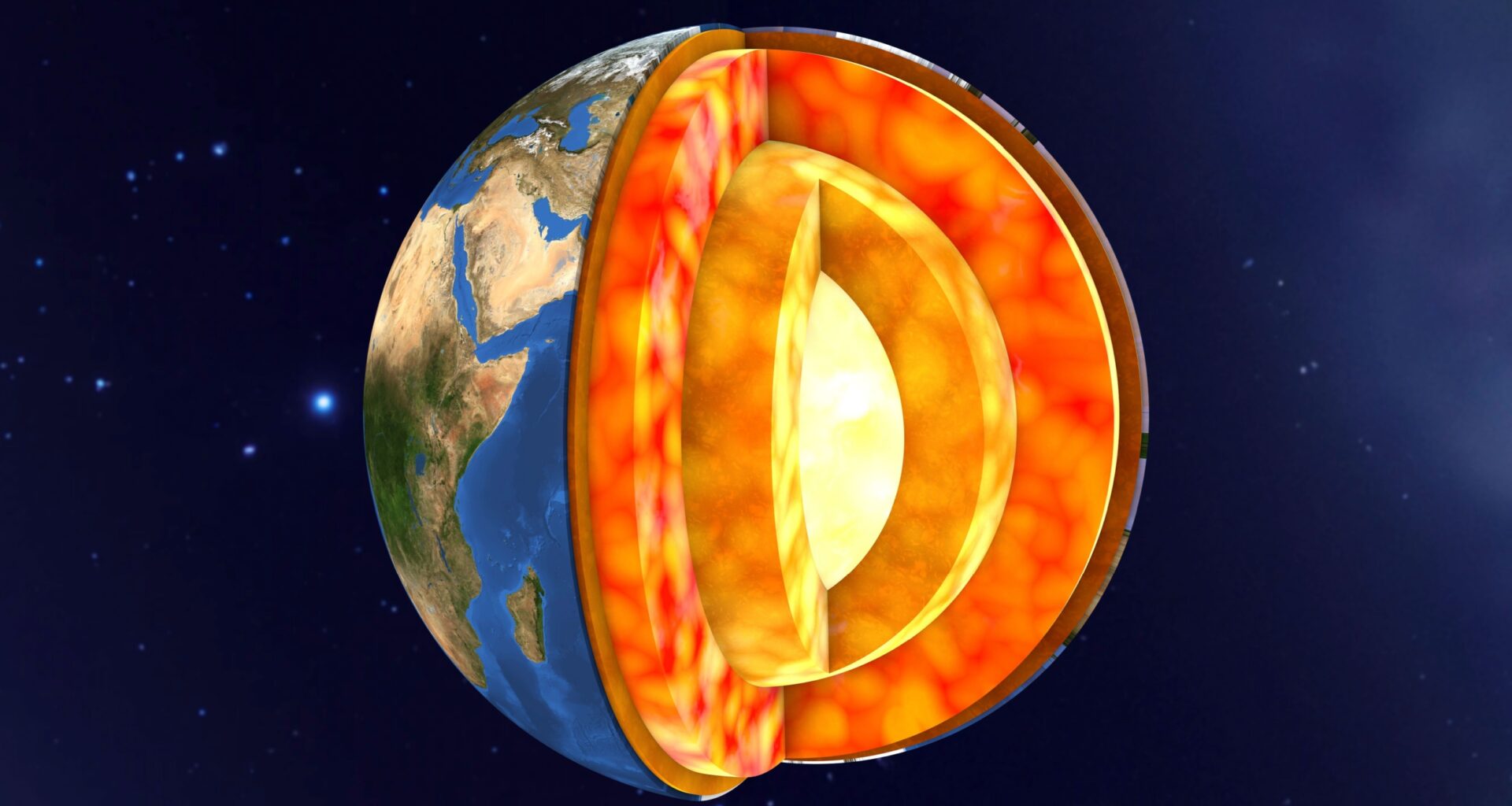
Most earthquakes begin in the Earth’s crust, along familiar fault lines that shift and grind beneath our feet. But scientists have now discovered that some earthquakes start much deeper – far below the crust, inside the mantle beneath continents.
A new global study has produced the first worldwide map of these rare “mantle earthquakes,” showing that even the solid rock deep within continents can sometimes crack under stress.

The finding challenges long-standing assumptions that rock mostly bends and flows instead of breaking. It also opens a new window into how stress builds and moves through the planet’s interior.
Mapping deep mantle earthquakes
The newly assembled global record captures earthquakes that originate beneath the crust, inside the upper mantle under continental landmasses.
Using those records, Shiqi (Axel) Wang at the Stanford Doerr School of Sustainability built a global filter designed to identify earthquakes that begin in the mantle.
Careful comparisons with nearby crustal quakes then helped Wang and geophysics Professor Simon Klemperer avoid mixing shallow and deep sources.
These findings are surprising because far below the crust, rising heat and pressure usually make rock flow instead of fracture.
Past the brittle-ductile transition – where rock stops snapping and begins creeping – earthquakes are expected to become rare. Yet the new catalog shows that some ruptures do occur in the upper portion of Earth’s mantle, a layer roughly 1,800 miles thick.
Although the resulting surface shaking is usually small, the unusual depths of these earthquakes point to hidden stresses inside continents that routine fault maps cannot detect.
These signals offer new clues about how the crust and mantle share and redistribute stress.
Deep earthquakes cluster worldwide
Patterns on the global map were not random. The deepest continental earthquakes tended to cluster rather than spread evenly. Smaller pockets also appeared beneath regions with active faults across several continents.
Because no single tectonic setting dominated, the uneven distribution places limits on any simple explanation for why mantle rock fractures under some landmasses but not others.
Understanding these events also requires looking closely at the boundary known as the Mohorovičić discontinuity, or Moho, where the crust gives way to the mantle and seismic wave speeds shift abruptly.
Most continental earthquakes began 6 to 18 miles (10 to 30 km) below the surface, yet sensors occasionally detected ruptures as much as 50 miles (80 km) beneath that boundary.
Outside ocean-trench regions, such deep signals fueled decades of debate, since mantle rock at those depths was long expected to deform gradually rather than break suddenly.
Tracking waves from mantle earthquakes
Seismic stations record every earthquake as a series of vibrations, and the research team focused on the waves that travel the farthest through the Earth.
Instead of relying only on estimates of how deep a quake started, they compared the strength of two different types of waves. That comparison allowed them to identify earthquakes that likely began below the crust, in the mantle.
To make the results more reliable, scientists compared each suspected deep earthquake with nearby shallow ones. This step helped them filter out distortions caused by the rocks the waves passed through.
“Our approach is a complete game-changer because now you can actually identify a mantle earthquake purely based on the waveforms of earthquakes,” said Wang.
Filtering deep earthquake signals
Global earthquake monitoring systems have recorded tens of thousands of quakes over the past several decades, but only a small number showed clear signs of starting deep in the mantle.
After reviewing about 46,000 events, the team identified 459 earthquakes that likely began beneath the continents, with records dating back to 1990.
Researchers believe many more deep earthquakes may still be undetected because some regions – such as the Tibetan Plateau in western China – have fewer seismic stations.
Adding more sensors and improving maps of underground rock layers could help scientists detect additional deep earthquakes.
These improvements may also reveal whether the same deep-earthquake hotspots appear repeatedly over time.
What triggers deep earthquakes
Mapping these deep earthquakes answered where they occur, but it left the question of what triggers them unresolved. In some cases, timing lined up with nearby crust earthquakes, hinting that stress can pass between crust and mantle.
Other events may tie to mantle convection, slow circulation that moves heat and rock, as the planet recycles old slabs.
“Continental mantle earthquakes might be part of an inherently interconnected earthquake cycle, both from the crust and also the upper mantle,” said Wang.
Reading Earth’s deep interior
Each mantle quake sent waves through rock that rarely breaks, giving scientists a chance to test how rigid continents stay at depth.
Because those ruptures occurred under the Moho, their signals sampled the crust-mantle boundary in a way shallow quakes cannot.
Changes in wave strength hinted at local differences in temperature and composition, including the upper mantle zones that feed magma.
Better models of those deep properties could tighten ideas about where stress concentrates before a damaging crust earthquake begins.
Trouble detecting mantle earthquakes
Even with a cleaner catalog, the team still faces a core challenge: deep earthquake sources often hide behind similar-looking seismic signals.
Their wave-ratio test works best where nearby crustal earthquakes provide a reliable local baseline, allowing fair comparisons.
In remote regions with sparse seismic history, researchers may need portable monitoring arrays and longer observation periods before confidently identifying mantle events.
As the catalog expands, scientists will be able to test whether deep earthquakes routinely follow large crustal events or emerge independently.
This growing record will also build a clearer global picture of earthquakes that originate deep beneath continents. It may reveal how often crustal earthquakes and deep mantle breaks share the same stress cycle – and when they do not.
The study is published in the journal Science.
—–
Like what you read? Subscribe to our newsletter for engaging articles, exclusive content, and the latest updates.
Check us out on EarthSnap, a free app brought to you by Eric Ralls and Earth.com.
—–