
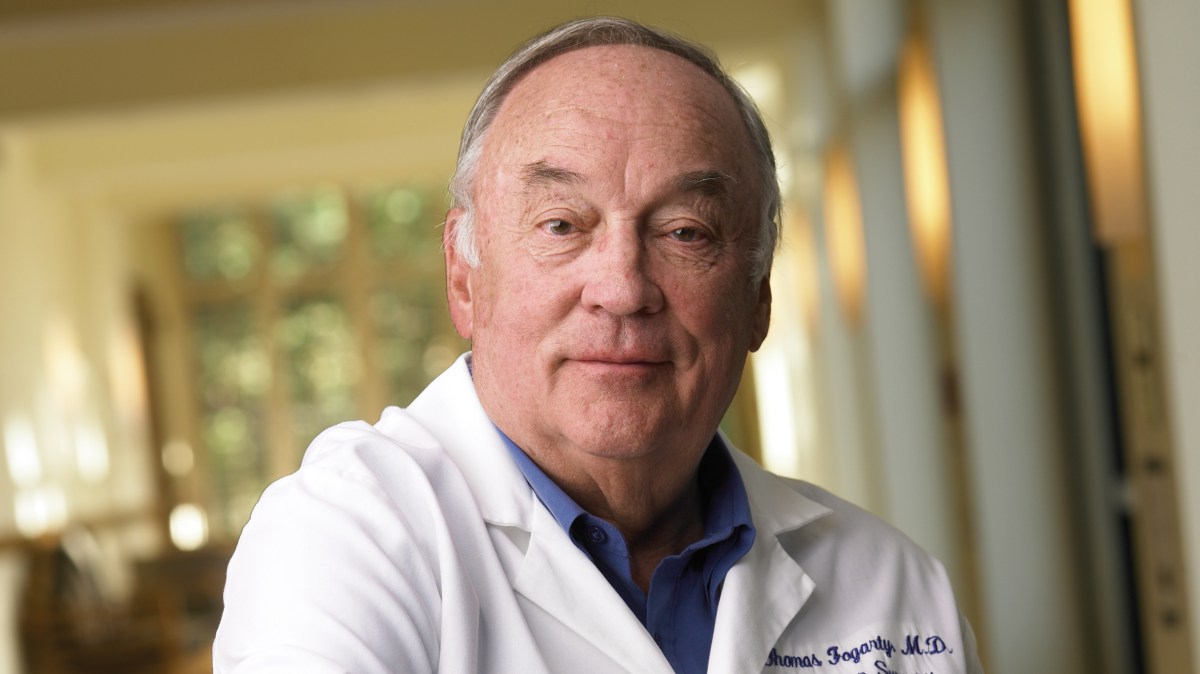
As a young American medical student in the early 1960s, Thomas Fogarty was dismayed to observe how many patients with blood clots were having limbs amputated — or worse. “They usually ended up having three operations. Fifty per cent of the patients died. I thought there must be a better way,” he told Stanford Medicine Magazine. John Cranley, his mentor and a vascular surgeon at the Good Samaritan Hospital in Cincinnati, Ohio, challenged him to produce something better.
Fogarty worked on the problem for about a year, eventually devising a solution that involved a tiny “balloon” fashioned from the baby fingertip of a size 5 latex glove. The balloon was tied to the end of a long tube or catheter, inserted into the patient’s clogged artery and inflated with a small amount of saline solution. It was then slowly withdrawn, pulling the clot with it. At first he experimented with a rudimentary model, pushing it through jelly in a test tube to simulate removing a clot. He then tried it on a cadaver. “There was no FDA regulation at the time,” he said, referring to the US Food and Drug Administration.
According to A History of Vascular Surgery, in early 1963 Cranley used the procedure on a 63-year-old female patient with rheumatic heart disease and an ischemic (blood-deprived) left leg. Her symptoms had been showing for 18 hours, her foot had become dangerously numb and an embolism was diagnosed. She was given a local anaesthetic and Fogarty’s balloon device was inserted, inflated and withdrawn, with its inventor watching. To their delight, blood immediately began flowing to her foot normally.
“The implementation, actually seeing it work, was the most exciting part,” Fogarty told Endovascular Today. “It was a severe bilateral iliac occlusion, and the clot broke up at the bifurcations … When I saw it work, my response was, ‘Holy cow!’” Cranley and another surgeon involved in the procedure had a similar reaction, adding: “Wow, this really works.”
After 22 successful procedures, Cranley and Fogarty presented their findings to a national meeting of the Society of Vascular Surgery. However, three prestigious medical journals refused to publish his methods. “It deviated so much from the standard that they thought it was dangerous,” he told the San Francisco Chronicle. Meanwhile, a leading vascular surgeon dismissed the concept, telling Fogarty: “Only one so inexperienced and uneducated as a medical student would think of this.” His work was eventually published in the lesser-known Surgery, Gynecology and Obstetrics journal in 1963.
A paper presented to the national gathering of the American Medical Association in New York in June 1965 covered 125 patients and suggested that the procedure was already saving twice as many lives and three times as many limbs as had previously been the case. Since then, the Fogarty embolectomy catheter has transformed a long, complicated and highly invasive procedure involving a hospital stay into a one-hour outpatient procedure undertaken under local anaesthetic involving only one tiny incision. According to the American College of Surgeons, today Fogarty’s catheter “remains the most widely used catheter for blood clot removal and is credited with saving millions of lives around the world”.
Fogarty went on to invent dozens of other devices and procedures, including one for removing gallstones and another for repairing life-threatening aneurysms. He also worked with the engineer Warren Hancock on creating the Hancock aortic tissue heart valve using pig tissue. By his own account he did not attach much importance to his balloon catheter at first, explaining: “My reaction was, ‘Good, it worked and that’s what it’s supposed to do, so let’s move on to something else’.”
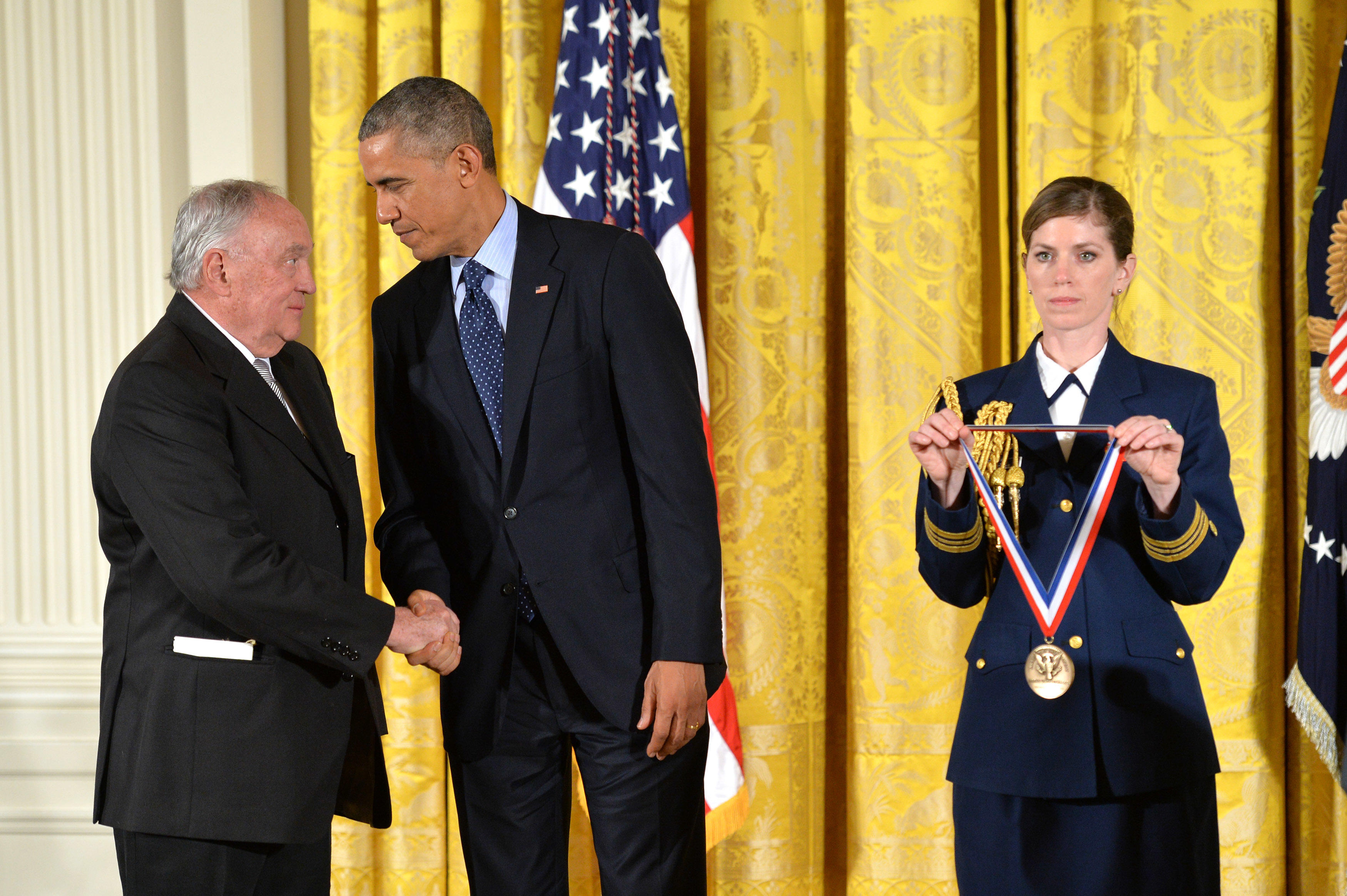
Fogarty received the National Medal of Technology and Innovation from Barack Obama in 2014
UPI/KEVIN DIETSCH/ALAMY
Thomas James Fogarty was born in Cincinnati in 1934, the youngest of three children of William Fogarty, a railway engineer, and his wife, Anna (née Ruthemeyer), an office worker who despaired of her eccentric son, saying that he “specialised in nonsense” and she often asked him: “Why can’t you be like other children?”
He was eight when his father died, after which he contributed to the family’s finances by delivering newspapers and mowing lawns while hoping to become a boxer. That dream was shattered, along with his nose and his opponent’s wrist, when he was in a bloody bout at age 17 that went to seven rounds before being declared a draw. “I thought, ‘If that’s a draw, I never want to lose’,” he told Vascular News.
From a young age he enjoyed fly-fishing, sometimes in a cemetery pond, learning to tie the knots that he later used to attach balloons to catheter tubes. At seven he built his first model aircraft and in his teens invented a centrifugal clutch mechanism for a friend’s Cushman motorcycle. The device was adopted by the manufacturer, providing its inventor with an early lesson in registering patents.
By 14 he was spending his summer holidays working in the Good Samaritan Hospital, setting up oxygen tents for patients and cleaning out stomach pumps, “a dirty, nasty job”, he recalled. After a couple of summers he had been promoted to scrub technician, handing instruments to surgeons including Cranley during operations.
Meanwhile, he was considered such a poor student that Roger Bacon High School refused to provide a reference for college. “The principal told my mother it wouldn’t be worth the money to send me,” the ruddy-faced Fogarty recalled. A concerned priest took up his cause and a sympathetic admissions officer at Xavier University, Cincinnati, accepted him to study biology on a probationary basis. During summer holidays he continued to help in Cranley’s operating theatre.
He went on to the University of Cincinnati’s College of Medicine and during a surgical residency at the University of Oregon Medical School met Rosalee Brennan, who between college semesters was working in the hospital’s records room. They were married in 1965 and she survives him with their four children, Thomas Jr, Jonathon, Patrick and Heather — all of whom helped at some point in the renowned California winery he owned.
Meanwhile, Fogarty had returned to work with Cranley in Cincinnati, where they continued to work on his balloon technology. After three years he took a year off to undertake research in cardiovascular physiology at the National Institutes of Health in Washington before joining Stanford University in California. He was also director of cardiovascular surgery at Sequoia Hospital in Redwood City, California, and in 1980 was named inventor of the year by the San Francisco Patent and Trademark Association. Later he founded Fogarty Innovation both to protect his patents and to support further research.
By 1981 Fogarty was combining his medical research career with growing grapes on his 320-acre estate in the Santa Cruz mountains. Within a decade Thomas Fogarty Winery and Vineyards was producing more than 10,000 cases of fine wine for distribution across the US. “I actually believe that the FDA should reconsider classification of wine. It should be classified as a health food,” he told Endovascular Today, adding that as a doctor he would prescribe a daily dose of “two or three glasses of Fogarty Pinot Noir”.
Thomas Fogarty, surgeon and inventor, was born on February 25, 1934. He died on December 28, 2025, aged 91