
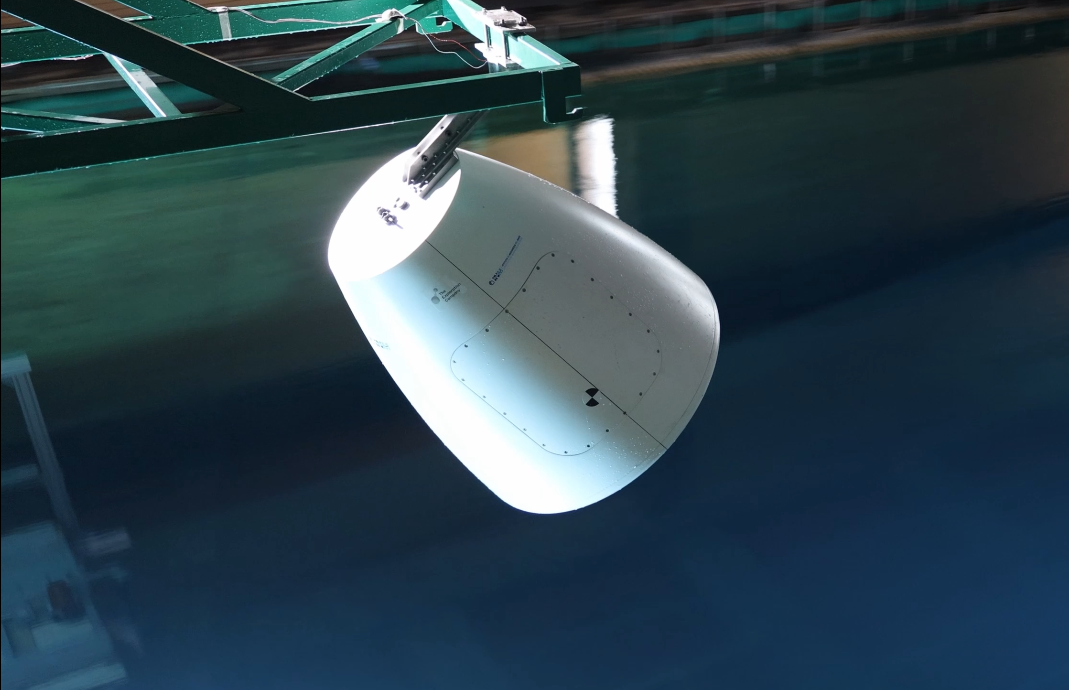
MILAN — The French-German aerospace company The Exploration Company completed mock splashdown tests for its Nyx space capsule, a modular, reusable spacecraft designed to transport cargo and eventually crew to low Earth orbit and beyond. The company conducted water-impact tests on a mock capsule from Jan. 13 through 28.
The testing campaign was not a full splashdown test, but a model-validation exercise carried out at the “Umberto Pugliese” towing tank facility in Italy. The company used a 135-kilogram, 1:4-scale mock-up in a 13.5-meter by 6.5-meter tank to characterize Nyx’s water-impact behavior and validate its numerical models. The testing is intended as a step toward future certification activities and subsequent splashdown activities.
“The primary objective was validation of the numerical splashdown model,” a company spokesperson told SpaceNews. “To do that, we varied release heights and velocities in a controlled way to reproduce multiple impact conditions with high repeatability.”
The tank tests follow the June 2025 failure of the company’s Mission Possible reentry test, during which the capsule survived splashdown in the North Pacific Ocean but contact was lost before parachute deployment, preventing the company from gathering part of the data.
The Exploration Company said that the recent validation splash test was not triggered by, nor is related to, the Mission Possible parachute non-deployment. The spokesperson clarified that “Nyx Flight Mission One is being developed with ESA involvement and to a different set of mission requirements and verification logic than Mission Possible, so we avoid drawing one-to-one conclusions between the two,” adding that Mission Possible was intended to be a demonstrator mission.
The company’s stated objective is to conduct a full test flight of its Nyx capsule to the International Space Station by 2028.
The date and location of the next test for Nyx Fight Mission One has not been disclosed yet, the spokesperson said, adding that The Exploration Company would share an updated schedule once it’s done with analysis, planning and coordinating with partners and authorities.
Related