
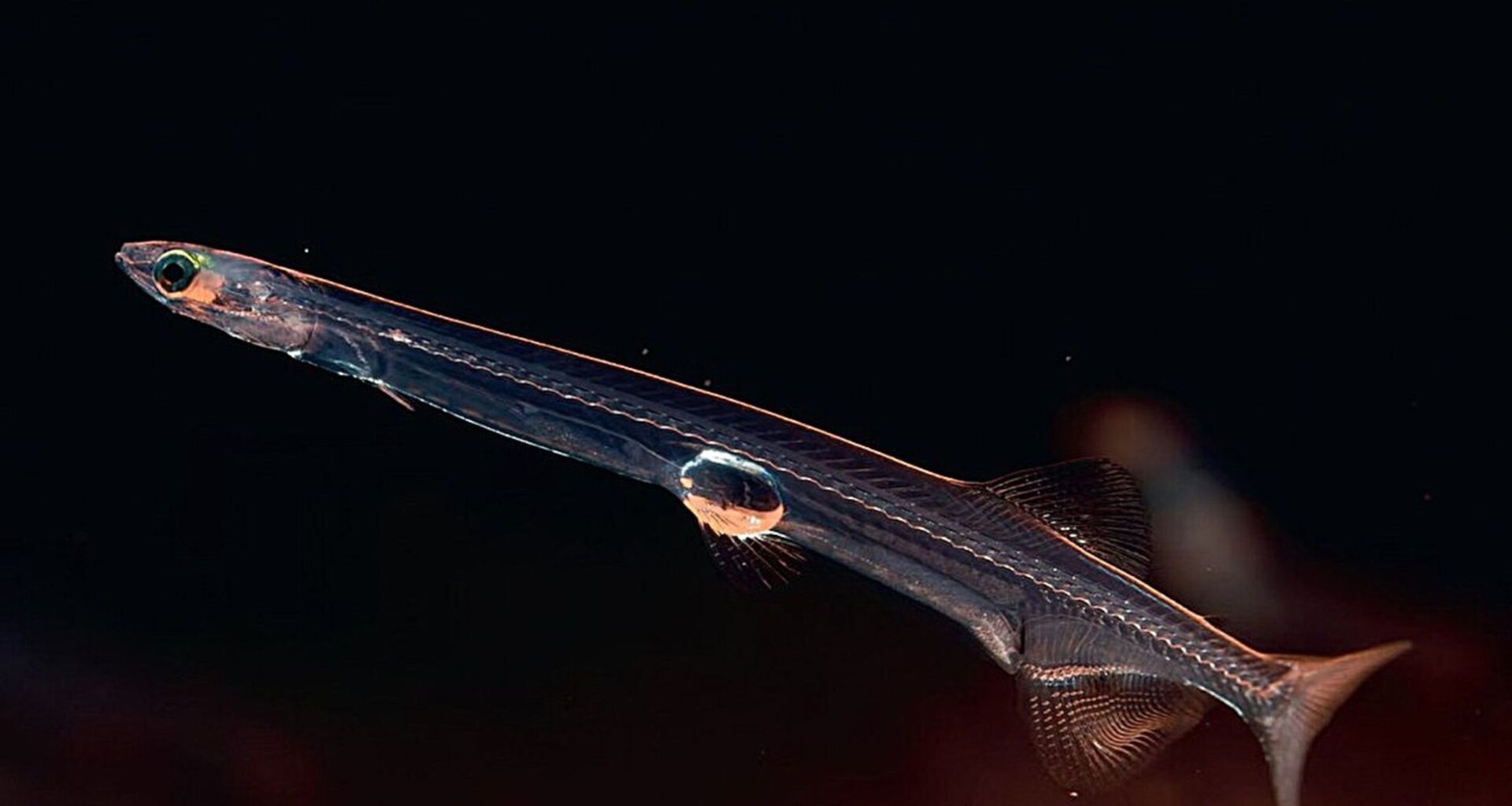
Two completely unrelated groups of fish have independently lost functional red blood cells, establishing that white blood has arisen more than once in vertebrate evolution.
The finding revises how extreme oxygen transport traits can emerge, and shows that identical outcomes do not require shared genetic histories.
Parallel loss of red cells

That realization sharpened when a slender, warm-water noodlefish lineage was found to share the same white-blood condition long associated only with Antarctic icefish.
Evidence for the parallel came as H. William Detrich, Ph.D., from Northeastern University, documented that bloodlessness in icefish results from the loss of oxygen-carrying genes.
He then joined Chinese collaborators to examine whether the same loss appeared elsewhere.
Those genome-wide comparisons showed that the noodlefish reached bloodlessness through a different pattern of genetic damage, rather than repeating the icefish path.
Together, the result established a shared physiological endpoint shaped by separate evolutionary histories.
This sets up a deeper comparison of how it was possible for each lineage to survive without red blood cells.
Role of red blood cells
Most fish depend on red blood cells because those cells pack oxygen into tiny spaces and move it around the body fast.
Inside each cell, hemoglobin, a protein that binds oxygen and releases it, grabs oxygen at gills and drops it in the body tissues.
Muscles also use myoglobin, a protein that holds oxygen inside cells, so swimmers can keep working when demand spikes.
When genes disable these pigments, fish must rely on dissolved oxygen and redesigned circulation, which narrows where the animals can thrive.
Gene loss in icefish
In icefish, whole blocks of hemoglobin genes disappeared, so the animals stopped making red blood cells over millions of years.
Cold, Southern Ocean water holds more dissolved oxygen, easing the pressure to pack oxygen inside cells.
“That means that the Antarctic icefishes are able to rely on oxygen that’s physically dissolved in their blood fluid,” said Detrich.
Yet that cold-water advantage could not explain how noodlefish survived with no red blood cells in habitats far from polar seas.
Different genetic damage
Researchers sequenced 11 noodlefish species and tracked damage across their oxygen genes, finding a pattern that did not match what was present in icefish.
Across all 12 species, the team found the myoglobin gene missing, pointing to a single early loss in their common ancestor.
Instead of deleting hemoglobin genes, each noodlefish lineage carried smaller mutations that blocked functional protein production in red blood cells.
Those mismatched injuries produced the same white-blood result, but they left distinct genetic fingerprints across the noodlefish and icefish genomes.
A life stuck in youth
Asian noodlefishes live for one year only, and that quick clock locks them into a form of neoteny, adulthood with juvenile traits still retained.
Adults reproduce near the end of that year, yet they stayed thin and transparent, and their blood never turned red.
Work on fish larvae showed skin can supply much of the oxygen early, before gills carry the load.
By keeping juvenile biology into adulthood, noodlefishes made red cells optional, so broken oxygen genes could linger without killing them.
Built-in fixes for low oxygen
With less oxygen bound in blood, both fish groups compensated by pumping more fluid and widening networks of small vessels.
The new analysis pointed to angiogenesis, the growth of new blood vessels, and heart-development genes that changed under strong selection.
Earlier work on Antarctic icefishes described enlarged hearts and higher blood volume that helped deliver enough oxygen to tissues.
Those upgrades cost energy and space, which helps explain why hemoglobin-free fish remain rare and tightly constrained.
Chance matters in evolution
Biologists call this convergent evolution, similar traits that arise independently, because the two lineages did not inherit bloodlessness together.
The paper also leaned on historical contingency, chance events steering what happens next, to explain why the genetic damage looked so different.
One candidate trigger was a transposon, a genetic sequence that can move around, which can disrupt genes in a single step.
Once those accidents happened, natural selection could only work with the scraps, favoring bodies that still met oxygen demand.
Surviving in warmer waters
The Asian noodlefish range ran from eastern Russia to Vietnam, crossing China, Korea, and Japan in warmer coastal and river waters.
“They don’t have the advantage of a cold and oxygen-rich environment like the Southern Ocean,” said Detrich.
Noodlefishes stayed slim, often just two to ten inches (five to 25 centimeters) long, which kept tissues close to blood.
That body plan reduced oxygen travel distance, yet warm habitats can carry less oxygen, which adds extra stress.
Searching for more relatives
The noodlefish finding suggests researchers may have overlooked other vertebrates that quietly shed oxygen proteins when conditions allowed survival.
Teams can now scan fish genomes for broken oxygen-transport genes, then test how hearts, blood volume, and behavior adjust.
“It turns out there may be more species than we think that don’t rely on red blood cells to transport oxygen,” said Detrich.
Each new case would sharpen what biologists can predict from genetics alone, and what still depends on history.
Where this leaves researchers
These two fish groups reached the same white-blood endpoint, yet their genes and life histories showed different paths to get there.
Researchers will need field work and lab tests to learn which compensations matter most, and which fail.
The study is published in Current Biology.
Image credits: Xuhongyi Zhen.
—–
Like what you read? Subscribe to our newsletter for engaging articles, exclusive content, and the latest updates.
Check us out on EarthSnap, a free app brought to you by Eric Ralls and Earth.com.
—–