
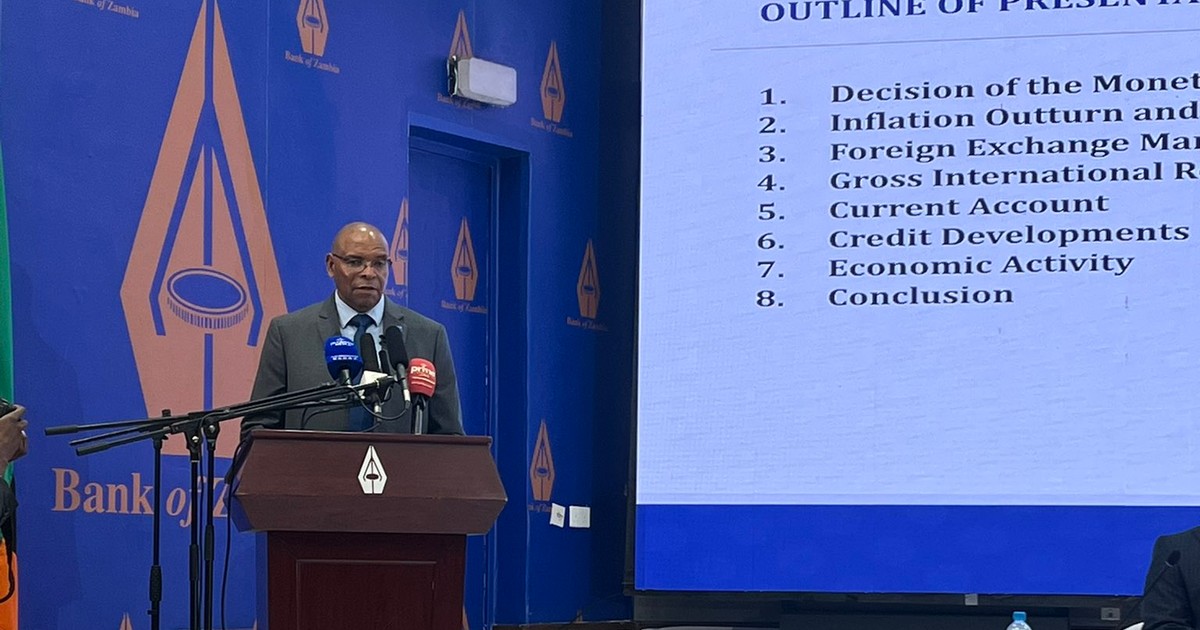
Governor Denny Kalyalya said the decision was driven by a faster-than-expected fall in inflation and stronger performance of the Kwacha, supported by improved market confidence and higher copper prices.
“In arriving at this decision, the Committee took into account the further decline in inflation in Q4 of 2025, the projected fall of inflation into the 6-8 % target band at a faster pace than was forecast, and the need to maintain an appropriate monetary policy stance,” he said.
Inflation dropped sharply to 9.4% in January, helped by a bumper maize harvest and currency gains. The central bank now expects inflation to fall into its 6–8% target band by Q2 2026, much earlier than projected in November 2025. It also expects inflation to move toward the lower bound of the target by mid-2027.
Kwacha appreciation strengthens market confidence
The Kwacha’s recent appreciation has been supported by increased foreign exchange supply, a sovereign credit rating upgrade, rising copper prices, and progress on Zambia’s IMF engagement.
The mining sector remained the largest source of foreign exchange, selling more than USD 400 million to the market despite a slight reduction. Mining-related tax payments nearly doubled to USD 344.6 million.
In gold reserves, the Bank of Zambia purchased 175.23 kg in Q4 2025, valued at USD 23.5 million, bringing total holdings to 3,226.51 kg worth about USD 446.9 million since December 2020.
Investor interest rebounds
Credit growth slowed to 14.4% in December 2025, compared with 17.4% in September.
Meanwhile, foreign appetite for government securities increased sharply, with non-resident investors raising their holdings by K4.2 billion, bringing the total to K65.7 billion, or 25.9% of all outstanding government debt.
The policy shift comes as Zambia continues working to stabilise its public finances. Although the debt-restructuring process has moved slower than expected, the central bank believes easing inflation pressures give room to support economic activity with a more accommodative stance.
With two consecutive rate cuts and inflation projected to keep falling, Zambia is positioning itself for lower borrowing costs, improved investor confidence and a steadier economic path in 2026.