
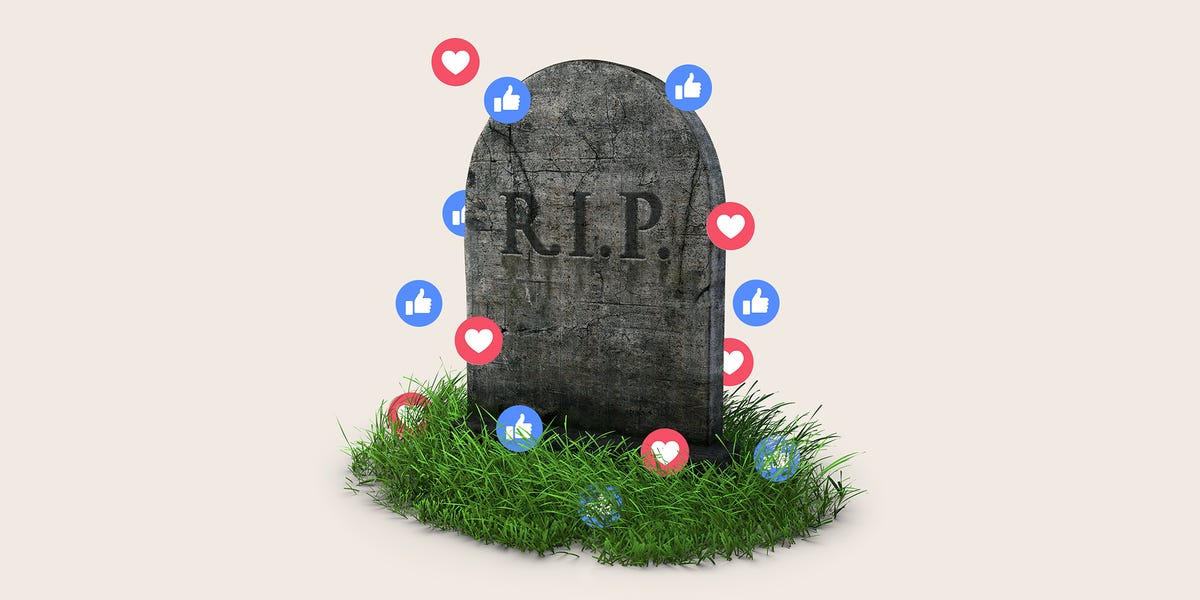
Does Meta want to make our social media accounts immortal?
The company was granted a patent in late December that outlines how a large language model can “simulate” a person’s social media activity, such as responding to content posted by real people.
“The language model may be used for simulating the user when the user is absent from the social networking system, for example, when the user takes a long break or if the user is deceased,” the patent says.
Andrew Bosworth, Meta’s CTO, is listed as the primary author of the patent, which was first filed in 2023.
“We have no plans to move forward with this example,” a spokesperson for Meta told Business Insider.
In the patent, Meta lays out why it thinks people might need this.
If you’re no longer posting online — whether that’s because you need a break from social media or … you … die — your followers’ user experience will be affected. In short, they’ll miss you.
“The impact on the users is much more severe and permanent if that user is deceased and can never return to the social networking platform,” the document says.
To fill that void, Meta would essentially create a digital clone of your social media presence, training a model on “user-specific” data — including historical platform activity, such as comments, likes, or content — to understand how you would (or rather, did) behave.
That clone can then respond to other people’s content by liking and commenting, or responding to DMs. For influencers or creators who make their livelihoods on Meta’s platforms and need to take a break from social media, such a tool could be useful.
Meta’s patent also references tech that would allow the LLM to simulate video or audio calls with users.
The Meta spokesperson said that while it files patents to disclose concepts, a granted patent does not always mean the company will pursue, develop, or implement that tech.
Still, it opens up many questions about the nature of tech — and grief. An AI bot that acts as your understudy while you’re on a digital detox is one thing, but imitating people who’ve died?
Edina Harbinja, a UK-based professor at the University of Birmingham’s Law School, has concerns.
“It does affect not just legal issues, but a lot of very important social, ethical, and deeply philosophical issues as well,” Harbinja, who specializes in digital rights and post-mortem privacy, told Business Insider.
Getting into the business of grief tech
Meta has thought about managing digital legacies for years.
About a decade ago, Facebook launched tools that let people designate a “legacy contact” to manage their accounts if they died. And back in the company’s metaverse days, in a 2023 interview with podcaster Lex Fridman, Mark Zuckerberg discussed virtual avatars for deceased people.
“If someone has lost a loved one and is grieving, there may be ways in which being able to interact or relive certain memories could be helpful,” Zuckerberg said at the time.
There are a lot of names for this broader category of tech — death bots, ghost bots, grief tech — that are aiming to help people face the loss of loved ones with eternally memorialized digital versions of them.
Several startups have launched around this premise, and many have emerged from founders’ own experiences with grief. Replika, an AI chatbot startup, was founded in 2015 by Eugenia Kuyda after the loss of her friend. Then there’s You, Only Virtual (YOV), which was founded in 2020 by Justin Harrison when his mother was diagnosed with cancer.
“Everybody in the tech world has been thinking about this for a while, as soon as we started having breaks in generative AI,” Harrison said.
In 2021, Microsoft patented an AI chatbot that could simulate a deceased person (as well as fictional characters or celebrities).
Meta’s patent signals that the technology category is moving more into the mainstream, Harbinja said.
Harrison isn’t surprised to see bigger tech companies dipping their toes in the space, and sees it as a sign that people are beginning to “feel more comfortable with doing this.”
“We can only improve on what we offer people,” Harrison said, adding that the resources for grieving are “horrible” to begin with.
“I think we have a moral obligation, if we have the potential, to do more for those folks than we should be,” he said.
AI, death, and grief are not easy topics to digest, however. The intersection of all three is a potent brew of taboos ripe for a philosophical debate on ethics, digital rights, and privacy for any dinner table.
‘Let the dead be dead’
Meta has more than helping people process grief as an incentive to pursue the tech it lays out in its patent, especially for accounts taking a break.
“It’s more engagement, more content, more data — more data for the current and the future AI,” Harbinja said. “I can see the business incentive for that. I’m just curious to see how they would, when, and if they will implement this innovation.”
Depending on how a product like this is rolled out, different questions could come up.
For instance, would this apply across all of Meta’s apps? Would it understand the nuance of your WhatsApp presence vs. the candor you have in the Instagram comment section?
Joseph Davis, a sociology professor at the University of Virginia, said he was concerned with the impact that tools like a Meta bot could have on how humans experience grief.
“One of the tasks of grief is to face the actual loss,” Davis said.
“Let the dead be dead,” Davis added. “The idea of bringing them back, but you’re not really doing that, but in fact, it looks like that. That’s the confusion.”
Have a tip? Contact this reporter via email at sbradley@businessinsider.com or Signal at sydneykbradley.123. Use a personal email address, a nonwork WiFi network, and a nonwork device; here’s our guide to sharing information securely.