
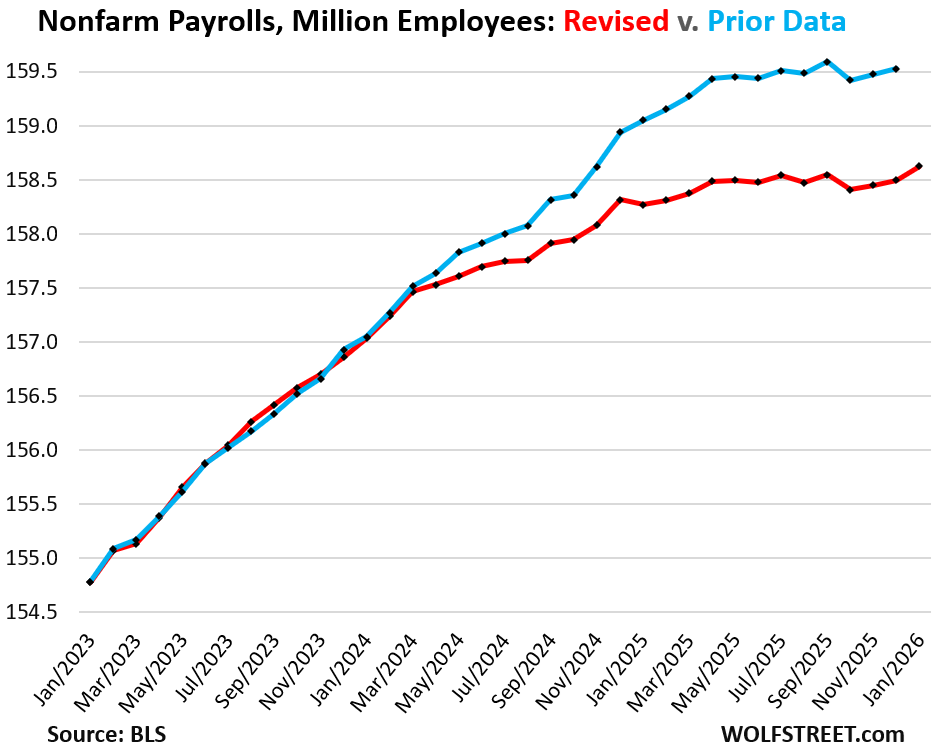
Total nonfarm employment is 1.03 million jobs lower than previously estimated.
By Wolf Richter for WOLF STREET.
The preliminary annual benchmark revisions of nonfarm payrolls were initially announced by the Bureau of Labor Statistics in September as a lumpsum figure (discussed here), but it was not calculated into the monthly nonfarm employment figures at the time.
Today, the BLS announced the final benchmark revisions and recalculated its monthly data going back years. It also revised seasonal adjustments back many years.
The revisions had the effect of reducing two-years’ worth of nonfarm payroll growth by 1.03 million jobs as of December, with far slower job growth in 2024 and 2025 then previously reported. The chart shows the prior data through December 2025 (reported in January) in blue; and the revised figures through January in red.
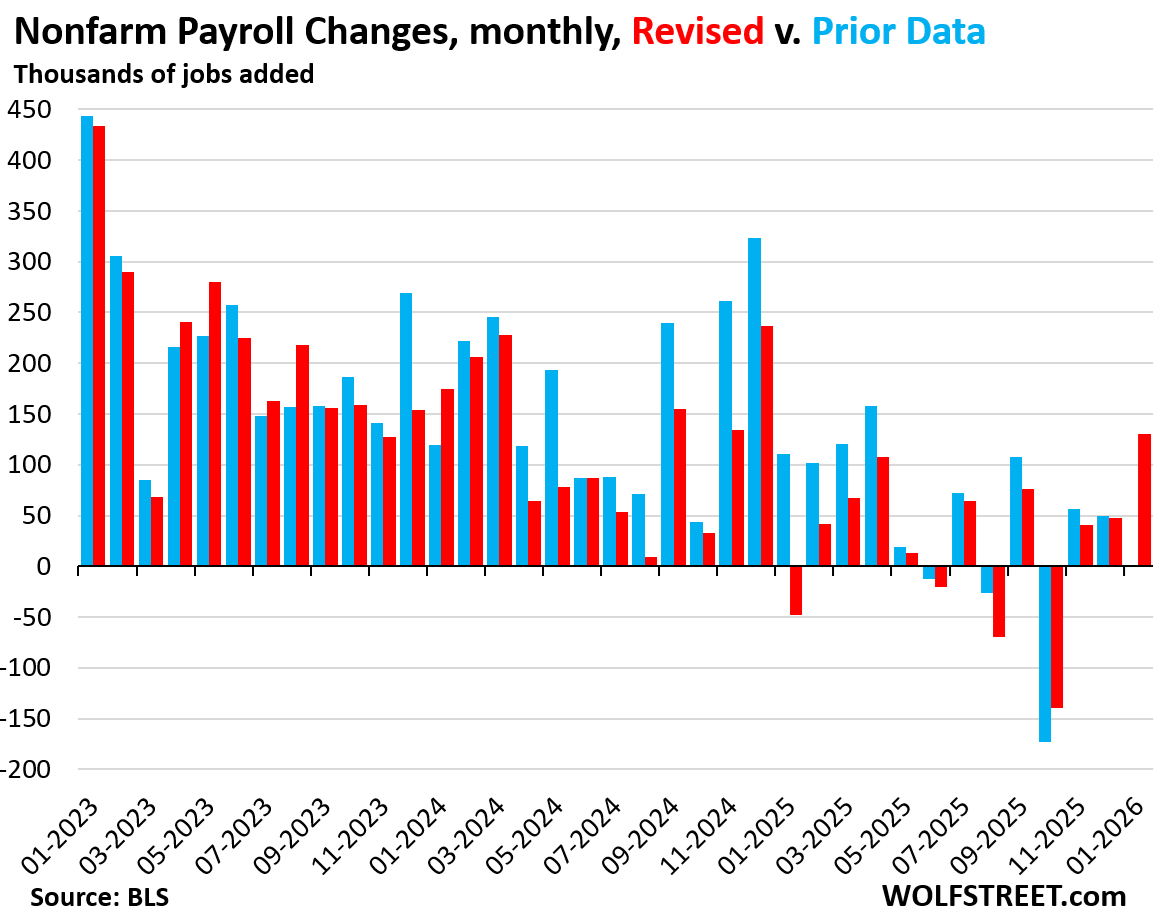
The chart below shows the month-to-month changes of nonfarm payrolls: The figures as reported a month ago in blue, and today’s revised figures in red.
The big changes in 2024 and 2025 were due to the benchmark revisions. The smaller changes in 2023 were due to revisions of seasonal adjustment factors and other revisions.
The BLS tracks nonfarm payroll jobs in two different ways:
Monthly data from employers via surveys. Every month, the BLS asks 10s of thousands of employment locations about their payrolls as part of its Current Employment Statistics (CES). It then uses the data, plus a model for estimating the employment effects of firms having shut down (“deaths”) and firms having been created (“births”) during the period, to estimate the nonfarm payrolls for that month. It then seasonally adjusts the data. These preliminary data are then revised several times in the following months as more data become available.
Quarterly payroll tax data. Employers file quarterly payroll tax reports with the Unemployment Insurance (UI) tax system. These reports contain all their employees and wages and give a count of total payrolls in the US. This data is collected by the BLS in the Quarterly Census of Employment and Wages (QCEW) and supplemented with additional data.
But this UI data is quarterly with filing deadlines well after the quarter ends, so it’s useless for monthly reporting.
To provide more current data on a monthly basis, the BLS uses the survey-based data. And then once a year within the January release, it adjusts (“benchmarks”) the survey-based data to the employment count of the QCEW.
The QCEW is the gold standard for US nonfarm employment, but it’s not available on a timely basis – hence the big annual benchmark revisions.
Obviously, these adjustments should be made quarterly, rather than annually which would be a huge improvement.
Detailed discussion of the employment report coming up shortly.
Enjoy reading WOLF STREET and want to support it? You can donate. I appreciate it immensely. Click on the mug to find out how:

WOLF STREET FEATURE: Daily Market Insights by Chris Vermeulen, Chief Investment Officer, TheTechnicalTraders.com.