

Scientists in Germany have shed light on how nanoscale imaging techniques like tip-enhanced Raman spectroscopy (TERS) can be distorted by metal surfaces by creating a powerful method to simulate atomic vibrations at the angstrom scale.
The study was carried out by Krystof Brezina, PhD, and Mariana Rossi, PhD, from the Max Planck Institute (MPI) for the Structure and Dynamics of Matter (MPSD), along with Yair Litman, PhD, from the MPI for Polymer Research (MPIP).
The team’s findings challenge long-standing assumptions about how vibrational images represent atomic motion, and offer a more accurate way to interpret data from high-resolution spectroscopic tools.
“TERS images are often interpreted as direct maps of atomic motion,” Mariana Rossi, PhD, a researcher at the Max Planck Institute (MPI) for the Structure and Dynamics of Matter (MPSD), pointed out.
All atoms vibrate at the nanoscale. These atomic motions define heat dissipation, chemical reactions and material properties. Because these vibrations are dictated by local chemical bonds and the surrounding environment, they serve as a highly sensitive fingerprint of a material’s internal structure and composition.
To study vibrations indirectly, scientists use spectroscopic techniques like Raman scattering. However, traditional methods collect signals from large groups of atoms at once, which limits their spatial resolution.
To address the challenge, the team turned to tip-enhanced Raman spectroscopy (TERS). This powerful analytical method combines laser light with a sharp metallic tip that concentrates the electromagnetic field into a tiny volume.
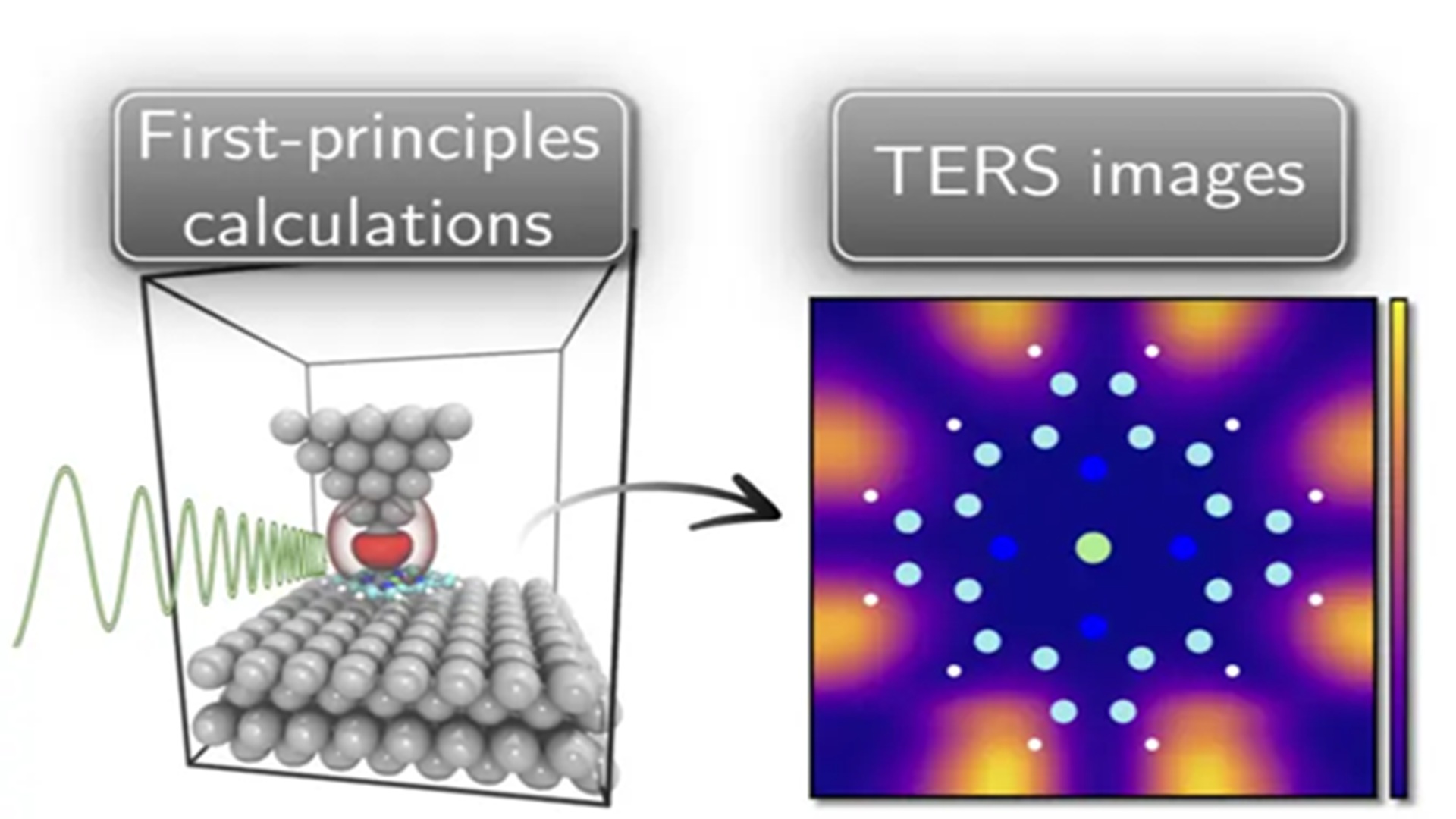 First-principle calculations inform the creation of correct TERS images.
Credit: Rossi et al.
This allows scientists to probe atomic vibrations with sub-nanometer resolution, reaching the Ångström scale, about one ten-billionth of a meter. At this level, they can even examine individual molecules or defects in 2D materials.
Yet, interpreting highly detailed TERS images requires reliable theoretical models that can connect measured signals to atomic-scale motion. There are several factors that can alter the produced signals, especially the electronic response of the metallic substrate beneath the sample.
Atomic motion redefined
To overcome this limitation, the team used first-principles quantum simulations. Rather than relying on oversimplified models, they built a realistic computational approach. It stimulates systems containing hundreds of atoms using only the fundamental laws of quantum mechanics.
The study found that common theoretical shortcuts, such as treating molecules as isolated systems or approximating surfaces with small clusters, can, in fact, lead to misleading results and oversimplified interpretations.
“Our results show that the electronic response of the surface can dominate the signal and fundamentally change what these images mean,” Rossi concluded in a press release.
The results showed that TERS is sensitive to the symmetry of local environments. This allowed the researchers to spot small structural changes and identify defects in 2D materials.
Additionally, electronic screening from the metal surface greatly altered images of vibrations that moved perpendicular to the surface. Meanwhile, those vibrations confined to the molecular plane were far less affected.
According to Brezina, spatially non-local interactions between atoms can strongly shape TERS signals at specific points in space. He added that the brightest areas in an image do not necessarily reflect the largest atomic movements.
The study provides a pathway to more accurate imaging of vibrational motion. It could impact several emerging fields, such as defect mapping in 2D materials, the design of single-molecule electronics, operando surface catalysis studies, as well as next-gen genome sequencing technologies.
The paper has been published in the journal ACS Nano.