
Efforts to detect dark matter have long been shaped by one core limitation: the inability to observe it directly. Most detection experiments rely on the hope that a dark matter particle might strike an atom and leave a trace. But researchers in Japan have introduced a different possibility—one that doesn’t depend on impact at all.
In a study published in Physical Review Letters in November 2025, a team led by physicist Hajime Fukuda at the University of Tokyo and Chuo University presented a concept for a quantum sensor array that could measure how light dark matter particles move through space. The method is built on principles from distributed quantum sensing (DQS), a system that uses coordinated detectors to register subtle, spatially distributed disturbances.
The work remains theoretical. No physical prototype has been built, and the approach has not yet been tested in an experimental setting. But if validated, it could expand the range of dark matter candidates scientists are able to investigate, particularly those too light to trigger conventional detectors.
Light dark matter, including wave-like particles at extremely low masses, remains one of the major unresolved areas in cosmology. The method proposed by Fukuda’s team represents a potential path forward in detecting such particles without requiring them to interact with matter in traditional ways.
A Detection Method That Doesn’t Rely on Collisions
Most direct detection efforts, such as those used in large-scale liquid xenon detectors, are model-dependent. They assume that dark matter particles interact with atomic nuclei through weak-force collisions. The new DQS-based approach avoids this dependency by focusing instead on motion detection.
Rather than detecting a recoil or flash of energy, the proposed system would measure phase shifts across a spatial array of quantum sensors as a dark matter wave passes through. These phase shifts are not tied to specific particle interactions but to the collective quantum behavior of the detector network.
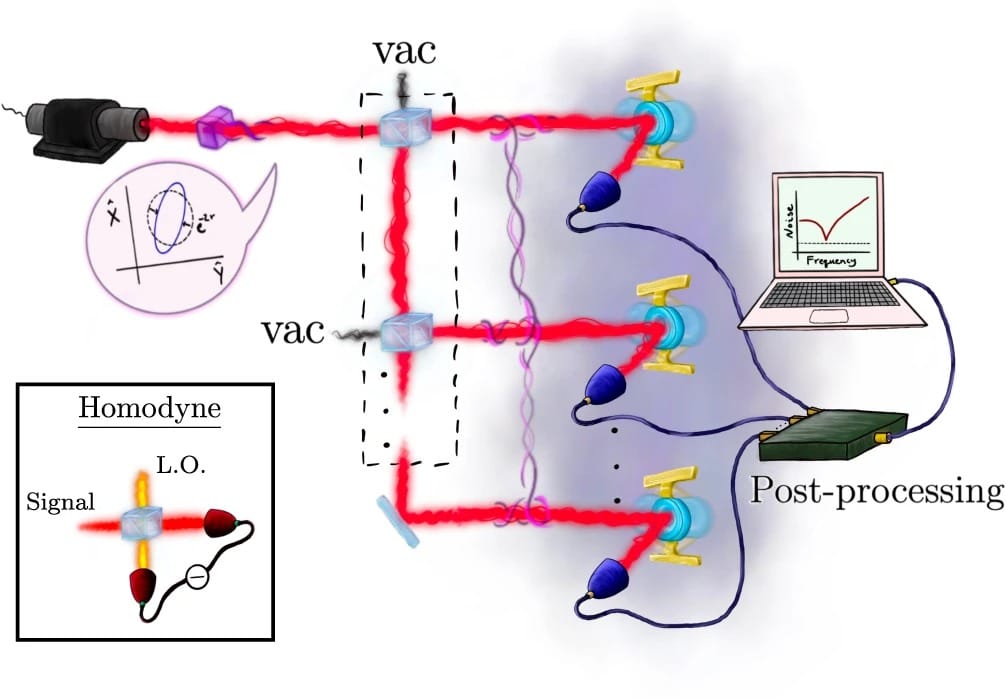 Illustration of a distributed quantum sensing (DQS) proposal. Credit: Communications Physics
As stated in the Physical Review Letters paper, “We found that we can measure the velocity of light dark matter not by measuring spatially extended signals (recoil tracks) but by measuring by spatially extended detectors.” The team describes a setup in which direction and velocity of dark matter particles could be inferred from spatially correlated sensor responses.
The design builds on advances in quantum coherence and long-baseline measurement techniques. While similar concepts have been used in gravitational wave detection, their application to particle tracking in this form is novel.
Simulated Results Highlight Sensitivity Challenges
The study includes a modeling framework outlining signal strength, noise levels, and measurement conditions required to reach statistical significance. Diagrams in the paper show how signal detectability varies with detector sensitivity and angle relative to the galactic center.
Fukuda’s team emphasizes that unlike earlier methods, their system does not require prior knowledge of the type of interaction between dark matter and ordinary matter. This generality makes the approach compatible with a wider range of dark matter models, including ultra-light candidates.
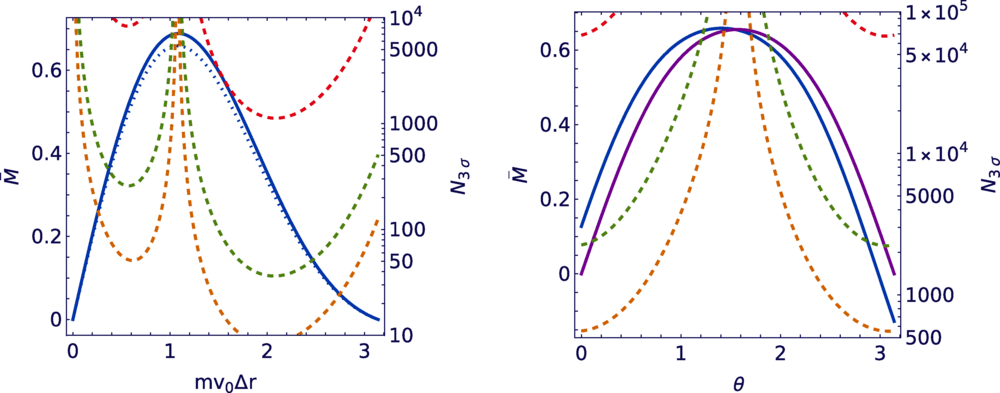 Left: averaged signal versus the parameter shown; dashed lines give how many measurements are needed for a 3σ detection at different noise levels. Right: the same quantity versus angle to the Galactic center, with and without annual modulation; dashed lines again show required measurements, with color indicating noise strength. Credit: Physical Review Letters
Noise remains the largest technical barrier. The modeling suggests that large numbers of measurements, at low noise levels, are needed to confirm detection. The paper notes that measurement fidelity across the sensor network is critical for resolving the faint and spatially distributed signal expected from light dark matter.
From Concept to Candidate for Future Testing
The authors acknowledge that their proposal is not yet experimentally verified. While the concept is grounded in established quantum sensing principles, its application to dark matter detection remains speculative until a functioning prototype is tested.
In a report by Phys.org, Fukuda said, “We showed that quantum methods could play an important role in high-energy physics.” The team indicated that future work may explore detecting spatial patterns in dark matter distribution, not just velocity and direction.
No institution has announced plans to build a working model of the detector, though the idea is likely to be of interest to research groups focused on quantum-enhanced sensors and non-collisional detection methods.
The concept was also covered by The Daily Galaxy, which noted that the sensor array could help track how dark matter moves through space rather than detect it via collisions. The article emphasized that the approach may apply broadly across different interaction models, making it attractive for next-generation detection experiments.
This comes at a time of renewed interest in light dark matter, particularly as observational data from gamma-ray telescopes continues to produce potential indirect signatures. A separate study, also based at the University of Tokyo and reported by Euronews, suggested that an unusual gamma-ray halo near the Milky Way’s center could result from dark matter annihilation—though this interpretation remains under review.
The DQS framework differs by not depending on emission, annihilation, or interaction, but on the ability to map how an invisible field moves through physical space.