
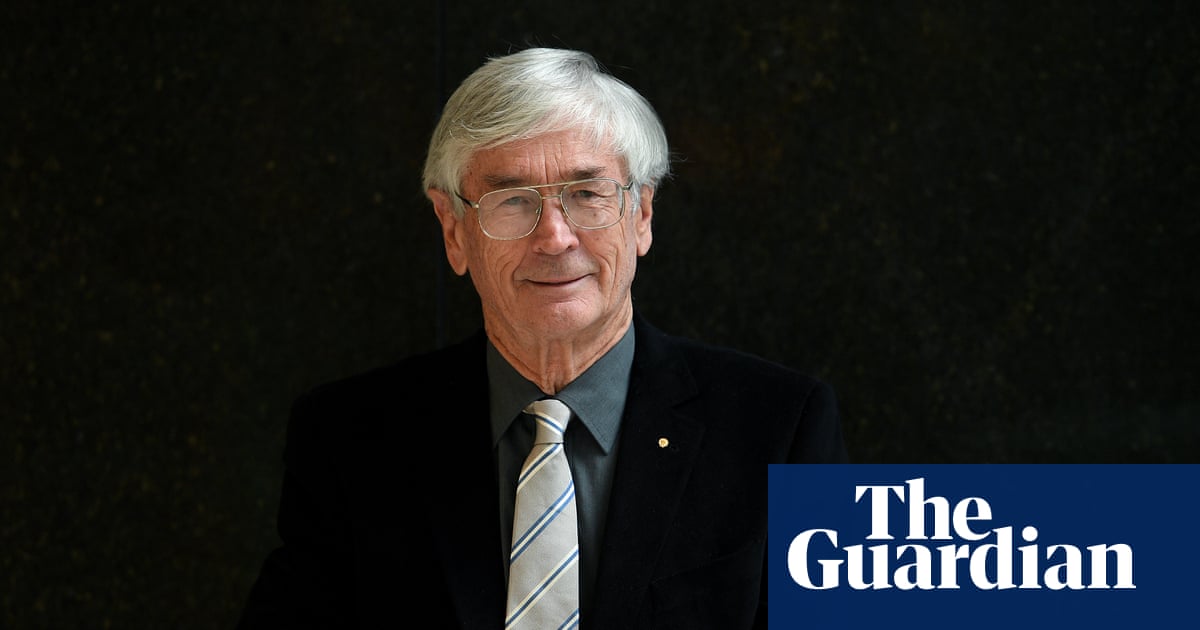
Dick Smith, Graham Marr and Richard Barnes were the only three Australians among the nearly 400 millionaires and billionaires who signed an open letter last month calling on all governments to increase taxes on the super rich.
The open letter, timed to coincide with the World Economic Forum in Davos, argued that extreme wealth was polluting politics, driving social exclusion and fuelling the climate emergency.
Smith told Guardian Australia he joined the call for a wealth tax simply because it would “benefit us greatly”.
“There’s such a large number of billionaires now, and a hell of a lot of people, I think about 30% of our population, lives pay packet to pay packet,” he said. “They have no savings at all.”
He added: “One of the things I’ve said consistently is the top 1% should pay 15% more tax. Because the top 1% have the wealth equivalent to about the bottom 30%.” This would bring the top tax rate to about 60%.
Smith and his wife have given away more than $90m throughout their careers, and are aiming for a total of $100m before they die. When asked why more wealthy Australians did not sign the letter, Smith said “probably greed”.
“Some of them, I don’t want to mention their names, but [they] don’t give anything away. It’s sort of a principle, or they’re proud that they’re a billionaire, and they don’t give any money to charity at all.”
Sign up: AU Breaking News email
Guardian Australia contacted the top 10 billionaires in Australia to ask if they would put their names to the open letter but did not get a response. On background, three said they were undertaking other philanthropic efforts and giving away large amounts of money.
Graham Marr has amassed his wealth through holding high-income executive roles in the tech sector. He said he signed the letter because Australia’s 48 billionaires hold more wealth than the bottom 40% of the population, which is 11 million people.
“And that divide is getting bigger,” Marr said. “The disparities are amplifying elitism around the country, and that opens doors for people when you have wealth, because it means access to lobbying. It means more access to potentially making political donations. It means more media ownership.”
He said a 5% wealth tax could raise around $17b annually towards childcare, housing and healthcare, and that government policies have not kept up with the growing divide between the super wealthy and everyone else.
“Every country has now got its runaway multi-billionaires, millionaires and billionaires,” he said.
“And they are having their time in the sun because their governments haven’t really caught up to how to manage them.
“Because, politically, [when] the government starts trying to leverage a tax on somebody that’s rich and influential, the media has a great way of turning that into a negative and spreading misinformation to the masses that somehow that tax is going to fall on them.”
The treasurer, Jim Chalmers, has hinted at changes to the capital gains tax in the next budget but has ruled out an inheritance tax. Photograph: Mick Tsikas/AAP
The third Australian to sign the list, Richard Barnes, has had a long career as an anaesthetist in the public system, making about $400,000 a year. With his wife, they have built $5m in assets.
“Which means there are about 150,000 Australians as well off as I am,” he said. “All of whom could make a greater contribution to the public purse than they currently do.”
The median full-time income in Australia is $90,532 per year, which means those in the middle-class aren’t likely to accumulate “a huge amount of wealth other than compulsory superannuation”, he said.
Barnes wants to see a more progressive income tax system, a tightening of the 50% capital gains discount and an inheritance tax.
“Wealth disparities are greater than income disparities,” he said. “And harder to capture, because wealth gives one the opportunity to avoid income tax.
“A wealth tax and an inheritance tax say: ‘we don’t care how you got your wealth, a slice is going to public revenue’. It would be levied annually, be based on net wealth, cast a wide net, have a threshold and be progressive.”
While the treasurer, Jim Chalmers, has hinted at changes to the capital gains tax in the next budget, he has ruled out an inheritance tax.
‘I call them stingy billionaires’
According to an Oxfam report released in January, eight new Australian billionaires have been minted since 2020, bringing the total number to 48. On average, they increased their wealth by almost $600,000 a day over the past year, or more than $10.5bn collectively.
But the economist Saul Eslake said Australia was “flying in the dark” in terms of measuring wealth inequality because the Australian Bureau of Statistics has not released new data on the issue since 2020.
In 2019-20, the ABS found the wealthiest 20% of the population owned 62.8% of total household wealth, up from 59% for 2003-04. It also showed the share of household wealth owned by people over 65 had almost doubled, reflecting “a significant increase in the intergenerational inequity in the distribution of wealth”, Eslake said.
Eslake said there were “reasonable grounds” for suspecting wealth inequality had increased in the five years since, given steep rises in the housing and stock markets.
Property ownership in particular is driving the wealth of older Australians, though Eslake said there were “some significant pockets of poverty” among the over-65 age group.
“Property is a much more important source of personal wealth in Australia than in any other comparable country,” he said. “The home ownership rate among people aged 25 to 34 at the 2021 census was 43% that was down from a peak of 61% at the census of 1981.”
Joking that he gives his wealth away for “selfish reasons” because “it makes me feel good”, Smith said the public perception that Australia’s billionaire class gives away their money was not true.
“It’s not as if there’s evidence that these billionaires – and I call them ‘stingy billionaires’ – are giving money away,” he said. “And when there’s no pressure from the media, why would they bother?”
Seven super-wealthy Australians, including billionaires Melanie Perkins and Cliff Obrecht, creators of Canva, and Andrew and Nicola Forrest, owners of Fortescue Metals Group, have signed the Giving Pledge, a campaign started by Bill and Melinda Gates and Warren Buffett to encourage wealthy people to give most of their money away before they die.
But Rebecca Gowland, the international director at Patriotic Millionaires, the organisation that coordinated the open letter said while philanthropy “still plays a role … we need to acknowledge that it hasn’t and it won’t fix systemic issues”.
“We need to address extreme wealth in a mandatory way that obliges all wealth holders to contribute their fair share – just as it obliges all ordinary people to contribute,” she said. “That’s the backbone of a functioning democracy.”