
A new analysis of exquisitely preserved laminated rocks (varves) from the Port Askaig Formation on the Garvellach Islands, Scotland, shows that climate oscillations occurred on annual, decadal, and centennial timescales during the Sturtian glaciation (717-658 million years ago), the most severe Snowball Earth event.
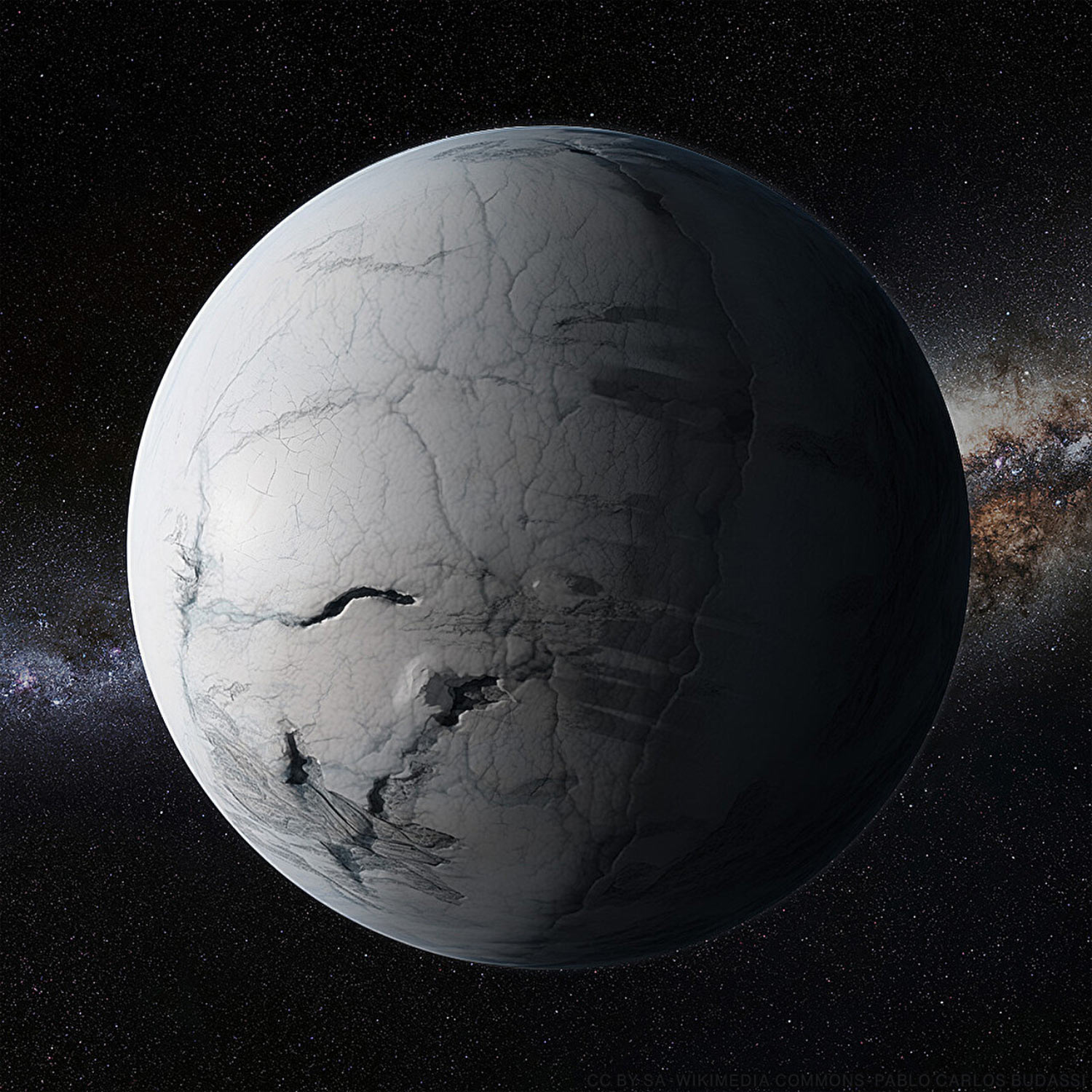
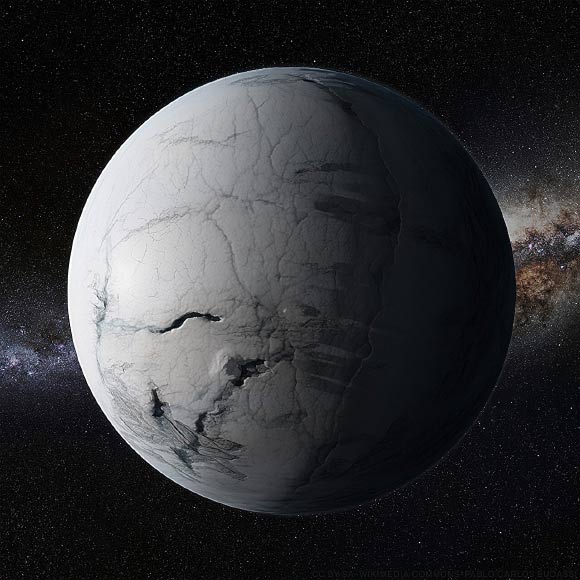
An artist’s impression of Earth around 700 million years ago during the Sturtian glaciation. Image credit: Pablo Carlos Budassi.
In their study, University of Southampton’s Professor Thomas Gernon and his colleagues examined 2,600 individual layers within the Sturtian Port Askaig Formation, each recording a single year of deposition.
“These rocks preserve the full suite of climate rhythms we know from today — annual seasons, solar cycles, and interannual oscillations — all operating during a Snowball Earth. That’s jaw dropping,” Professor Gernon said.
“It tells us the climate system has an innate tendency to oscillate, even under extreme conditions, if given the slightest opportunity.”
“These rocks are extraordinary,” added Dr. Chloe Griffin, also from the University of Southampton.
“They act like a natural data logger, recording year-by-year changes in climate during one of the coldest periods in Earth’s history.”
“Until now, we didn’t know whether climate variability at these timescales could exist during Snowball Earth, because no one had found a record like this from within the glaciation itself.”
The microscopic analysis showed that the layers likely formed through seasonal freeze-thaw cycles in a calm, deep-water setting beneath ice.
When the researchers used statistics to analyze variations in layer thickness, a surprising signal emerged.
“We found clear evidence for repeating climate cycles operating every few years to decades,” Dr. Griffin said.
“Some of these closely resemble modern climate patterns, such as El Niño-like oscillations and solar cycles.”
These climate cycles, however, were unlikely to have been the norm for Snowball Earth.
“Our results suggest that this kind of climate variability was the exception, rather than the rule,” Professor Gernon said.
“The background state of Snowball Earth was extremely cold and stable.”
“What we’re seeing here is probably a short-lived disturbance, lasting thousands of years, against the backdrop of an otherwise deeply frozen planet.”
The team ran climate simulations for Snowball Earth, which showed that a completely ice-sealed ocean would suppress most climate oscillations.
However, if a small fraction, around 15%, of the ocean surface remained ice-free, familiar atmosphere-ocean interactions could resume.
“Our models showed that you don’t need vast open oceans,” said University of Southampton’s Dr. Minmin Fu.
“Even limited areas of open water in the tropics can allow climate modes similar to those we see today to operate, producing the kinds of signals recorded in the rocks.”
“This finding supports a scenario in which Snowball Earth was generally frozen solid but punctuated by intervals, sometimes dubbed ‘slushball’ or more extensive ‘waterbelt’ states, when small patches of open ocean emerged.”
The results appear in the journal Earth and Planetary Science Letters.
_____
Chloe Griffin et al. 2026. Interannual to multidecadal climate oscillations occurred during Cryogenian glaciation. Earth and Planetary Science Letters 679: 119891; doi: 10.1016/j.epsl.2026.119891