

Find winning stocks in any market cycle. Join 7 million investors using Simply Wall St’s investing ideas for FREE.
Apple has delayed its anticipated Siri virtual assistant upgrade after new software issues surfaced.
The setback pushes several AI driven Siri features beyond the expected iOS 26.4 release window.
The move comes as Apple aims to reinforce its position in artificial intelligence and voice technology.
For investors tracking NasdaqGS:AAPL, the delay lands at a time when Apple shares are trading around $275.5 and the stock has returned 16.8% over the past year and 79.9% over three years. These figures indicate that the market is reflecting a long track record of product development, which can make any bump in the technology roadmap feel more significant.
The key question now is how quickly Apple can resolve the Siri issues and bring the planned AI features to users. The timing and quality of that rollout could influence how both customers and investors view Apple’s next phase of AI and voice assistant capability.
Stay updated on the most important news stories for Apple by adding it to your watchlist or portfolio. Alternatively, explore our Community to discover new perspectives on Apple.
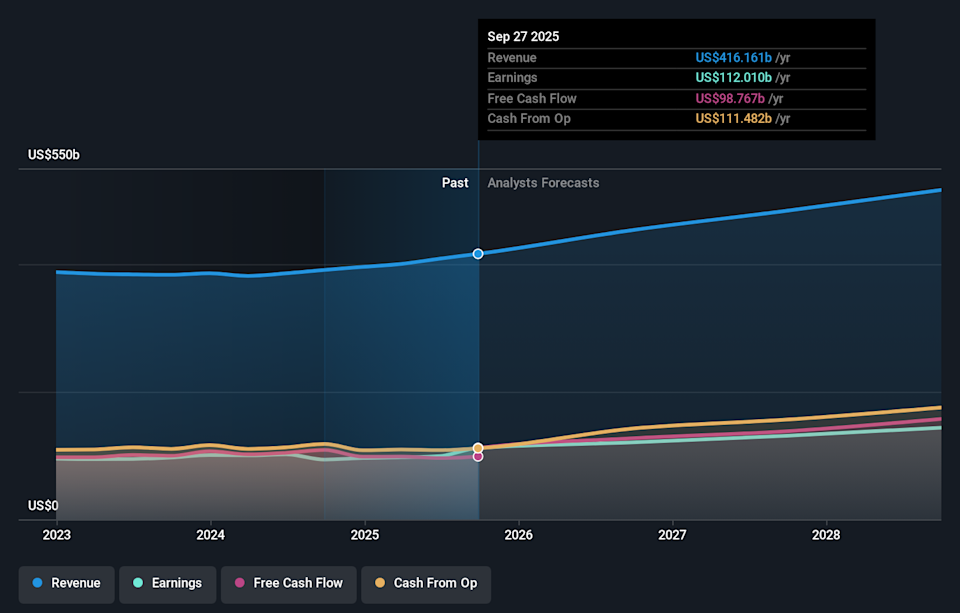 NasdaqGS:AAPL Earnings & Revenue Growth as at Feb 2026
📰 Beyond the headline: 0 risks and 2 things going right for Apple that every investor should see.
The Siri delay lands at an awkward time for Apple because AI-powered experiences are increasingly a key selling point for smartphones from competitors like Alphabet and Samsung. Apple has talked up Apple Intelligence and Siri 2.0 as a core part of its next product cycle, including the upcoming iPhone 17e and refreshed Macs, so pushing some features from iOS 26.4 to later versions could limit how quickly it turns that story into day to day usage. That said, recent results show iPhone 17 demand, services momentum and record quarterly revenue of US$143,756 million with net income of US$42,097 million are currently driven more by hardware and services than by the new Siri features themselves. For you as an investor, the key issue is not this slip in timing on its own, but what it signals about Apple’s ability to keep pace in AI while controlling costs, especially as tech peers ramp up heavy AI spending on data centers and infrastructure.
The delay still lines up with the narrative that AI-powered features and Apple Intelligence could support a new upgrade cycle and deepen ecosystem engagement, as Apple is prioritizing quality before pushing Siri 2.0 across hundreds of millions of devices.
At the same time, setbacks in rolling out more capable Siri features challenge the idea that Apple can rely on AI to smoothly support future product differentiation, especially when rivals like Microsoft and Alphabet are already pushing visible AI assistants.
The narrative focuses on broad Apple Intelligence and services growth, but this specific timing risk around voice assistant reliability and user trust in Siri does not appear fully captured, even though it may influence how quickly AI usage turns into higher services revenue.
Knowing what a company is worth starts with understanding its story. Check out one of the top narratives in the Simply Wall St Community for Apple to help decide what it’s worth to you.
⚠️ Repeated delays or quality issues in Siri could hurt Apple’s AI reputation relative to Microsoft, Alphabet and Amazon, especially as investors are already questioning which platforms will convert AI spend into clear user value.
⚠️ If Siri improvements roll out more slowly than expected, it may take longer for Apple to influence user behavior toward more voice-based interaction, which could delay potential upside for services and app engagement tied to Apple Intelligence.
🎁 Apple’s recent quarterly revenue of US$143,756 million and net income of US$42,097 million, together with ongoing buybacks of roughly US$25.2b in the last tranche and a regular dividend of US$0.26 per share, show that the business model is not currently dependent on this single AI release.
🎁 The company is lining up a broad 2026 product slate, including the iPhone 17e, refreshed iPads and a low-cost MacBook that could widen the installed base, which would increase the eventual reach of Siri and Apple Intelligence once the delayed features are ready.
From here, it is worth watching how Apple sequences the Siri upgrades across iOS 26.5 and iOS 27, and whether it clearly explains to users and developers which AI-powered capabilities arrive when. Pay attention to any commentary on testing progress, latency and accuracy, as those are the issues that triggered the delay. It is also useful to track how much Apple leans on its Google Gemini partnership versus on-device models, since that will influence both user experience and cost. Finally, watch whether strong iPhone 17 demand, App Store trends and the upcoming low-cost MacBook continue to support revenue and services growth while Apple fine tunes its voice assistant plans.
To ensure you’re always in the loop on how the latest news impacts the investment narrative for Apple, head to the community page for Apple to never miss an update on the top community narratives.
This article by Simply Wall St is general in nature. We provide commentary based on historical data and analyst forecasts only using an unbiased methodology and our articles are not intended to be financial advice. It does not constitute a recommendation to buy or sell any stock, and does not take account of your objectives, or your financial situation. We aim to bring you long-term focused analysis driven by fundamental data. Note that our analysis may not factor in the latest price-sensitive company announcements or qualitative material. Simply Wall St has no position in any stocks mentioned.
Companies discussed in this article include AAPL.
Have feedback on this article? Concerned about the content? Get in touch with us directly. Alternatively, email editorial-team@simplywallst.com