
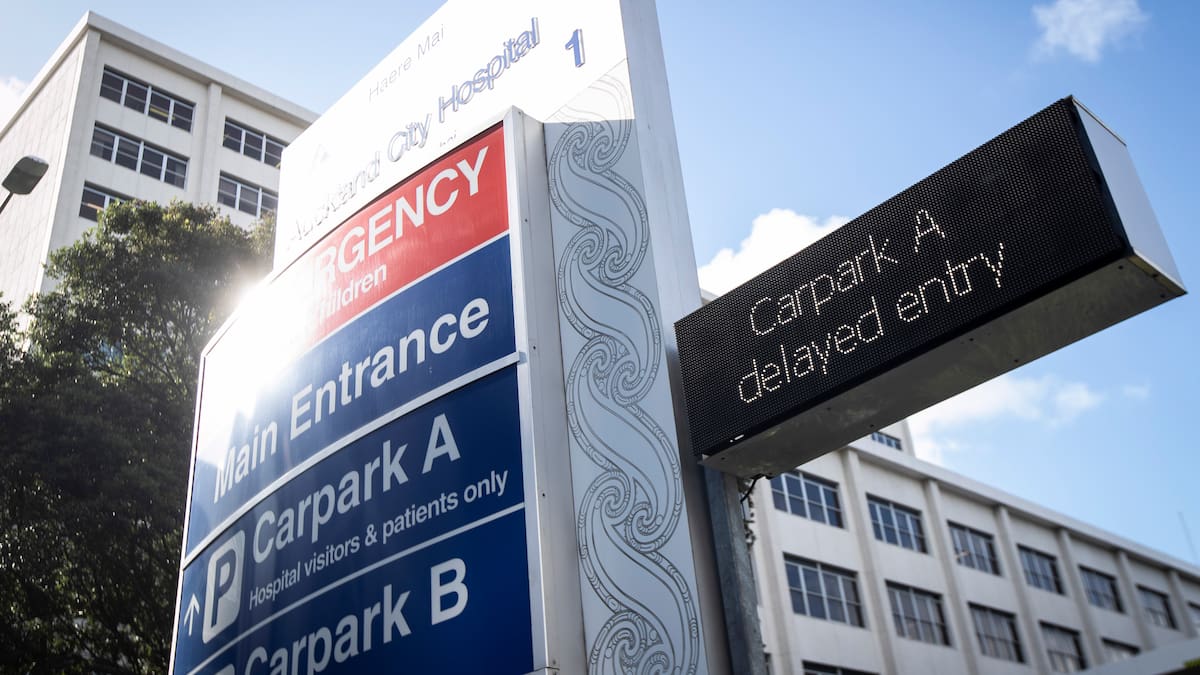
The key topics up for consultation and feedback were:
Safety, accessibility and convenience.Off-site parking.Parking charges.Employment agreements.User pays.Private sector management and capital.
Under the third principle, Health NZ said parking charges will be linked to market rates, with free or reduced parking for those in need.
“The ultimate goal, in terms of pricing parking, is to directly internalise the cost of parking to road users for the fair price of land,” the document read.
“Parking charges will be made to staff, people and visitors who use the health services.
“Market pricing for the location – alongside comparative public transport pricing and the costs to provide and maintain the carpark – will be used as a guide to set parking rates and reviewed on a two-yearly basis to ensure that parking charges are fair and equitable.”
The sixth principle asked workers if they agreed that private sector parking management and capital should be used in preference to public sector capital.
The consultation period was set to be open until next Wednesday, February 18. However, in a surprise move, Te Whatu Ora announced this afternoon that the consultation period is now over.
“Health New Zealand has stopped consultation on its draft car parking policy,” a spokeswoman said.
“Any changes to hospital parking must be considered carefully – particularly in the context of cost-of-living pressures.
“Health New Zealand’s focus remains on ensuring patients, visitors and staff can access safe, secure and sufficient parking.
“Health New Zealand will not be progressing any changes at this time.”
‘Embarrassing U-turn’
Christchurch healthcare worker and NZ Nurses Organisation delegate Al Dietschin. Photo / NZNO
The Herald had earlier asked for more details about the proposed carpark policy.
The New Zealand Nurses Organisation (NZNO) said Health NZ had failed to meet consultation requirements, as the union had not been consulted beforehand.
The union said it was an “embarrassing U-turn”.
“Te Whatu Ora needs to go back to the drawing board and prioritise worker safety after reversing plans to charge hospital workers market rates for car parks,” the NZNO said.
Christchurch health worker and NZNO delegate Al Dietschin said: “Last year, there were several shocking attacks on hospital health workers forced to walk to their cars because they can’t park at or near their workplaces.
“This includes a Palmerston North nurse being carjacked and a Christchurch nurse being left with a concussion.
“Our members provided robust feedback that charging health workers market rates for car parks was not the answer and would leave those unable to pay up to $100 a week even less safe.
“This is an embarrassing U-turn for Te Whatu Ora, but it is heartening they have listened to our members.”
Female staff afraid to walk to cars after late-night shifts
Female staff at Christchurch Hospital are banding together to walk to their cars late at night after their shifts. Photo / George Heard
Car parking in and around hospitals – particularly for workers – has been a controversial issue for many hospitals around the country, including hospitals in Auckland, Christchurch and Whangārei.
At Christchurch Hospital, shift workers have been known to park about 15 minutes’ walk away from the hospital due to a lack of car parking spots.
One man, who asked not to be named, said his partner consistently felt unsafe having to walk past Hagley Park – with limited lighting – to get to her car parked on the other side.
“They’ve been finishing around 2am and 3am because of the backlog and not having enough staff. Then to [have to] go outside and be threatened trying to get to their vehicles – it’s terrifying,” he said.
“It’s just another slap in the face to all the frontline workers.
“I’m concerned about my partner going to work and finishing late shifts … and being able to safely get home.”
Others had started to walk in small groups after work to get to their vehicles safely.
He said staff had been told about a recent incident in which a group of female staff came across a drunk man while walking to their vehicles late at night.
Deciding to stay together, they made a beeline for the closest of their vehicles and dropped the others one by one to each of their vehicles.
The man said he often stayed on the phone to his partner as she walked to her car late at night.
He wanted health officials and authorities to come up with a better parking solution for shift-working staff, in particular, before something bad happened.
“It’s a ticking time bomb.”
Sign up to The Daily H, a free newsletter curated by our editors and delivered straight to your inbox every weekday.