
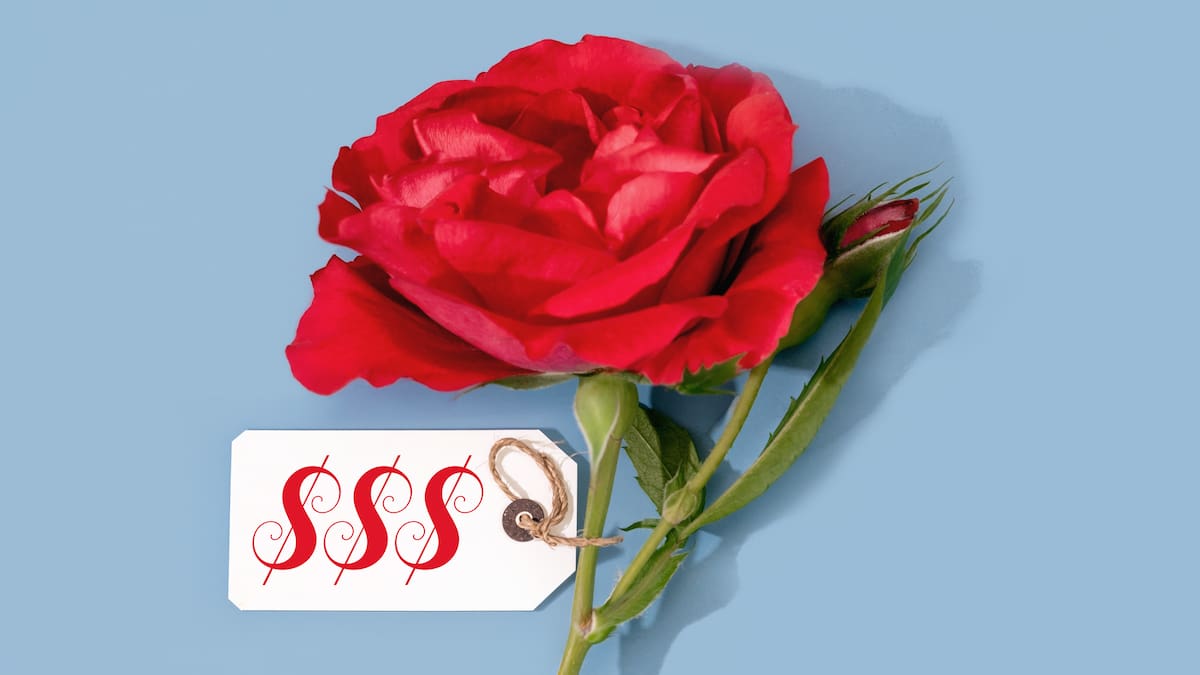
“Everyone wants red roses one day of the year. And it’s not like picking up a can of beans off the shelf … Someone’s got to look after them while they grow. Feed them and nurture them. Then they’ve got to cut them, pack them, ship them, then someone else has got to handle them.”
At Wild Poppies, a wrapped and ribboned bouquet of one-dozen super-grade red roses with foliage will set you back $229. (A boxed dozen is slightly cheaper at $199).
“Our pricing is the same as last year,” says Bradburn, noting florists have to factor in damaged flowers and wastage, along with their own labour.
Are they worth it?
“Roses are symbolic. They’re not just a product, they’re a declaration of love and you pay for that. Like oysters, they’re not growing on every street corner.”
Online searches showed that, this week, supermarkets were selling small bouquets of red roses for $35, and some florists were offering one dozen bunches for $125. The New Zealand Herald’s attempts to find an inner-city red rose for a photo shoot were thwarted by the price tags – $15 for a single stem with no ribbons or wrapping, from a florist who said wholesale prices had doubled since last Valentine’s.
Bradburn, meanwhile, says one red rose is not the same as the next.
“You can definitely find cheaper roses. But the heads on ours would probably be three times bigger and they’ve been well looked after, nurtured and loved and adored – as opposed to mass-produced, mass-picked, mass-bucketed and mass-marketed.
“Romance is romance and people associate red roses with romance. If you’re romantically involved with someone, it’s the ultimate gift. It’s saying ‘I absolutely adore you’ – because we both know these roses are costing you.”
Rose orders were, so far, on a par with last year, Bradburn said, although some customers had opted for cheaper deliveries of hydrangeas and cupcakes.
How do you say “I love you” without breaking the bank? Read on for one dozen Valentine’s Day gifts that are lighter on the wallet – but no less laden with meaning.
Pack a pink picnic (this one features rosé from Astrolabe, one of Viva’s Top 50 wineries in 2025).
Pink drinks: Roses for $240 or a decent rosé for less than $24? It’s amazing what a price difference l’accent can make.
Happily monogamously masked lovebirds.
Animal attraction: Auckland Zoo has 25 pairs of resident masked lovebirds. Grab your own significant other (and a $24 adult day pass) and promenade the African savannah for close-up views of the Tanzanian bird that mates for life. Other ongoing zoo romances include the monogamous siamangs Kera and Intan, and Zayana and Ramah – Sumatran tigers who have their own rooms but come together for mating.
Tourism New Zealand used beach art to promote its $6.3m spend on the Michelin Guide (but you could probably write “I love you” for less).
Long-distance love: Find a sandy beach. Write a message. Hire a drone. Film your message. Open your laptop. Press send. Mic drop.
Homemade (with love): Marry Me Chicken is the internet’s favourite matchmaker. The recipe that features heavy cream sauce, garlic, sun-dried tomatoes and parmesan cheese, the dish was first created in 2016 when, coincidentally, New Zealand’s divorce rates dropped to some of its lowest levels since 1979. Alternately, consider a readymade package like the $140 flowers, dinner and dessert deal from My Food Bag because nothing says “I love you” like a lasagne (serves four).
Trust us, cheese is a love language. Photo / Dean Purcell
Say cheese: In which the British attempt to get sexy with cheese. (Mature Cheddar might sound like the Coronation Street of the dairy section but then you remember that time Rosie Webster wore rollerblades and a mini-skirt and while this analogy might not be 100% working if you don’t watch Coro, this cherry red, heart-shaped block of Somerset’s finest is definitely the cheesiest $16 you could spend this Valentine’s Day).
Kawakawa: Nature’s Valentine.
All the other flowers: How, exactly, did roses get the monopoly on love? Consider the heart-shaped profiles of kawakawa (free from your neighbour’s fenceline), violets (less than $12 from Bunnings) or cyclamen (buy now, regift at Mother’s Day) and spend the hundreds of dollars you saved on something truly romantic like a toasted sandwich maker.
An $11 packet of petals from Secret Kiwi Kitchen.
Edible dried rose petals: Romance AND a plant-based snack.
Double-scoop entendres: Ice cream lovers are no longer limited to hokey pokey, chocolate and vanilla. New Zealand’s artisan brands are delivering flavours that speak to hot dates and cozy mornings. Consider Little ‘Lato’s pink champagne sorbet followed by crumpets and golden syrup, or Island Gelato’s grapefruit gin and yuzu with a breakfast-adjacent coconut latte.
George Bernard Shaw once said there is no sincerer love than the love of a squishy marshmallow heart (or something like that). Photo / Dean Purcell
Sweet nothings #1: Repeat after me – chocolate is not a cop out. Also, this raspberry marshmallow heart from Potter Brothers definitely looks like it is worth at least $2 more than the $3 you will actually pay for it (stylish wrapping not shown).
Two hearts beat as one (etcetera). Photo / Dean Purcell
Sweet nothings #2: Multiple Valentine’s? No judgement here. This $4.29 seasonal treat from Molly Whopper’s offers double ginger biscuit bang for your buck.
Venison heart for the more literal Valentine (as recently eaten al fresco, in the romantic courtyard at Auckland’s Cazador restaurant).
All heart: Sure, you could sit down to a set menu (there are some ridiculously good deals out there, as per this recent round-up from Viva). Absolutely, you could order aphrodisiacal oysters or pomegranates or artichokes. But why not get a plate that goes straight to the heart? In Auckland, Cazador routinely serves both duck and venison hearts. Further along Dominion Rd, Go Go Music Lounge will sling you a skewer of tiny, tasty chicken hearts for just $1.80.
Jewellery, but make it Valentine’s shaped ($249 from Zoe & Morgan).
A heart of gold: Technically, these Gypsy Heart Earrings are gold vermeil plated. They are slightly more expensive than a bunch of roses – but they will last longer and are 100% easier to carry home on the bus.