
What’s faster: a less frequent direct service or a more frequent service that requires a transfer?
In my post last week about needing a metro timetable to match our upgraded rail network, a few things came up that caught my attention:
That the testing didn’t go wellThere were a number of suggestions about west-to-Newmarket services – with some similar comments I’ve seen from time to time in other places.
So let’s look at these.
First up, AT has admitted that testing didn’t go well; hopefully this means they will make changes to remove some of the complexity and give us a more metro-style timetable.
“The testing was a valuable learning curve”, Ms van der Putten says.
“It highlighted several challenges, particularly around network congestion, which our teams are now working through. We’ll tweak a few things before we run the simulation again in the April school holidays, to help us finalise a robust timetable and provide reliable services from day one.”
The main focus of this post, though, is about west-Newmarket services. Talk about retaining some services for this journey is understandable given it’s been an important destination for Western Line rail users up until now. It’s also personal for me – not only do I live out west near the rail line, so I have an interest in the connection, but my wife works in Newmarket so any change will impact her.
However, nostalgia and individual benefit alone isn’t a good enough reason to keep direct services to Newmarket, in the face of such a transformative change as the City Rail Link.
As a reminder, the CRL does three fundamental things for the rail network.
It adds two new stations in the heart of the city and at K Rd, significantly widening direct access to so many more destinations from the current sole downtown edge point – making it easier to get directly to tens of thousands of jobs, and also to the universities and other education facilities in the city.It increases the capacity of the rail network – currently 18 trains an hour arrive at Waitematā, but with the CRL, from day one up to 32 trains an hour (16 per direction) will access the city. Eventually, with additional investment around the network, this could go as high as 48 trains an hour. More trains means more capacity – but often overlooked is that more trains also means faster journeys, because it reduces how long you need wait for a train at a station. Even just moving from 6 trains per hour to 8 is like being a station closer to your destination.It significantly shortens travel times from the Western Line to the city. With the CRL up and running, a trip from Maungawhau to Waitematā should take around 9 minutes – that’s about half what it does now via Newmarket. For trips to destinations near the new stations, the total travel time saved will be significantly higher.
When it comes to the Western line, there are three general options for how services could be run:
All services into the city, and then out to either the Southern or Eastern lines. Passengers needing to get to Grafton or Newmarket would need to transfer.A loop around around the city and Newmarket, and then back out west again. This could be either all in the same direction, or some having alternating directions e.g. half go via the city first and the other half via Newmarket first.Some services go to the city, and some run a west-south pattern.
See below for what this would look like:
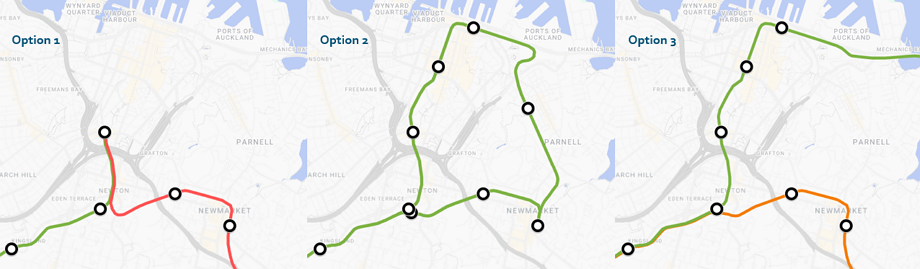
To help explain why I think Option 1 is the best, let’s dive into some numbers.
Limited train slots
In a perfect world we’d have a far more developed rail network, with additional tracks on our lines to enable more services to run, and no level crossings flat junctions to create constraints.
We don’t live in that world and mostly we’re limited to one track per direction. The Western Line has the additional disbenefit of having a lot of level crossings.
AT is concerned that more trains on the network means level crossing barriers will be down for longer, and that this will result in more people taking risks around crossings. There is currently no funding to replace those level crossings, and current projections are it will take decades to remove them all.
Currently, at peak there are six trains per hour in each direction, or 12 tph in total. Once the CRL opens, AT has said that due to the safety concerns they can’t increase the total number of trains crossing those level crossings. So they’ve opted to redistribute how the trains are used, with eight trains per hour in the peak-direction and four tph in the counter-peak direction.
So, eight trains per hour in the peak direction is our limit – and the question then becomes: where do we send those eight trains?
As an aside, I think there’s more AT could do with things like enforcement to reduce the safety risk at crossings. If the CRL is as successful as expected, I won’t be surprised if they resort to other measures in order to enable more services.
Changing Passenger Demand
To help answer the question of where to send the trains, looking at where people currently catch them to is a useful starting point. The station boarding and alighting data I have is about six years old now – and while the exact numbers might not be the same, the general trends for where people are travelling to/from are likely still relevant.
Looking at all people boarding at a Western Line station (west of Grafton) and heading in a city-bound direction, we get the following breakdown of destinations:
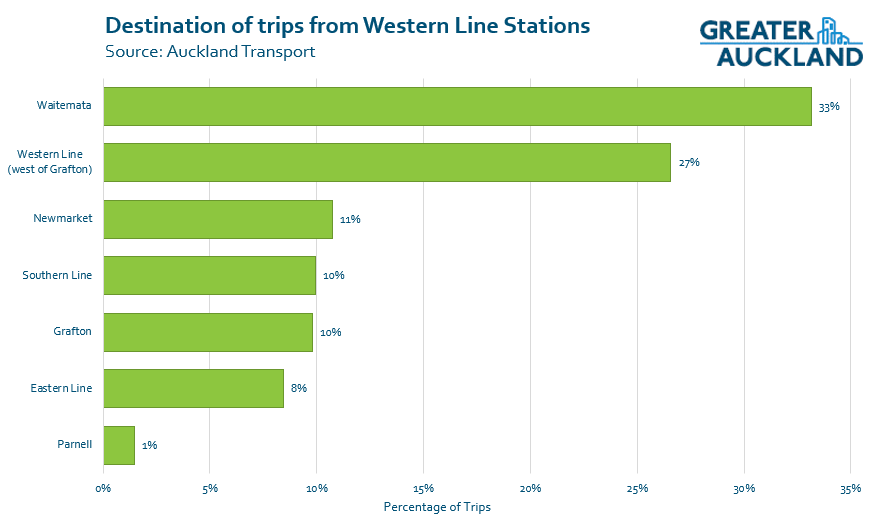
The numbers might be slightly different at peak times but as you can see, about a third of all boardings are heading to Waitematā, with over a quarter heading to another station along the Western Line.
Trips to Grafton and Newmarket account for just over 20% of all boardings. Notably, that’s off-set by the just over 8% of people who would directly benefit from the currently proposed CRL service pattern.
Interestingly, Grafton and Waitematā also have the largest (and near identical) discrepancies in the number of people boarding and alighting, i.e. how many people get on trains vs how many get off.
This is due to something we call ‘downhilling‘ – where people (most likely students) are getting off at Grafton and catching a bus down to Uni, then at the end of the day, continuing downhill – walking, scooting – to catch a train home from Waitematā. I suspect there are a lot of trips currently using Grafton that will likely be replaced by travelling to Karanga-a-Hape and Te Wai Horotiu and a short walk or sometimes a bus.
With the changes noted earlier in the post, the CRL will significantly change demand on the Western Line. For example, currently public transport use from the west to around Midtown (the Civic, Aotea Square) and the Karangahape Rd ridge is lower than it is around Waitematā. Clearly, the CRL will change that by creating direct access to both of these zones.
It would not be unreasonable to expect that over the short to medium term, that overall ridership via the Western line would double. I’m not sure what the modelling is predicting, but let’s assume that within that doubling of usage, those non-central-city trips increase by about a third – a not insignificant number.
The percentage of trips to Grafton and Newmarket would therefore drop – and even if you included the inner-Southern line stations like Ellerslie, overall that will make up likely less than 20% of all trips. That’s because it would mean trips to the city would increase from about a third now to well over half of all trips.
Notably, currently about 54% of boardings on the Southern and Eastern lines are destined for Waitematā – though you’d expect their share of trips to the city centre to also increase.
The point of all of this is that while it may seem like a lot of people are going to Grafton and Newmarket today, once the CRL opens, a lot more will be wanting to travel to the city centre.
The question then becomes, is it worth diverting some trains to service what might be 10-20% of trips?
At 10-20% of trips that’s maybe two trains per hour.
Would it actually be any faster, anyway?
A key feature of Auckland’s public transport network development over the last decade or so has been the focus on making much of our PT network frequent enough that it becomes “turn-up-and-go”, meaning there’s no need to remember a timetable. That’s really important for making public transport easier for people to use.
To start to answer our question: in terms of time spent on the move, of course a direct service from Western Line stations to Grafton and Newmarket will always be faster than one that requires a transfer at Karanga-a-Hape.
Based on existing timetables and planned frequencies, the alternative – a train from Maungawhau to Karanga-a-Hape, then transferring to another train to Grafton – would take between 3 and 10 minutes longer than a one-seat ride to Grafton. On average this is likely to be about an extra seven minutes of travel time compared to a direct service.
But with perhaps just two trains an hour running the direct route – so, one every 30 minutes – what option is actually faster for your overall journey time?
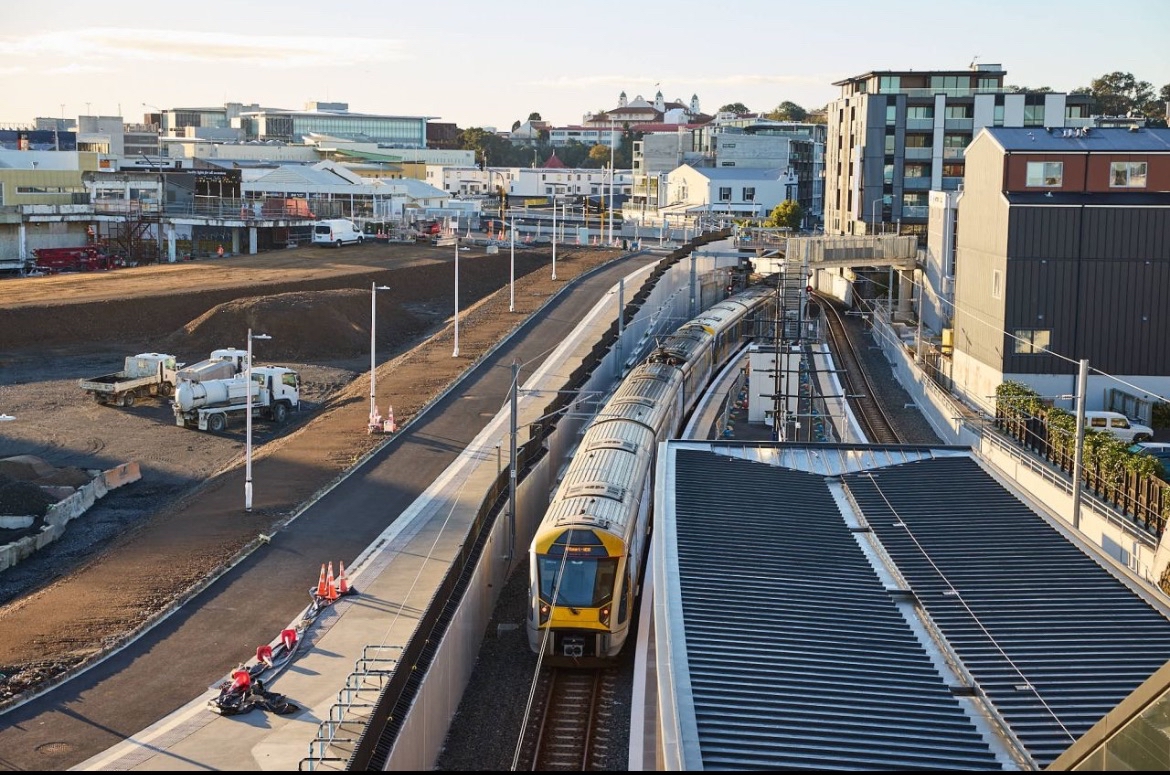
One of the cross passages between platforms at Karanga-a-Hape, showing access to the escalators up to Beresford Square
To answer this question, I built a little model to compare the two options: direct journey vs transfer at Karanga-a-Hape. The model assumes someone just turns up at a station hoping to go to Grafton or Newmarket, and wants to know: which option gets them there faster?
Even in the worst case scenario – you catch a train to Karanga-a-Hape intending to transfer, then discover you’ve just missed a train heading to Grafton, leaving you a 7 minute wait for the next one – still, for 60% of the time the transfer will be a faster option than the less frequent direct service.
If, on the other hand, you’re lucky with timing – you step out of your first train, stroll across the platform, and your next train turns up within a minute – then the transfer journey will be the faster option 83% of the time.
Remember too, Karanga-a-Hape offers a short, all-weather, level, cross-platform transfer. The easiest of all transfers.
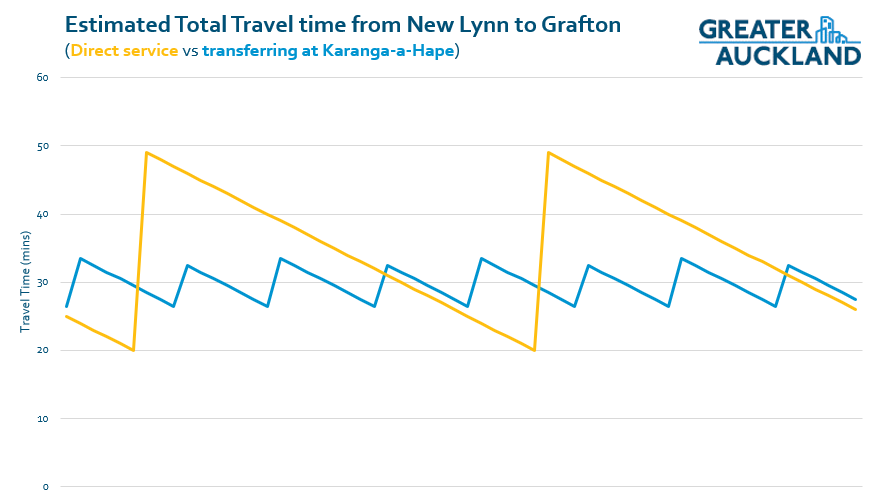
Focusing in on travel times like this is also why options like the loop pattern won’t work in this situation like ours. The loop is big, so people travelling to the far side of the loop have to go the long way around – which again would be slower than just transferring. And attempts to answer that by alternating trip directions around the loop to give every destination a one-seat ride would not only makes the network much more confusing to operate and to use, but would halve frequency for everyone.
Frequency is freedom: provide enough of it, on a regular and legible pattern, and people will transfer – because overall their journeys will be quicker, easier, and more predictable.
No one likes a (slightly) longer journey but mastering the option of the Karanga-a-Hape transfer seems like a pretty decent trade-off for 10-20% of travels, given the wider benefits of CRL for everyone.
And furthermore, as frequencies go up, the transfer option becomes even more likely to be the faster option every time.
Greater Auckland’s work is made possible by generous donations from our readers and fans. We’re now a registered charity, so your donations are tax-deductible. If you’d like to support our work you can join our circle of supporters here.
Share this