
“As a New Zealander, I have seen how growers and producers seem to work the hardest and get paid the least. The current supply chain is asymmetric in favour of retailers. That’s largely an information and data problem. I believe we can address this for the benefit of everyone – and especially growers” – Blomfield.
The second is an envisioned “Bloomberg terminal” for fruit selling r what Blomfield says will be an online trading market, fuelled by artificial intelligence (AI) data from his company’s systems, which will “move the balance of power back to fruit producers”.
He says it will provide fully-fleshed-out data (so to speak) for the $1.7 trillion fresh produce market for the first time.
“As a New Zealander, I have seen how growers and producers seem to work the hardest and get paid the least. The current supply chain is asymmetric in favour of retailers. That’s largely an information and data problem. I believe we can address this for the benefit of everyone – and especially growers,” Blomfield says.
Blomfield says revenue increased by 100% last year as his company grew its business in fruit-producing regions, including North America, Europe, and Latin America as his firm collected data on 17 billion apples and 37 billion cherries.
He won’t say off what base the increase was achieved, but his company’s outlook saw its original Series A target of $10m over-subscribed.
Hectre’s packer dashboard.
“Customers are really buying it. The operations manager at a large US fruit packer told us that Hectre sounded so good it must be ‘bulls***’. He now loves it.”
Hectre still makes its original product, software for running orchards, including payroll and timesheets, but Blomfield sees fruit-quality scanning and the trading market as the key growth areas.
His firm currently has 40 staff, with around 95% of its business offshore.
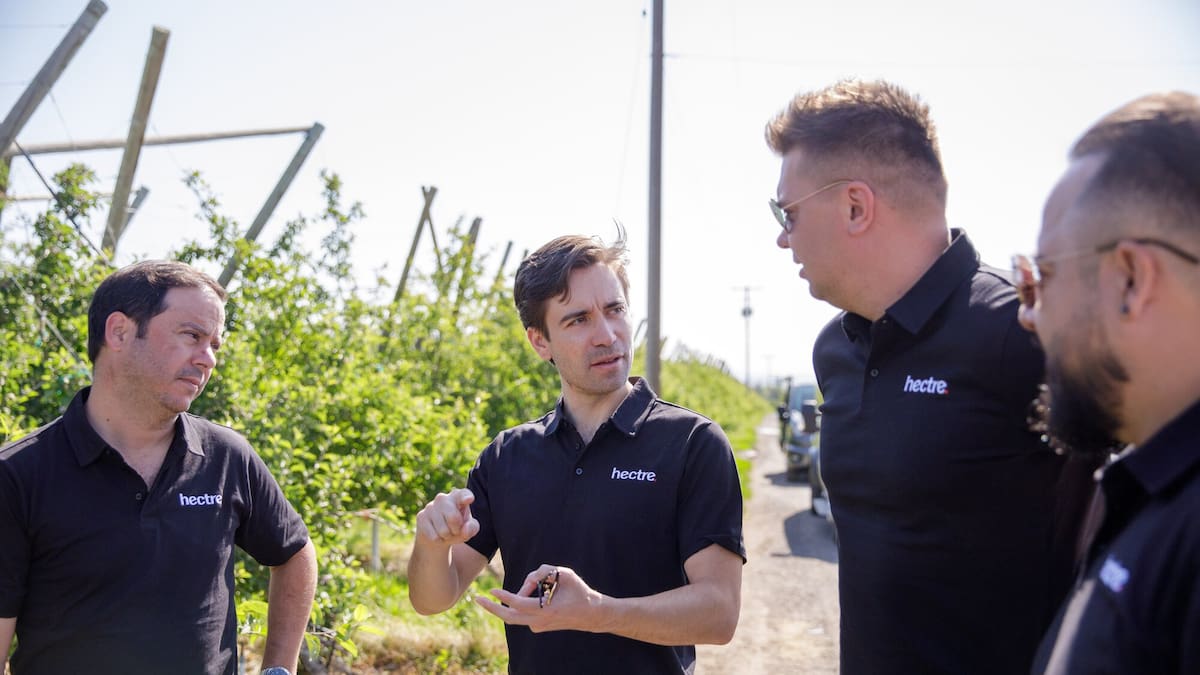
Hectre co-founder and chief executive Matty Blomfield (centre) with his sales team in Berlin for Fruit Logistica 2026.
Customers across 22 countries include Borton Fruit in Washington State in the US (also a 9% shareholder in Hectre), Spain’s Verfrut and Italy’s VOG.
While there are many automated grading systems for inside packhouses, Blomfield says Hectre’s point of difference is that its Arc system can scan fruit in trucks as it arrives, saving time, money and emissions as it reduces spoilage and repacking rates.
Results can be seen in a live software dashboard.
A staffer works on Hectre’s Arc overhead scanner.
An upgrade for external defects is on the table for this year, with a system that will reveal internal defects and internal maturity is also in the works.
The co-founder says Hectre is not an original equipment manufacturer. It uses third-party “hyperspectral imaging and sensing equipment” as it focuses on its software and machine learning (a branch of AI) – but the hardware and software is bundled and sold as a single solution.
‘Golden visas’ underpin Hector’s raise
Punakaiki Fund partner Nadine Hill said her firm had seen a steady inflow of funds from high-net-worth individuals gaining residency to New Zealand under the Active Investor Plus (AIP) or “golden visa” scheme introduced in April last year.
The AIP scheme lowered investment thresholds and removed an English-speaking requirement.
AIP centres on two categories, one for those willing to put at least $5m into “growth” investments such as venture capital, the other for $10m in “balanced” investments.
Immigration NZ updates golden visa numbers
In a January 23, 2026 update, Immigration New Zealand said there have now been 532 applications.
So far, 392 have been approved in principle (324 in “growth” and 68 in “balanced”), representing “a potential total minimum investment of $3.16 billion”.
As of January 19, 2026, 159 applications have been granted resident visas, 34 in the balanced category and 125 in the growth category.
The total committed investment from these applications amounts to $926.2m into New Zealand’s economy, Immigration New Zealand says.
The majority of the investments to date have been into Invest New Zealand approved managed funds, and bonds.
The US (201 applications) has been easily the biggest source of applicants, followed by China (86), Germany (86), Hong Kong (69) and Singapore and Taiwan (both 26).
There are signs the golden visas have helped boost the local venture capital scene after its post-Covid lull.
Last year saw a 38.7% increase in angel investment – usually high net worth individuals investing in early-stage companies.
Icehouse Ventures recently credited the AIP scheme as one of the factors behind its recent record-settiing $70m raise for its Seed Fund IV.
Chris Keall is an Auckland-based member of the Herald’s business team. He joined the Herald in 2018 and is the technology editor and a senior business writer.