
Microbes could be the future space miners, helping humans survive on long-term missions by extracting mineral resources from extraterrestrial rocks.
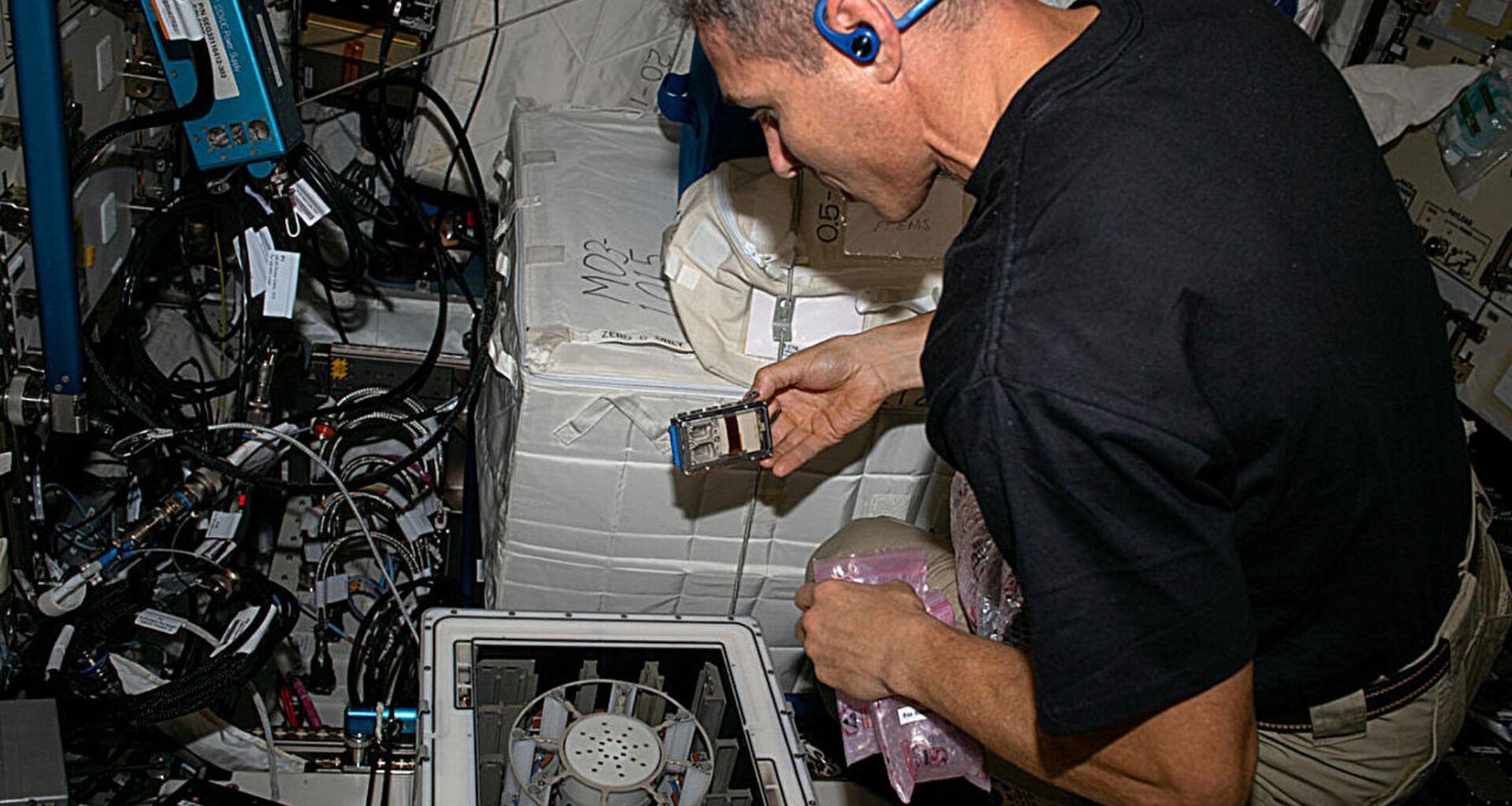
Researchers from Cornell, US, and the University of Edinburgh, UK, sent microbes to the International Space Station (ISS) to see how they interact with meteorite material in microgravity.
The microscopic crew consisted of the fungus Penicillium simplicissimum and the bacterium Sphingomonas desiccabilis.
NASA astronaut Michael Scott Hopkins tested how well these organisms could extract precious platinum-group metals from rocks in zero gravity.
“This is probably the first experiment of its kind on the International Space Station on meteorite,” stated Rosa Santomartino, the lead author, on February 11.
“We wanted to keep the approach tailored in a way, but also generally to increase its impact. These are two completely different species, and they will extract different things. So we wanted to understand how and what, but keep the results relevant for a broader perspective, because not much is known about the mechanisms that influence microbial behavior in space,” Santomartino explained.
Biomining precious elements
If humans are ever to build cities on the Moon, Mars, or even fuel stations on distant asteroids, we have a huge weight problem.
Every kilogram of metal or machinery launched from Earth costs a fortune.
But the new experiment showcases that “biomining” microbes could help solve the problem of heavy equipment load in spacecraft.
Microbes can act as miners because they secrete carboxylic acids, carbon-based molecules that bind to minerals through a process called complexation. This process helps unlock essential minerals from the rock.
The ISS experiment’s goal was to determine which elements these microbes could extract from L-chondrite asteroidal material.
The results showed that while standard chemical leaching struggled without gravity to move fluids, the microbes didn’t blink. These microbes stayed consistent.
Even better, the fungus actually thrived, ramping up its metabolism to pull even more palladium out of meteorite samples than it does on Earth.
Palladium is a powerhouse in the platinum group. Previous studies have shown that it serves as a master catalyst for life-support systems and a “hydrogen sponge,” capable of absorbing 900 times its own volume for use in deep-space fuel cells.
Moreover, its extreme durability and resistance to heat and corrosion make it an essential material for the punishing conditions of rocket engines and advanced electronics alike.
Microbes outperform chemicals
Interestingly, space conditions triggered a metabolic shift in the fungus, causing it to ramp up the production of carboxylic acids and improve its extraction of palladium and platinum.
While standard chemical leaching (without microbes) performed worse in microgravity than on Earth, the microbes maintained consistent extraction levels regardless of gravity.
The team analyzed 44 elements and found no single universal reaction to space; instead, microbial metabolism changed in distinct, element-specific ways.
“And this is not just true for the palladium, but for different types of metals, although not all of them. Indeed, another complex but very interesting result, I think, is the fact that the extraction rate changes a lot depending on the metal that you are considering, and also depending on the microbe and the gravity condition,” Santomartino said.
The findings could also benefit Earth, potentially advancing how we recover rare minerals from mine waste and resource-poor environments to fuel a circular economy.
The results were published in the journal npj Microgravity on January 30, 2026.