
Those scars linger for a squad that boast a pack to go toe-to-toe with anyone – and a lethal backline featuring rapid finisher Kyren Taumoefolau, having snaffled his talent from Moana Pasifika.
Any team with Damian McKenzie, Quinn Tupaea, Tupou Vaa’i, Samisoni Taukei’aho, Wallace Sititi, Leroy Cater, Emoni Narawa and Luke Jacobson demands respect.
Wallace Sititi has been a powerful force for the Chiefs. Photo / Photosport
Crusaders: A new home
Next in line we have the ever-present Crusaders. Workhorse openside Tom Christie has departed to Newcastle but if he can stay fit – which is a big if – Ethan Blackadder will fill the void he leaves.
James O’Connor’s exit strips experience from the playmaking ranks but the Crusaders will back Rivez Reihana and Taha Kemara to continually mature.
Leicester Fainga’anuku is a huge, hulking in. He starts on the left wing in the Crusaders’ first squad of the year – that contains 13 All Blacks – but Fainga’anuku will feature in the midfield and could spend time in the loose forwards, after switching there during his two years in France.
“Having Leicester back … he’s played midfield, he’s played loose forward so you could be in for a bit of a surprise there,” All Blacks hooker Codie Taylor hinted.
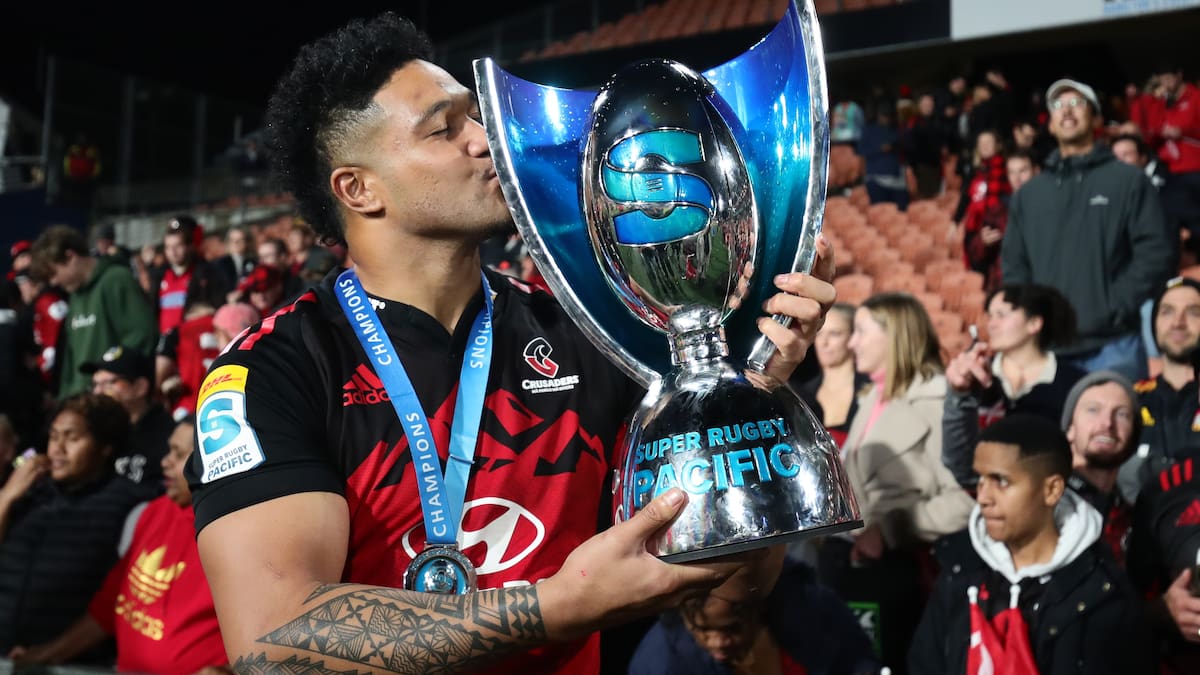
David Havili proved an inspired choice as captain last season as the Crusaders rectified missing the playoffs for the first time in nine years to reclaim the title.
With Scott Barrett missing the regular season due to a contractual rest, Havili, Taylor and Will Jordan will be focal leadership figures.
The big unknown for the Crusaders is how the new stadium could affect their finals push.
All teams loathed travelling to Christchurch in the winter elements. This year, though, from late April, the Crusaders will embrace their shiny new roofed arena.
While the pristine venue promises to provide a welcome haven for spectators, visiting teams will harness renewed confidence attacking the Crusaders’ remarkable 30-0 finals record in Christchurch.
“Apollo Projects Stadium was great for us as a team. It was a place that brought the city together after such a tragic event,” Taylor said. “It’s been a long time coming to have something new. To bring that mana to a new stadium is going to be pretty cool.
“The mindset of most teams now is going to be a bit different coming to Christchurch. The roof is going to be fast-paced footy but we can’t wait to get in there.
“The Crusaders pride themselves on being able to deal with and apply pressure. We’ve got a DNA around how we want to play; we just might have to be a bit more accurate in the new stadium.”
Hurricanes: Storm brewing
Nestled behind the Chiefs and Crusaders, the Hurricanes are dark-horse contenders.
Throughout Super Rugby’s 30-year history, the Hurricanes are well adept at failing to meet expectations. Three quarter-final losses in four years speaks to their recent business end battles.
But if the Canes can keep the influential Cam Roigard and Jordie Barrett fit, they possess a coaching staff and roster to challenge anyone.
Laidlaw’s coaching team – that already features the well-regarded Cory Jane, Jamie Mackintosh and All Blacks lineout expert Bryn Evans – is further strengthened by Jason Holland’s return from national duties.
Historically, the Hurricanes tight five has been exposed but with three All Blacks tightheads – Tyrel Lomax, Pasilio Tosi and Tevita Mafileo – as well as the hulking prop Siale Lauaki, and powerhouse hooker Asafo Aumua returning from injury, there are no excuses in that department.
New Zealand-born Japanese lock Warner Dearns is another notable inclusion.
While Du’Plessis Kirifi will miss the start of the season through injury, the loose forwards are typically stacked, with Peter Lakai, Devan Flanders and Brayden Iose dynamic athletes.
Losing Harry Godfrey to a season-ending ACL is a blow but the Hurricanes are clear in their vision for Ruben Love and Brett Cameron to run the cutter.
Barrett’s return from his successful one-season stint with Leinster drastically improves the Hurricanes’ title claims, too, with his experience, backline guidance and physicality sorely missed last season.
While Barrett will rekindle his midfield partnership with Billy Proctor, second five-eighths Riley Higgins’ presence is expected to push the All Blacks vice-captain to fullback at times this year.
Hurricanes midfielder Billy Proctor. Photo / Photosport.
Sevens convert Fehi Fineanganofo has impressed on the edge, Josh Moorby’s return from France adds valuable versatility and Kini Naholo, when he returns from injury, will inject his power finishing.
“We’ve got a good roster this year, plenty of experience and a couple of boys coming back from overseas. It’s an exciting group,” Kirifi said. “If we can put everyone on the park and play the brand of rugby we know we can [then we can] build the momentum through the season.
“A title is long overdue, but everyone is getting better and it’s a hard competition to win.”
Blues: Team on song?
There’s plenty to unpack with the Blues too.
How will Vern Cotter’s looming departure impact their campaign?
A breakthrough title in Cotter’s first year at the helm was followed by last year’s semi-final defeat in Christchurch.
Departing coaches can have a distracting or galvanising effect. Which one will it be for the Blues, and how much will they evolve their largely combative, direct game plan?
Rieko Ioane’s sabbatical paves the way for A.J. Lam and Pita Ahki, following his return from seven years in France, to team up in the midfield.
Stephen Perofeta and Dalton Papali’i have points to prove – Perofeta after his prolonged injury absence, Papali’i after last year’s All Blacks snub. And Hoskins Sotutu should be highly motivated in his final year before joining Newcastle.
Caleb Clarke seems primed to enhance his status as New Zealand’s premier wing. Patrick Tuipulotu (round nine, shoulder) and Beauden Barrett (round four, rest) will miss the start of the season but Sam Darry’s return – after missing all last season – will add a towering returning lineout target.
Highlanders: Southern sting
Elsewhere, the Highlanders, last year’s wooden spooners, are set for another testing campaign after losing future All Blacks halfback Dylan Pledger and World Breakthrough Player of the Year Fabian Holland to season-ending setbacks.
Jamie Joseph’s audition for the All Blacks head coach role also hovers as a major distraction.
While Timoci Tavatavanawai’s return from injury and outside backs Jacob Ratumaitavuki-Kneepkens and Caleb Tangitau evoke hope, the Highlanders desperately need Josh Jacomb’s arrival next year and for a fairer share of talent to be imposed on their New Zealand rivals, through some form of draft system, to be consistently competitive.
Moana Pasifika: The Ardie-shaped hole
Moana Pasifika seek to continue their progression from one win in 2022 to their stirring rise to the cusp of the top six last year.
Upsetting the Crusaders and Blues typified Moana’s drastic improvement last year.
While Moana’s atmosphere remains unmatched, filling their inspirational Ardie Savea-sized hole won’t be easy – and dark financial clouds remain off the field too.
Ardie Savea was a totemic figure with Moana Pasifika last year. Photo / Photosport
Offshore challengers
For all the Fijian Drua’s vibrancy in Suva and Lautoka, where they have won 15 of 22 games, until they rectify their dire three road wins in four years, they will remain out of contention.
The Australian teams collectively rising to consistently challenge is the narrative Super Rugby Pacific must shift.
Every engaging competition has genuine jeopardy at its core. The needle started to move in the right direction last year but, by the end of the season, it was an all-too-familiar theme, the Western Force finishing outside the playoffs for a fourth straight season before the Queensland Reds were blown away in the quarter-finals and the ACT Brumbies no match for the Chiefs in their semi.
The New South Wales Waratahs have recruited strongly to bolster a squad that includes Joseph-Aukuso Sua’ali’i and Max Jorgensen.
The Tahs should, on paper, join the Reds and Brumbies as threats but winning on New Zealand shores remains Australia’s collective litmus test. The Force have former All Black George Bridge and Argentinian hooker Leonel Oviedo but the fact they are the one team not appearing at Super Round points to their contender status.
Fifteen years after the Reds claimed the crown as the last Australian champions, Super Rugby Pacific chief executive Jack Measley made no secret of his desire to witness a changing of the guard.
“As an administrator, I’d love a different winner every year,” Measley said. “There’s some big marketplaces in Australia that would help us all if we unlock them so it would be great to see the Waratahs go really well, selfishly, because there’s so many eyeballs in Sydney.
“It was great last year to see the Aussie teams do better; to see Moana win against opposition for the first time and the Brumbies win in Auckland for the first time in 12 years. We hope for more of that.”
Mark the Hurricanes down as this year’s potential big movers but Super Rugby Pacific’s inherent issue is there are four teams capable of winning this competition – and another Chiefs-Crusaders final is odds-on.
Liam Napier is a Senior Sports Journalist and Rugby Correspondent for the New Zealand Herald. He is a co-host of the Rugby Direct podcast.