
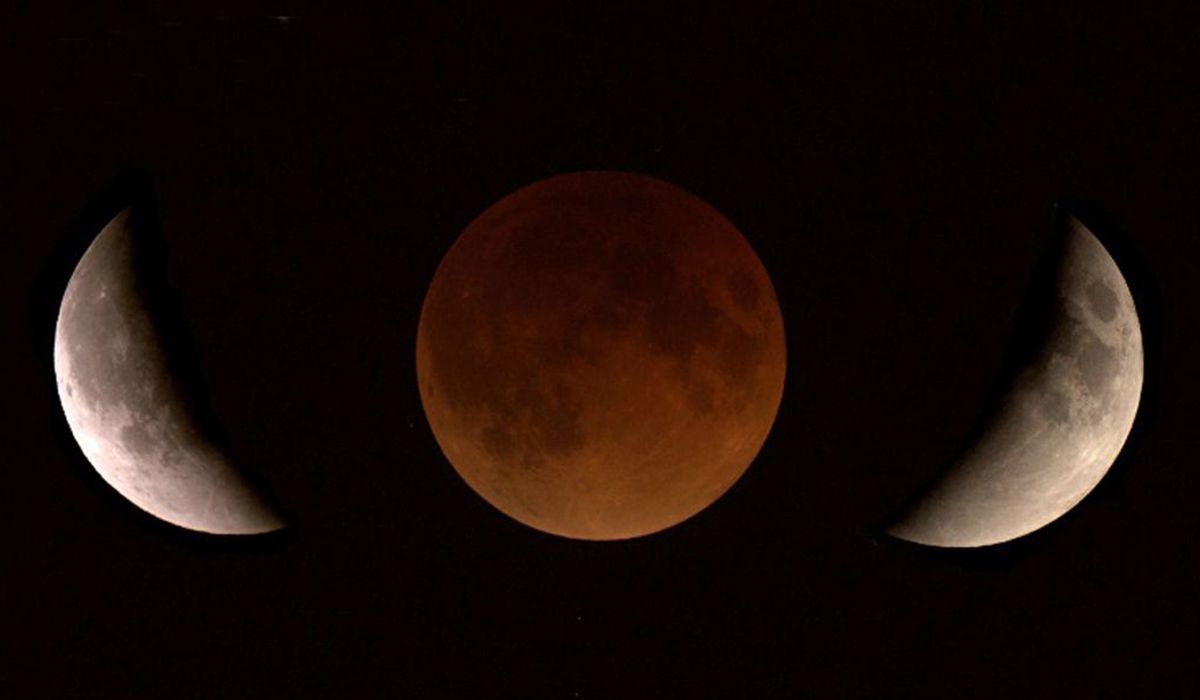
3. What Is Visible During a Lunar Eclipse?
As the shadow of the Earth covers the Moon, note that our natural satellite doesn’t become completely dark. Some of the sunlight bent by the Earth’s atmosphere still reaches the shadowed Moon and gives it a dull brown or reddish glow. The exact color of the glow and its darkness depend in part on the “sooty-ness” of our atmosphere – how recently volcanoes have erupted, plus how much cloud cover,storm activity, fire smoke, and human pollution there is around the globe. Once the Moon is eclipsed, the stars in the sky should become easier to see. Note that in the eastern parts of the country the eclipsed Moon will be low in the western sky, and may be hard to see if you have hills or buildings on the horizon.
4. Is It Safe to Watch, and How Do I Watch?
Since the Moon is safe to look at, and eclipses make the Moon darker, there’s no danger in watching the eclipse with your eyes, binoculars, or a telescope. And lunar eclipses don’t require you to go to a dark location. Bring binoculars to see the Moon larger, but just your eyes are fine. Be sure to bundle up against the cold night and to take someone along with whom you like to spend time in the dark!
5. What Can I Tell My Kids (or Grandkids)?
Suggest that they take a careful look at the shadow of the Earth as it moves across the bright face of the Moon. What shape is it? The round shape of the Earth’s shadow during such eclipses suggested to the ancient Greeks, more than 2000 years ago, that the Earth’s shape must be round like a ball. Eclipse after eclipse, they saw that the Earth cast a round shadow, and deduced that we lived on a ball-shaped planet (long before we had pictures of it from space).