
A supermassive black hole may have been caught in the act of fleeing its galaxy, carving a 200,000-light-year trail of newborn stars behind it. The observation provides some of the strongest evidence yet that gravitational-wave recoil can eject black holes from their cosmic homes.
For years, astrophysicists have theorized that when two supermassive black holes merge, the resulting object can be launched away at tremendous speed. The mechanism is rooted in Albert Einstein’s theory of general relativity: if the emitted gravitational waves are uneven, the merged black hole receives a powerful kick.
A Gravitational-wave Kick Strong Enough To Expel A Giant
When galaxies collide, their central black holes eventually spiral together and merge. In that final dance, they radiate energy as gravitational waves. If that radiation is emitted more strongly in one direction, momentum conservation dictates that the newly formed black hole recoils the opposite way.
According to ScienceAlert, this recoil can be strong enough to eject the black hole entirely from its host galaxy. The object identified in the recent observations appears to fit that scenario, displaced from the galactic center and moving at extreme velocity.
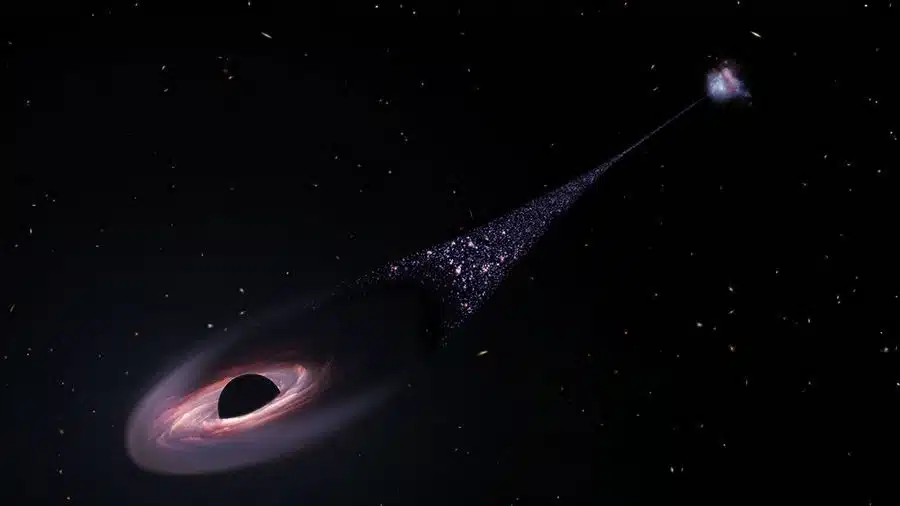 Artist’s impression of a runaway supermassive black hole flung from its host galaxy. Credit: NASA, ESA, Leah Hustak (STScI)
Researchers estimate its speed at roughly 1,600 kilometers per second. At that rate, escape from the galaxy’s gravitational grip becomes plausible rather than hypothetical.
A 200,000-light-year Ribbon Of Star Formation
What sets this candidate apart is the extraordinary structure trailing behind it. A luminous, narrow feature stretches approximately 200,000 light-years, longer than the diameter of the Milky Way.
As outlined in the same article, astronomers interpret this structure as a wake of star formation triggered by the black hole’s passage. As it barrels through surrounding gas, it compresses material ahead of it, igniting the birth of new stars. At the leading tip of the trail sits a compact, bright source consistent with an actively feeding the supermassive object.
The geometry of the system aligns with predictions from earlier models. Rather than a random streak, the trail appears coherent and directional, as though marking a clear escape route.
Why Galactic Centers Look Different Now
Supermassive black holes are usually found at the centers of large galaxies, where they regulate gas dynamics and influence star formation. A sudden ejection would leave the host galaxy without its central gravitational engine.
ScienceAlert noted that confirming more cases like this could refine our understanding of how often such recoil events occur and how they affect galactic evolution. Future gravitational-wave missions, including the planned Laser Interferometer Space Antenna (LISA), are expected to detect mergers of supermassive cosmic voids directly.