
Photo: Supplied / New Zealand Medical Journal
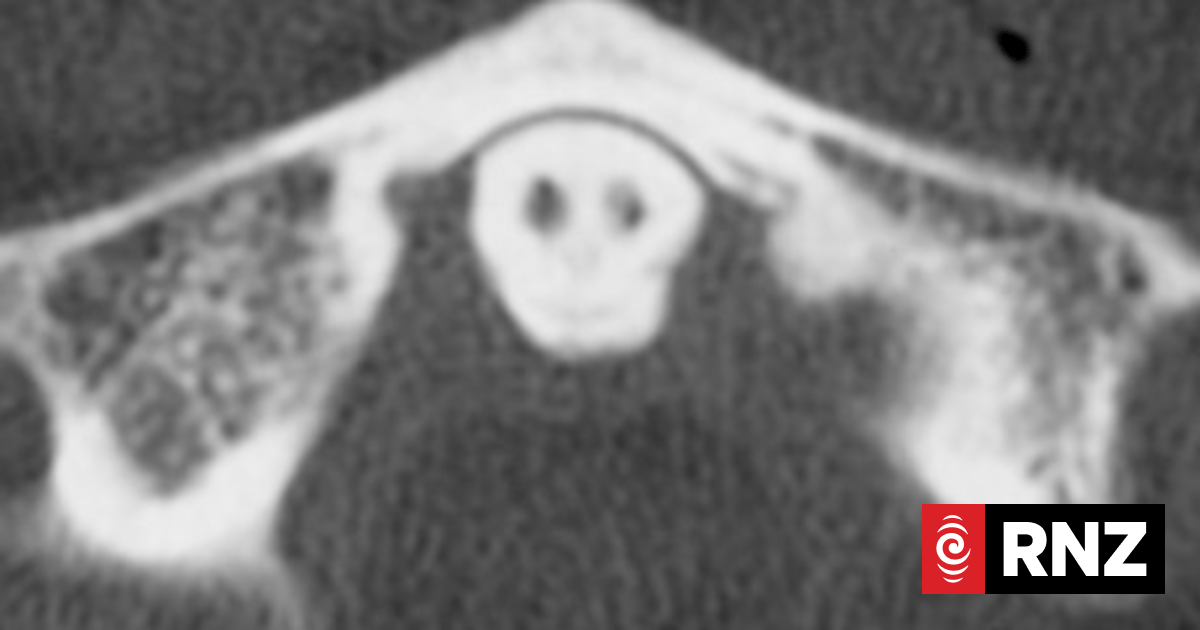
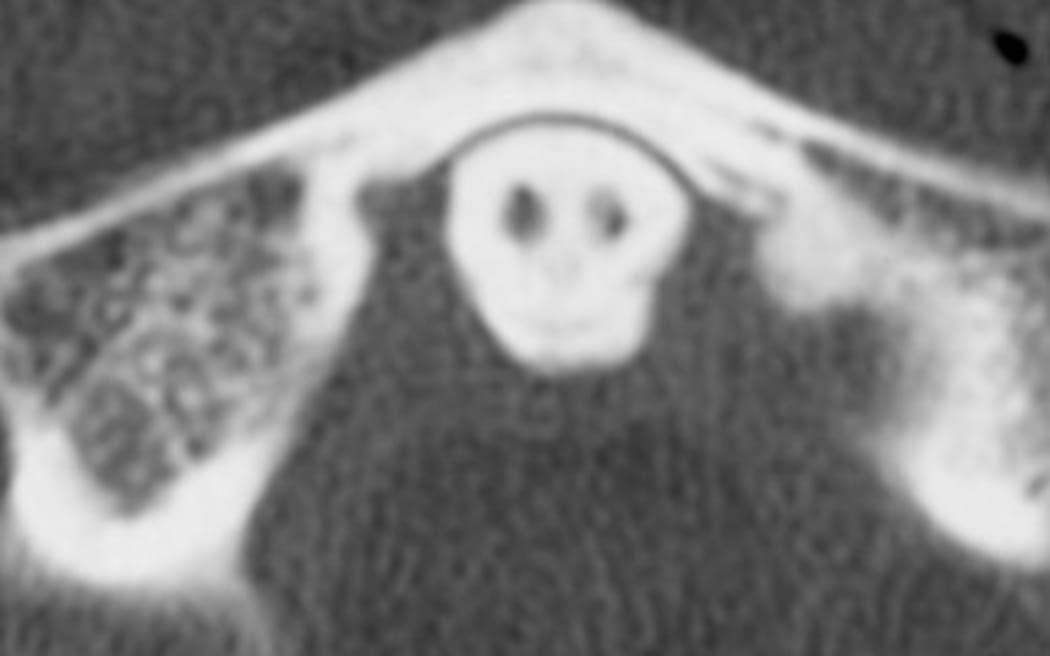
A spooky image described a “grim reaper” has shown up in a medical scan of someone who’d just been in a car accident.
The person was actually unharmed, but the New Zealand Medical Journal has highlighted the case an an example of pareidolia.
That was the tendency of humans to see faces or figures in objects.
The image in the journal was from a radiograph of the atlas bone of the neck.
It looked like a skull surrounded by a black hood although, on closer inspection, it could also be perceived as a friendly skeleton.
The report, by Stephen Rowlands, said the tendency to spot faces in objects was evolutionarily advantageous but the interpretations could sometimes be humorous or eerie.

Photo: Supplied / New Zealand Medical Journal
“Cases of pareidolia in medicine are rare but not unprecedented, with reported examples including the Star Wars “Baby Yoda” character being seen in sacral magnetic resonance imaging and computed tomography scans,” it said.
The image was in fact created by a cluster of cysts in the neck.
Even though the patient was not seriously injured, the cysts could make them more susceptible to a neck injury.
The image was a good chance to reinforce anatomical knowledge but also to show the “cognitive pitfalls” that could come with radiology, the report said.
“Awareness of pareidolia is important for radiologists and clinicians alike, as it underscores the influence of subconscious visual biases on image.”
A University of Sydney study in 2021 concluded being good at spotting faces was part of human evolution – and that was why they tended to see them in objects.
Facial recognition happened in a few hundred milliseconds.
It was beneficial to be able to spot and assess a face quickly and the benefit of never missing a face outweighed sometimes getting it wrong, the study found.
Social media is full of examples of faces in gherkins or trees or power sockets and more.
More than 20 years ago a Florida woman made headlines when she sold a cheese sandwich for US$28,000 because it looked like an image of the Virgin Mary.
Sign up for Ngā Pitopito Kōrero, a daily newsletter curated by our editors and delivered straight to your inbox every weekday.