
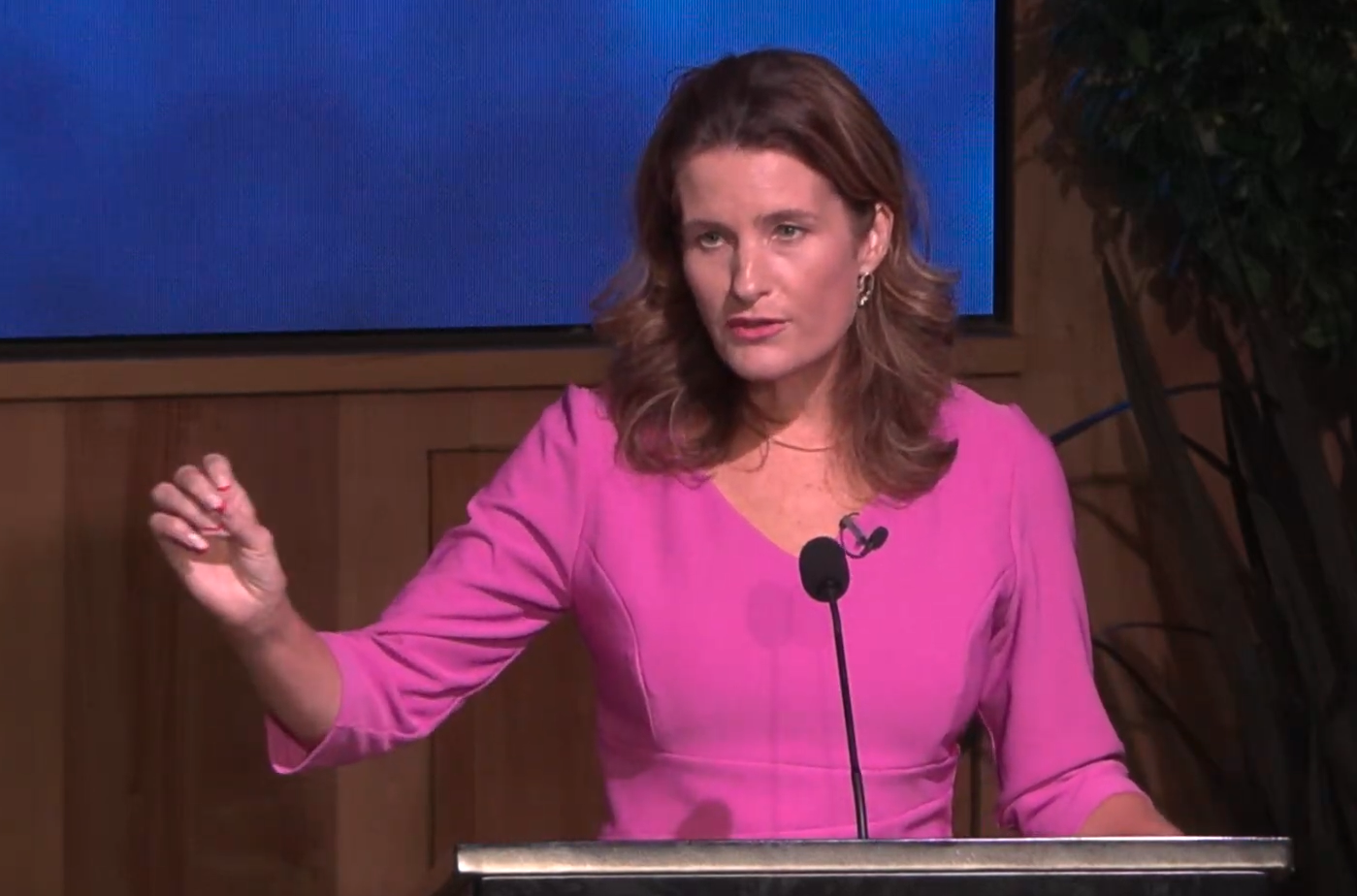
A sense of impatience ran through the first day of the New Zealand Economics Forum, as business leaders, economists and politicians alike voiced frustration over sluggish recovery and a lack of long-term vision.
Opening the event at the University of Waikato Management School, Finance Minister Nicola Willis outlined new data on the Government’s Investment Boost policy before saying it would only reach its full potential with bipartisan consensus.
“Firms do not invest in long-lived capital such as plants, machinery, buildings, if they think the tax rules may change at the change of an election,” Willis said.
“So my question today to Mr Hipkins and his colleague Barbara Edmonds is pretty straightforward, will they commit to retaining Investment Boost as a permanent fixture of our tax settings to unlock growth, or will it be sacrificed to fund higher spending?”
Confidence boost needed
Kiwibank chief economist Jarrod Kerr, speaking on a panel covering the state of the world economy and New Zealand’s macroeconomic choices, said New Zealand as a nation needed to develop a longer-term mindset around investment.
As for business investment, however, he believed a lack of spending was simply due to companies not having the capacity.
“When we look at our customers, and how many are taking on this Investment Boost, it’s actually very low at the moment, because confidence is low. That investment boost will work, and it will work into next year, as confidence lifts and more and more businesses actually look to invest.”
‘The thing that frustrates me at the moment is the short term political cycle combined with policy inertia. The demographic shape of this country should not come as a surprise.’
Professor Paul Spoonley, Massey University
Willis’ Investment Boost policy, introduced in Budget 2025, allows businesses to deduct an extra 20 percent of a new asset’s value from their taxable income in the first year, ahead of the asset’s depreciation.
Highlighting its early results, Willis said that of firms that invested in new assets and were aware of the scheme, 40 percent reported increased spending over the past year.
Labour’s spokesperson for finance Barbara Edmonds had her own frustrations when quizzed by the media on her response to Willis’ challenge after her own keynote speech.
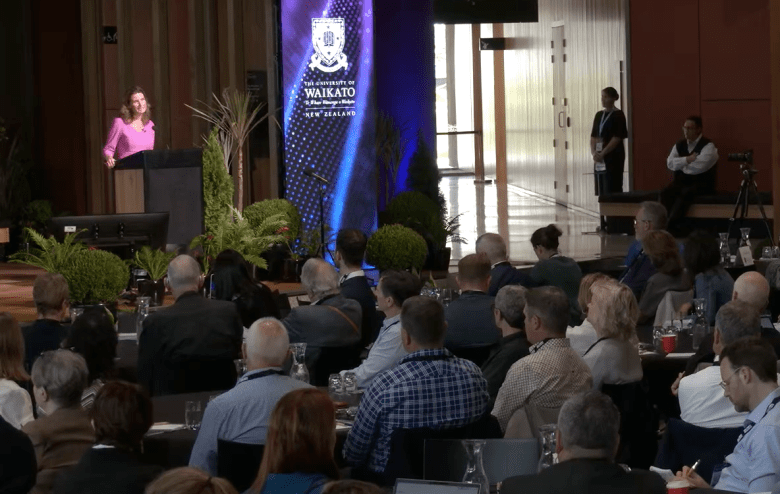 Finance Minister Nicola Willis issued a challenge to Labour to stick with her flagship Investment Boost policy. Photo: Supplied
Labour would make its decision “based on evidence” – which it had not yet had an opportunity to digest, she said.
“Quite cynically, [Willis] released some survey information this morning, despite us asking her just last week around what numbers she had… and then she issued the challenge to me.”
Asked about Willis’ assertion that businesses are holding off investing because they believe a Labour government could scrap the policy, Edmonds’ response added to the broader sense of political frustration woven through the day.
“The contradiction is that she is also saying that they are spending money,” she said.
“So I don’t know which one it is.”
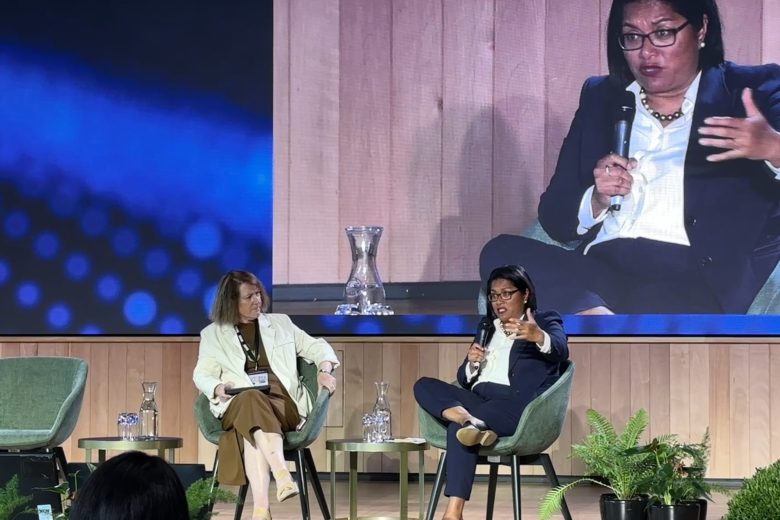 Labour’s finance spokesperson Barbara Edmonds reiterated her party’s plans to instate a capital gains tax should they return to power following the General Election. Photo: Alice Peacock
A report prepared by Treasury officials for Willis in October said: “Investment Boost added momentum to our [Budget] forecasts of business investment…
“The vast majority of firms we have spoken to have, however, noted that Investment Boost is not changing their investment intentions. This may in part reflect the current position in the economic cycle.”
Planning lags demographic changes
New Zealand’s lagging economy was credited as both a cause and symptom of a slowdown in net migration in a panel on ‘The Demographic Tipping Point’.
In the year ending November 121,900 Kiwis left the country, latest Stats NZ figures show, with the 132,600 arrivals resulting in a relatively slim net gain of 10,700. This is compared with a gain of 29,000 in the year to November 2024.
Sociologist Paul Spoonley spoke of the need for a long-term demographic plan to support economic planning: “The thing that frustrates me at the moment is the short term political cycle combined with policy inertia.
‘I find it quite frustrating, the 65 to 67 discussion. I think it’s slightly rhetorical, because we can’t afford either. Treasury is very clear, unless it goes like 72 or 73 we can’t afford it.’
Blair Turnbull, Milford Asset Management
“The demographic shape of this country should not come as a surprise, leaving aside some of the volatility around immigration, the shape of this country, in terms of age, where people live, and so on, we know now.
“The issue for me is that we don’t put all the elements together.”
Spoonley referred to education and training systems that mirror the nation’s future needs, cultural transition programmes for immigrants and mechanisms to distribute immigrants around the provinces, as areas in need of attention.
“It’s really the ability to put all of those elements together to depoliticise some of the debates, and think: ‘what is it that we need to do in terms of anticipating this new demography that epitomizes the new New Zealand?’”
Super ‘unaffordable at 67 too’
Change was the word on everyone’s lips when it came to the panel discussion ‘Superannuation and the Silver Tsunami’ – though it was clear the political hot potato has long passed the point of an easy fix.
ANZ chief economist Sharon Zollner said the cost of the pension scheme sat at 5 percent currently. Under current settings it is forecast to reach 8 percent of GDP over the next 40 years.
“That’s obviously a lot of money we’re not spending on something else, but it’s also part of a bigger problem. In particular, the healthcare costs are a huge part of the story as well,” she said.
Superannuation gets a lot of air time relative to other retirement settings, she said, because it is “clearly a policy choice… we could actually do something about”.
Milford Asset Management chief executive Blair Turnbull said what can and should be done to give the scheme longevity was less clear cut than what was suggested in coverage and conversations on the topic.
“I find it quite frustrating, the 65 to 67 discussion. I think it’s slightly rhetorical, because we can’t afford either. Treasury is very clear, unless it goes like 72 or 73 we can’t afford it.
“The truth is… we just cannot afford the superannuation system, because we don’t have the workers and unfortunately, I absolutely agree we don’t have the productivity.”
Turnbull says addressing both age of eligibility and means-testing is inevitable but needs to be done “thoughtfully”. He raises the issue of poverty in retirement, with 40 percent of retirement-age New Zealanders having little to no private savings and relying fully on their pension income.
Zollner said any conversation around changes to Super was complemented by a discussion on better incentivising KiwiSaver contributions – growing balances of the latter would enable the Government to give people less public money when they retire.
“There’s no nice way to reduce the fiscal cost of superannuation,” she said.