
New Delhi: India reported January retail inflation at 2.75%, the first reading under the revised Consumer Price Index (CPI) series with 2024 as the base year, according to official data released Thursday.
The price measure returned to within the 2-6% target band of the Reserve Bank of India (RBI) for the first time since August 2025. Sequentially, inflation accelerated 0.3% in January. Inflation in December was 1.33% under the old 2012 base year series. According to CareEdge Ratings, imputed inflation in December 2025 under the new series was 1.2%
The new series seeks to capture changing consumption patterns in the country through a revamped basket–358 items, revised weights, and the updated base year of 2024. The faster inflation in January was largely due to higher food inflation. To be sure, the weight of food items—one of the most volatile components of the retail price index—has been reduced to 37% from 46% earlier.
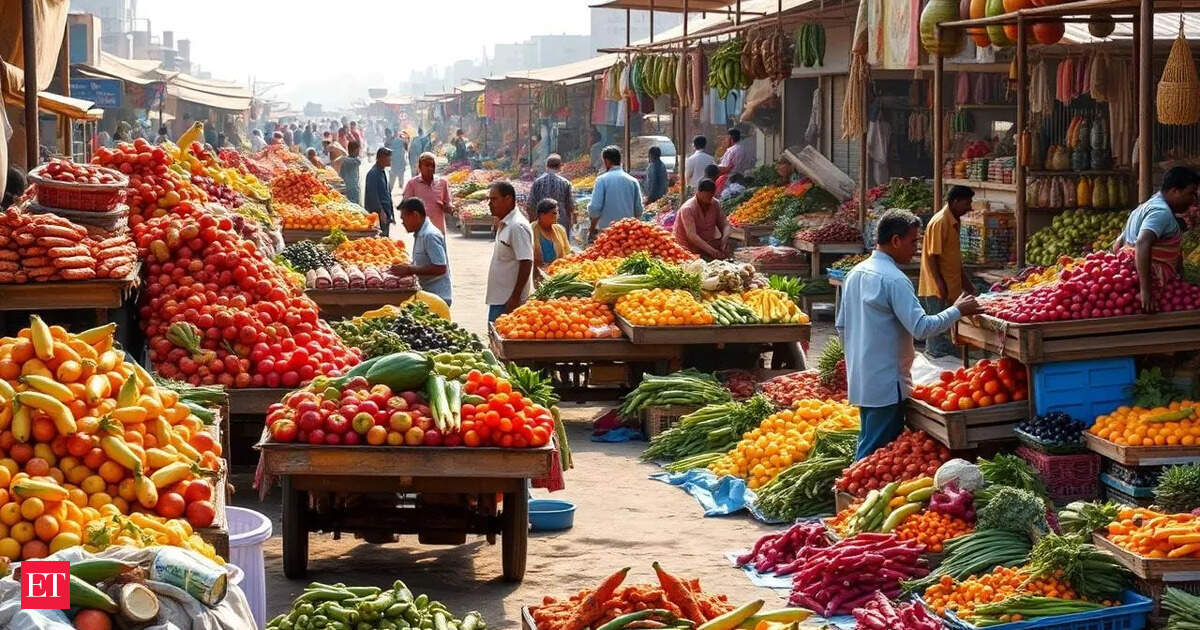
Food inflation returned to positive territory at 2.13%, led by a sharp 64.8% jump in tomato prices. Onion prices fell 29.3%, while potato and garlic prices declined 29% and 53%, respectively.
“The pickup in inflation in January 2026 was on account of food prices, which turned inflationary,” said Paras Jasrai, associate director at India Ratings and Research.The Reserve bank’s inflation target is 4% with a two percentage tolerance band on either side of that.

 Live Events
New series impactLast week, the central bank raised its inflation projection for the current financial year to 2.1% from 2%.
Economists expect inflation to edge up in the coming months as base effects fade, potentially prompting a pause in interest rate cuts. The RBI’s Monetary Policy Committee kept the benchmark repo rate unchanged at 5.25% in February. Ind-Ra expects inflation to average 3.2% in February, while Barclays estimates it at around 3%.The new series is based on the Household Consumption Expenditure Survey (HCES) 2023-24. The collection mechanism of data has also been revised with price data now obtained from 1,465 rural and 1,395 urban markets as well as 12 online marketplaces.
The new CPI series covers 12 groups from the earlier six, adding several standalone categories to provide greater granularity.
“Internationally also, it is seen that as incomes rise, the proportion of expenditure on food reduces, and increases on other services, which is also seen… For example, transport and conveyance, and some of the other recreation or services have increased,” said Saurabh Garg, secretary, statistics ministry.
Chief economic adviser V Anantha Nageswaran said inflation could increasingly be driven by core components rather than food, shifting the focus of monetary policy toward managing aggregate demand pressures instead of supply-driven shocks.
He described the new CPI series as an important development that aligns India with global best practices and said the country may even be “going one step ahead of others” in the way it collates and presents key macroeconomic data.
The higher weight assigned to food in the previous inflation series had led to volatility in the key price gauge. That had prompted demands to exclude food from the central bank’s inflation-targeting framework, a review of which is due next month.
Although the government did not release comparable annual component-wise data under the new series, sequential numbers suggest food prices are moderating, while the broader basket remains relatively stable. On a month-on-month basis, food prices fell 0.05% in January.