
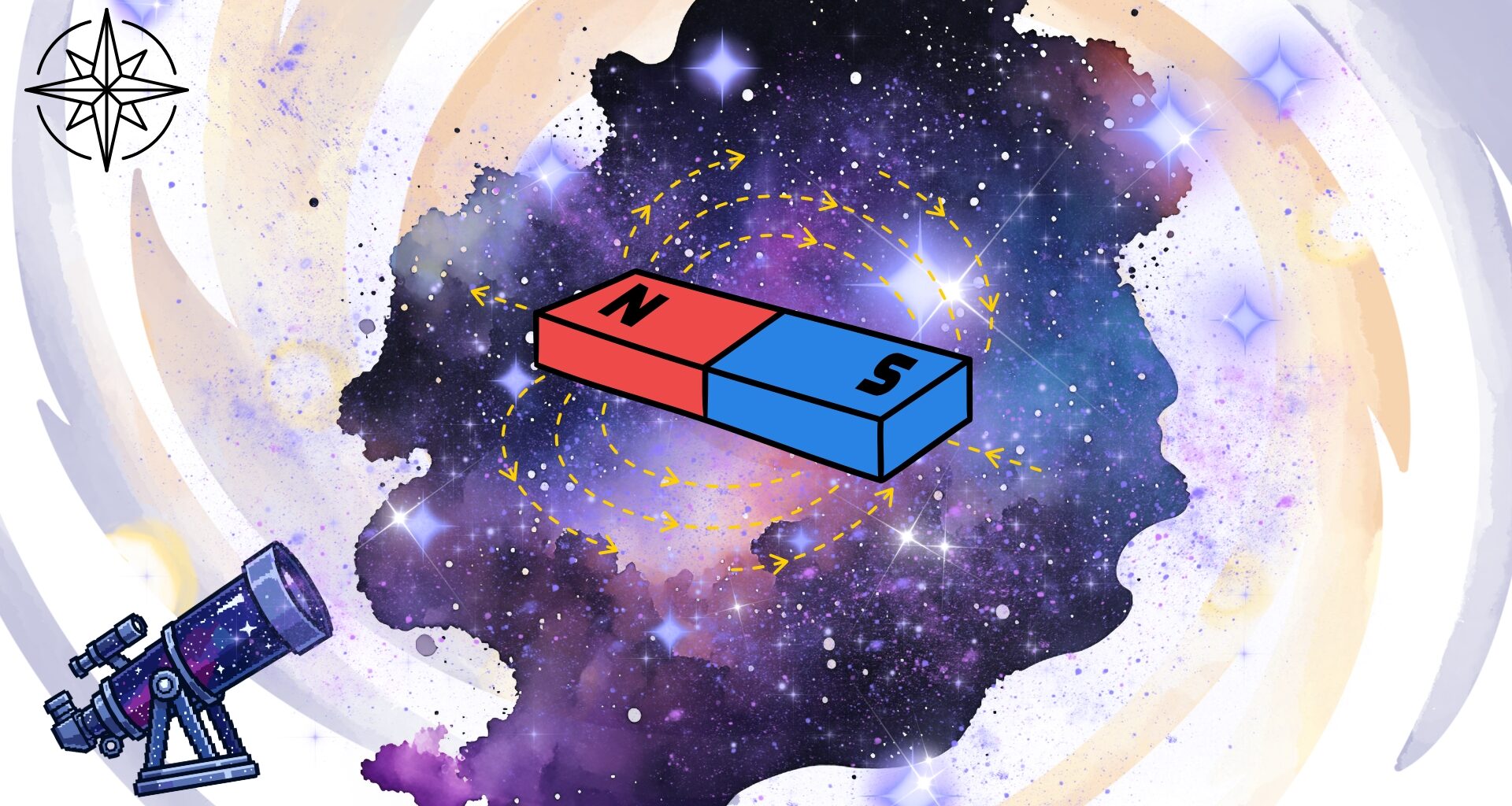
Scientists have long wondered why the universe isn’t simply a firestorm of constant star birth, given the amount of gas clouds that surround us. A new study by researchers from the Indian Institute of Astrophysics, Pondicherry University, University College London, UK and Korea Astronomy and Space Science Institute, Korea, suggests that the answer lies in the invisible magnetic scaffolding that permeates deep space. By observing a dense core of gas and dust known as LDN 328, located roughly 880 light-years away, researchers have shown that magnetic fields in the surrounding neighbourhood are strong enough to resist the pull of gravity. This magnetic resistance likely delays star formation, ensuring that stars are born at a much slower, more regulated pace than gravity alone would allow.
The research was conducted using the James Clerk Maxwell Telescope (JCMT) in Hawaii, equipped with a highly sensitive instrument called SCUBA-2 and its polarimeter, POL-2. To detect these magnetic fields, the team examined the glow of cold cosmic dust. Although space is mostly a vacuum, it is filled with tiny dust grains that align with magnetic field lines, much like iron filings around a bar magnet. As these grains heat up slightly and emit light at submillimetre wavelengths, the light becomes polarized, meaning it vibrates in a specific direction. By measuring the angle of this vibration, the researchers mapped the orientation and strength of the invisible magnetic fields surrounding the LDN 328 core.
In the regions surrounding the central core, the researchers found that the areas are magnetically subcritical. This means the magnetic pressure is currently winning the tug-of-war against gravity, preventing the gas clumps from shrinking further. However, at the very centre of the LDN 328 core, where a baby star is already beginning to form, the forces are transcritical, meaning gravity and magnetism are locked in a near-equal struggle.
The researchers also observed a phenomenon known as the depolarisation hole, where the polarisation signal weakens in the densest parts of the cloud. They believe this occurs because magnetic field lines become tangled or dust grains lose their alignment in the crowded, dark environment of the core.
By zooming in on our cloudy neighbourhood and mapping the magnetic fields, the team has bridged a major gap in our understanding of how magnetism transitions from a large-scale structural force to a small-scale regulator of individual stars. It also provides a clearer map of our cosmic origins and a better understanding of how planetary systems like our own Solar System come into existence. Moreover, the study reminds us that we live in a universe governed by a delicate balance of invisible forces, and that our existence is the result of a long, magnetically-regulated history of the stars.