
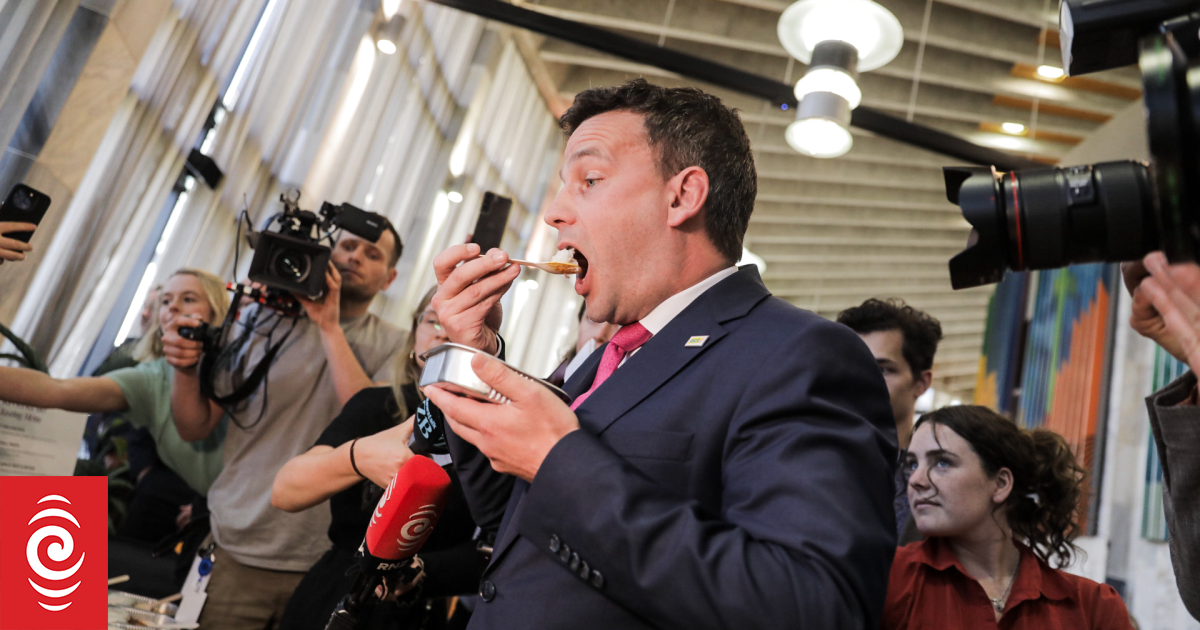
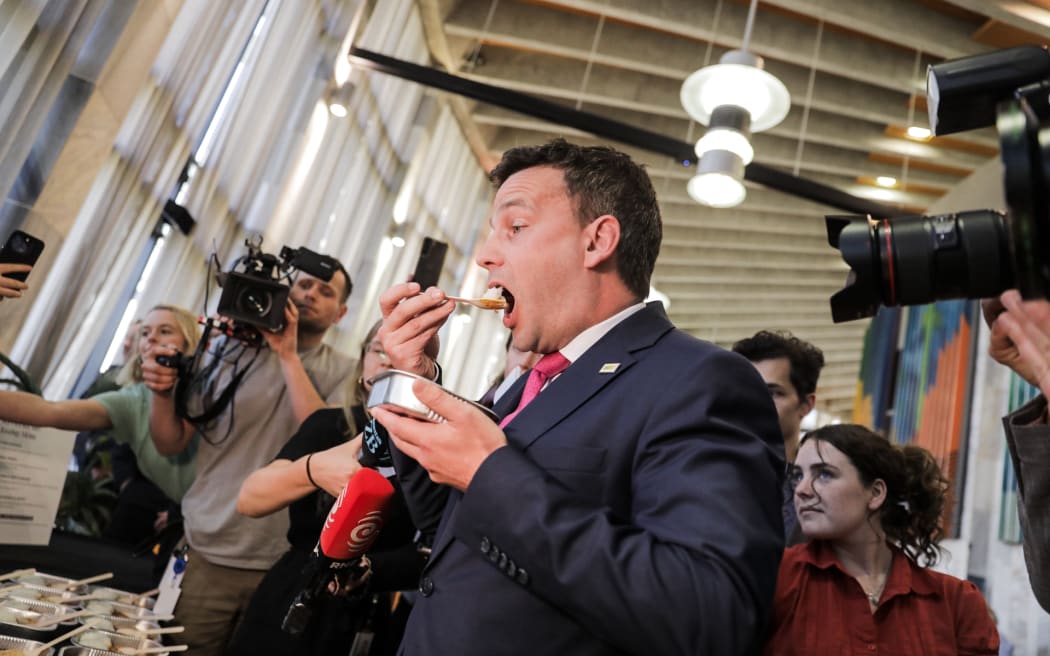
David Seymour eating a school lunch.
Photo: RNZ / Samuel Rillstone
A free school lunches programme rebrand has dropped the reo Māori name Ka Ora Ka Ako, in a move Associate Minister of Education David Seymour says is “delivering real value”.
The change comes alongside a new purpose statement and a review of the overall policy.
Papers released under the Official Information Act showed Cabinet agreed on 20 October to rename the programme formerly known as ‘Ka Ora, Ka Ako Healthy School Lunches’, to simply ‘Healthy School Lunches’.
“People need to know what things are,” Seymour said. “That’s why we’re using an English name that everyone understands. Delivering real value with taxpayer money is important to Kiwis. That’s why we’ve delivered a healthy school lunch programme which gets the same results, and has been forecasted to save the taxpayer almost $300m already.”
He said they would continue to find ways to ensure the programme fed children “and gets value for the taxpayer”.
Labour’s Willow-Jean Prime said the change was “beyond ridiculous”.
“This government is more worried about what the programme is called than ensuring that our children have lunches that don’t explode. This government’s school lunches program has been a flop.”
Green MP Teanau Tuiono said it was “the opposite of virtue signalling”.
“I’m going to call it toxic signalling to their base… that’s going to bring out a particular contingent of people that think that way… It’s anti-Māori, it’s racist and in many ways pathetic.”
Seymour saying everyone could understand English was “just an excuse”, Tuiono said. “The English and the Māori sit right next to each other.”
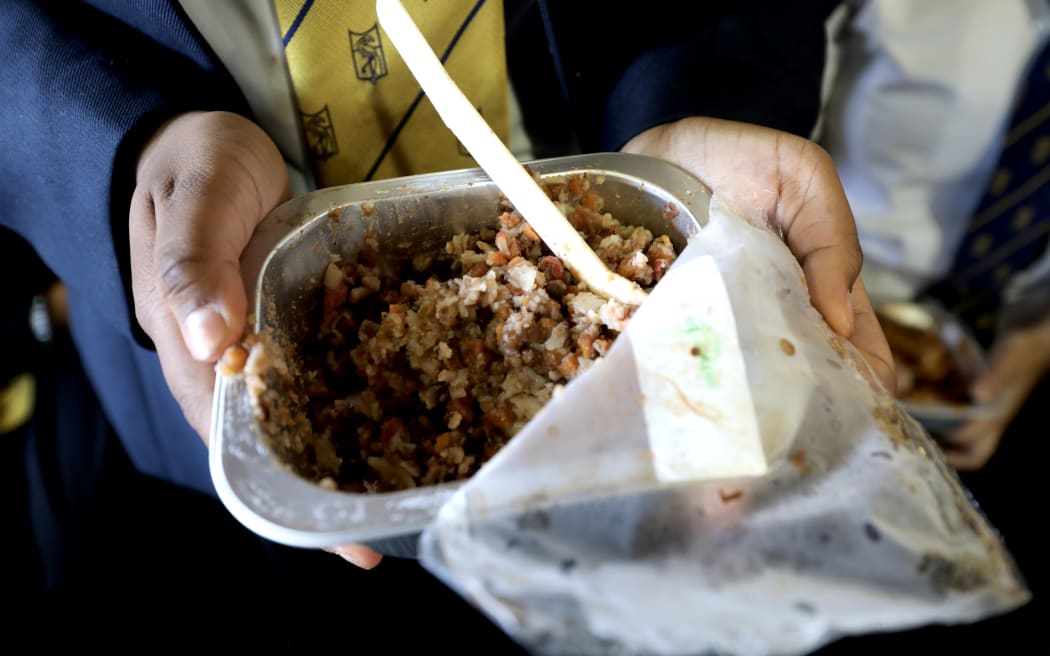
A student from Otahuhu College holds an example of a school lunch in 2025.
Photo: RNZ / Marika Khabazi
Te Pāti Māori co-leader Debbie Ngarewa-Packer said it was a “sad reflection of the views of this government”, and showed ACT was trying to get votes.
“We’ve seen Winston [Peters, NZ First leader] double down and basically say, ‘Unless you are a good Māori, you don’t deserve to have Māori representation.’ … These guys on Friday, sitting there saying, ‘Oh, we don’t want to see Māori names in the schools.’
“Expect the campaign from these two parties to be an attack at the Treaty, an attack at Māori, and it starts by again attacking our reo – no surprise.
“Buckle up, believe in yourself and vote against this type of divisive politicking.”
Seymour rebuffed the opposition’s criticisms.
“If they’re getting excited about minor administrative issues like this, they’ll be in opposition for a very long time,” he said.
Ngarewa-Packer denounced that.
“Takes a certain type of narcissist to sit there and trivialise the significance of food in schools, the significance of culture and communities, the significance of te reo Māori… it’s just too important for us to sit quiet and let David dismiss it as administrative.”
Tuiono said if it was so minor, “Why is the effort being put put on this in the first place?”
The papers showed Cabinet considered the original objectives of the programme “no longer fit for purpose”.
Those objectives include providing regular access to healthy lunches to reduce risk of food insecurity, improve wellbeing and promote attendance at school, and boost local economies through job creation including by providing a living wage.
They will be replaced by a new single primary objective, “to mitigate the impact of food insecurity in school”, and new “sub-objectives” focused on mitigating “the immediate negative impact of hunger on a student’s ability to learn” and “the long-term negative effects of food insecurity on a child’s physical, cognitive, and neurological development”.
Asked about this, Seymour said the priority was feeding hungry children at the best value for taxpayers.
“When you pile on unrelated objectives like subsidising local cafes and setting wages, the value for taxpayers disappears.”
Tuiono told RNZ people should be paid a living wage.
“This government keeps going on about [the] cost of living crisis, seem to be doing nothing about it and we’ve seen tens of thousands of people jumping on a plane and going elsewhere. We need to make sure that we can support workers.”
The Ministry of Education was directed to investigate how to achieve the objectives, including whether curbing food insecurity could be better achieved “in other contexts that reach children during the time they are not at school”.
The review would also investigate other ways to target those at risk of food insecurity including “exploring a voucher-type solution and use of the Integrated Data Infrastructure Database” – indicating it could be brought into a Social Investment approach.
Sign up for Ngā Pitopito Kōrero, a daily newsletter curated by our editors and delivered straight to your inbox every weekday.