
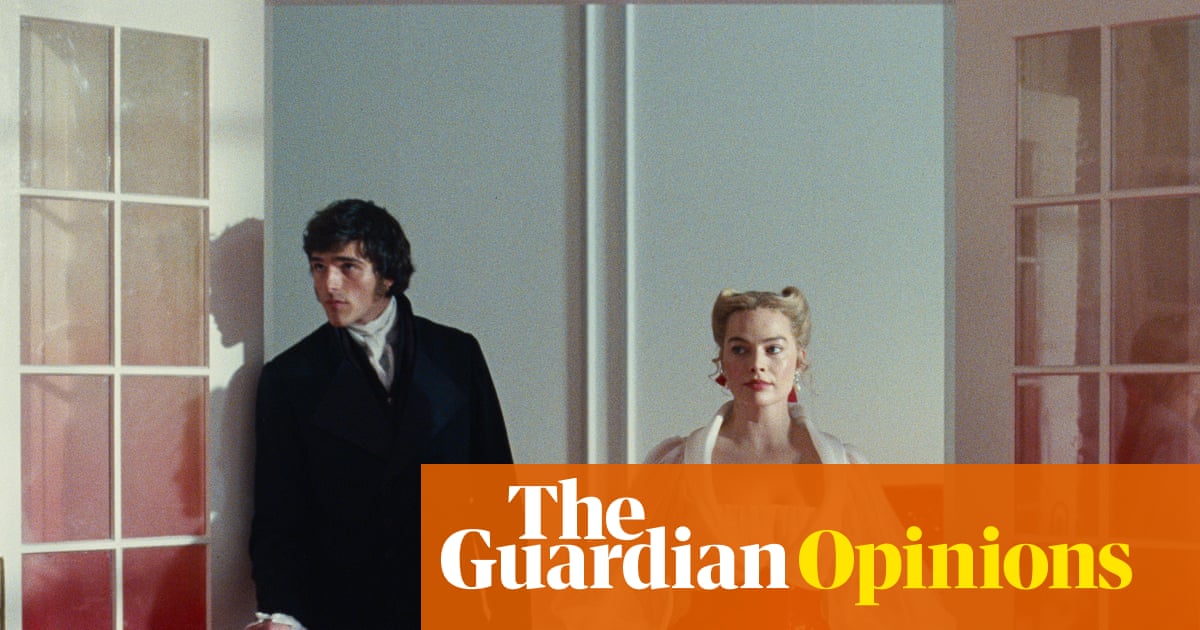
Readers of The Australian seemed as surprised as we were to read Nikki Gemmell’s review of the new Wuthering Heights movie starring Margot Robbie and Jacob Elordi.
“My first five-star review: I inhaled Wuthering Heights with my groin,” screamed the headline.
“Well, there’s a phrase I never thought I would read in a film review,” one reader commented. “Glad you enjoyed it, but I don’t think I’ll be having what you are having.”
Another reader said: “I hope you kept the noise down Nikki. No doubt very distracting for the other movie goers who are probably still … recovering. Hopefully this doesn’t set the tone for future movie reviews.”
Nikki Gemmell’s five-star review of Wuthering Heights. Photograph: The Australian
Gemmell didn’t hold back: “Be still, my churning 14-year-old heart. After the clit-tease of a muscular marketing campaign we now get the actual product, ripe for Valentine’s Day. A film of such gleeful power it may well liquify your innards just watching it.”
Not everyone agrees. The Guardian’s Peter Bradshaw gave the movie two stars, writing: “It’s quasi-erotic, pseudo-romantic and then ersatz-sad, a club night of mock emotion”.
Perhaps Gemmell wanted to make a splash after landing the role of chief film critic for the rebranded Culture section at the Oz. Both Gemmell and the former ABC broadcaster Phillip Adams have been dropped as weekly columnists, as has the former literary editor and chief film critic Stephen Romei.
The cuts at the Oz are starting to show. When David Stratton and Romei were writing for the old Review section, the paper would publish between five and seven film reviews. Now they are down to a couple. But the real cuts have been to the once fine literary section, where the book reviews have shrunk from seven pages to between two and four under the literary editor, Caroline Overington.
A spokesperson for The Australian said the masthead was “modernising and expanding its culture, arts, and entertainment coverage through a new multi-platform Culture vertical led by Milanda Rout, investing in video, newsletters, and fresh voices”.
“New columnists include Charlotte Ree, who has joined The Australian Weekend Magazine as a columnist under editor Elizabeth Colman. Results have been very strong, with audience growth and subscriber engagement accelerating.”
Missing MarksThe ABC’s managing director, Hugh Marks, said Asio wrote to him about claims aired by Four Corners, but: ‘They did get my email address wrong.’ Photograph: Lukas Coch/AAP
The Australian Security Intelligence Organisation (Asio) took aim at the ABC this week, threatening “to take further action” if it was not happy with the claims aired by Four Corners about intelligence failures before the Bondi massacre. Asio failed to specify if it meant legal action or something else, but no “action” eventuated.
What did emerge from Senate estimates the next day was slightly awkward for a security agency that prides itself on having top notch investigative skills.
The ABC’s managing director, Hugh Marks, revealed that Asio tried to send him an email about Four Corners but got the address wrong.
“Asio released a very strong statement about that particular program,” Marks said. “They wrote to me. They didn’t seek to call me or contact me. They did get my email address wrong.”
Asio’s message, published online on Sunday, did however manage to get through to the Australian’s political analyst, Simon Benson, who published an article later that day.
Benson had his own spin on why Asio had acted “so aggressively and publicly” – the Four Corners program was “a stitch-up”. “[It] would be far more convenient for the government, parts of the bureaucracy and even parts of the media if Bondi were seen as an intelligence failure rather than a failure to address antisemitism”, he wrote.
Can the centre hold?
David Armstrong, who was the editor (1990-1992) and then editor-in-chief (1996-2002) of The Australian, has accepted a new gig as editor-in-chief of John Menadue’s public policy journal, Pearls & Irritations. We asked him how one pivots from editing the Oz to leading a progressive publication described by its founder as coming from a “liberal perspective, with an emphasis on peace and justice”.
“The Oz in my time was centre-right (not flat out right) and the general approach was to be conservative on economic policy and more liberal on social policy,” Armstrong said. “The Oz, for instance, was the strongest media advocate of the republican cause and firmly favoured closer engagement with Asia. My personal views would be regarded as progressive and I am happy and proud to be appointed to my new role at P&I. From 1975 onwards the Oz had been a right-wing paper. My aim when I took over as editor in 1990 was to move it back towards the centre, making it more open to the discussion of a range of ideas.”
No more ‘marking own homework’
The extraordinary practice of allowing corporations like Sportsbet and the Commonwealth Bank to inspect and change a regulator’s draft media release announcing they had been penalised appears to be on the way out.
The chair of the Australian Communications and Media Authority (Acma), Nerida O’Loughlin, admitted at Senate estimates this week: “We do, from time to time, provide media releases in advance to the companies that we’re dealing with, to make sure that we have our facts accurate.”
In one case, the Commonwealth Bank asked Acma to delay the release of a negative announcement until after its AGM, and in another Acma changed O’Loughlin’s own quotes after Sportsbet objected.
The independent ACT senator David Pocock, a strong voice against the influence of the gambling industry, was aghast, telling estimates: “I am so concerned that the regulator of this predatory industry, after slapping them with a fine — a pretty small fine, it seems to me — then says, ‘Hey, this is our media release; what are your thoughts?’ And then you change the chair’s quotes. Chair, do you regret this? Do you think this is a good look?”
O’Loughlin repeatedly said the corporations were only checking for accuracy.
The ABC revealed in December that Acma went further than that, allowing the gambling giant Sportsbet to water down a media release that announced it was being fined for breaching anti-spam laws.
Thanks to a Freedom of Information request from ABC reporters Michael Atkin and Alison Branley and persistent questioning from Pocock, Acma conceded it would stop allowing companies to “mark their own homework”, as suggested by Greens senator Sarah Hanson-Young.
“So we’ve taken on board the criticism that has been put to us by this committee and we will amend those processes, and in future we will not be consulting on media releases before they go public,” O’Loughlin told estimates.
“I accept the criticism from the committee, and we will change our processes accordingly.”
False climate ads banned
A Climate Study Group advertisement that was published 16 times across News Corp Australia publications since November has been found in breach of advertising standards.
Members of the Climate Study Group have links to the Institute of Public Affairs.
The print ad was headed “Carbon dioxide and plant nutrition” and the online ad was “The science of fossil fuel CO2 for plant nutrition”. Both contained claims that were neither truthful nor factual and have been banned.
A Climate Study Group advertisement which ran 16 times across News Corp, breached Ad Standards for not being ‘truthful and factual’. Illustration: Climate Study Group
The regulator found the ad – which rejects the science of human-caused climate change – “appeared to be expressing a view that the fossil fuel industry is not as harmful as generally accepted and could benefit the environment…”.
The dubious claims were accepted by advertising departments and ran across seven News Corp mastheads despite a similar breach in 2024 when the ad was “discontinued” after Ad Standards found it contained misleading or deceptive environmental information.
Meanwhile, a Senate inquiry into the prevalence and impacts of climate misinformation and disinformation, which will sit in Canberra next week, has received almost 200 submissions. Several groups, including the Climate Council, WWF-Australia and Climate Action Against Disinformation, are pointing to a long list of claims promoted recently by conservative politicians, thinktanks and conservative media.