
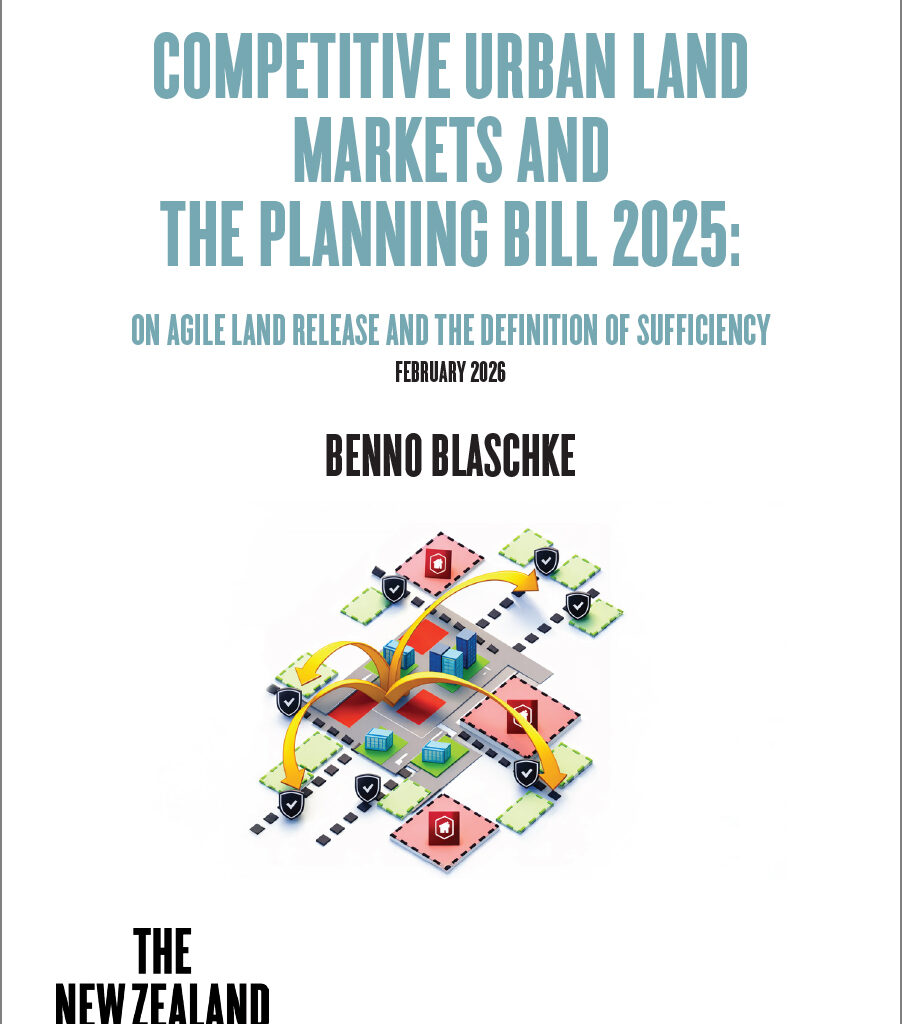
The Planning Bill 2025, introduced to Parliament on 9 December 2025, represents the most significant reform of New Zealand’s resource management framework since the Resource Management Act 1991. Among its stated objectives is the enablement of “competitive urban land markets”, which signals a conceptual shift in how the planning system conceives of its relationship to housing supply and affordability. Yet a close reading of the Bill reveals a structural gap between aspiration and operative provisions. The Bill articulates competitive land markets as a goal but does not embed the mechanisms necessary to achieve them.
This note examines the Bill’s treatment of land release, focusing on the concept of “development capacity” and its “sufficiency” for urban land market competition.[1] It finds that the current statutory framework preserves the conditions under which scarcity rents can persist, notwithstanding the Bill’s reformist language.
This note recommends amendments to the Planning Bill and foreshadows national direction that addresses the structural deficiencies identified herein.
We propose a two-pronged approach: first, surgically revise the concept of “sufficient development capacity” to create a statutory hook for national direction to lean on; second, provide guidance on specific land release mechanisms to give effect to that purpose. Annex A operationalises this approach in comprehensive statutory language. Annex B identifies the minimum viable statutory hook.
On the first prong, we propose that the statutory concept of “sufficient development capacity” be replaced with “competitive urban land supply.”[2] This is not an additional requirement layered onto sufficiency, but a replacement that performs the same systemic role: determining whether the planning system is enabling housing and business development using a market-structural rather than volumetric lens.
This research note accompanies the New Zealand Initiative’s submission on the Planning Bill 2025, which applies the framework developed here to specific recommendations for the Bill.
[1] The Planning Bill uses the term “development capacity”, which it has inherited from National Direction on Urban Development (NPS UD). The term “sufficient” has been used only in the NPS UD to qualify the quantum of development capacity supplied, being a measurable concept that can be modelled and informs planning decisions. Therefore, the concept “sufficient development capacity” as a whole is embedded in our planning system, which the Bill inherits. See New Zealand Government, “National Policy Statement on Urban Development (NPS UD),” Ministry for the Environment, 2020, Sections 3.2 (sufficient development capacity for housing) and 3.3 (sufficient development capacity for business land), https://environment.govt.nz/acts-and-regulations/national-policy-statements/national-policy-statement-urban-development/.
[2] An alternative statutory-facing label for this concept could be “responsive” urban land supply as long as it is framed in the competitive logic outlined in subsections (j) and (k) in Annex A.