
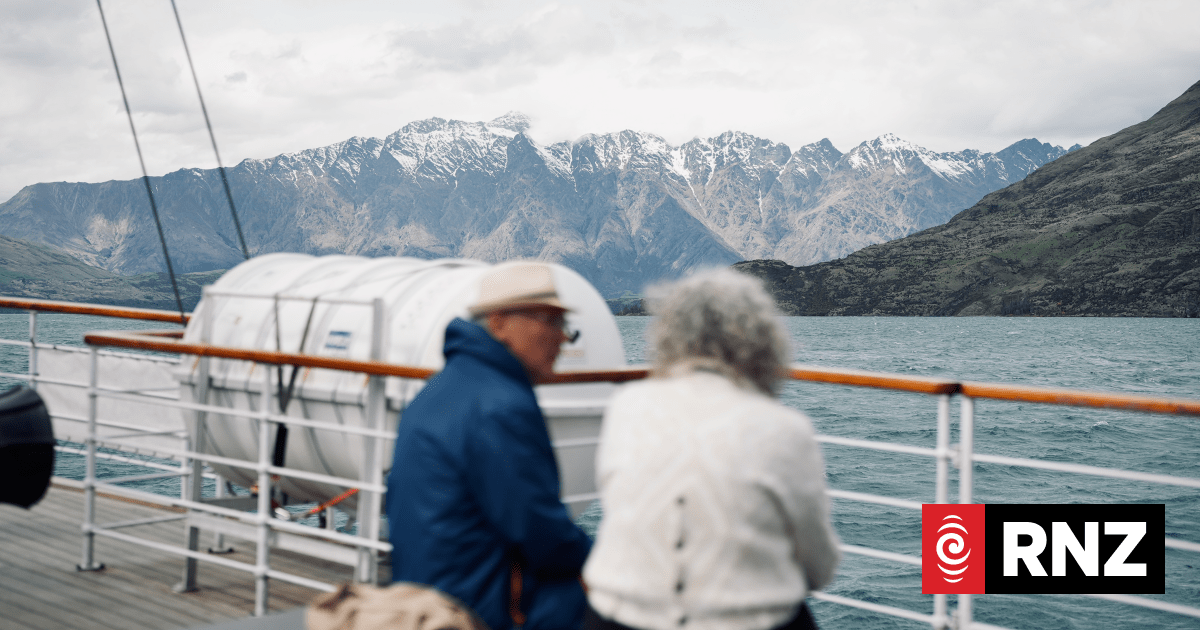
Tourists on a boat in Queenstown in October 2025.
Photo: RNZ / Ziming Li
Immigration advisors say it is unfair to withhold the $100 tourism levy paid by visitors when applying for their visas if the application is rejected.
The International Visitor Conservation and Tourism Levy (IVL) was introduced by the Labour government in July 2019 at $35.
The coalition government increased the fee to $100 in October 2024.
Individuals applying for a visitor, student, working holiday or Electronic Travel Authority visa, as well as some other work visa types, need to pay the levy upon application.
More than $300 million has been collected through the levy since it was introduced as of 2024/25, with $190 million forecast for 2025/26, according to figures provided by the Ministry of Business, Innovation and Employment (MBIE).
“The IVL is your contribution to maintaining the facilities and natural environment you will use and enjoy during your stay,” Immigration New Zealand says on its website.
However, the levy isn’t refundable if an application for a visa is declined.
Since October 2024 to early February this year, the amount collected from the more than 71,000 people who have been declined a visa was about $5.7 million, said Jock Gilray, director visa at Immigration New Zealand.
“Of those 71,565 people, 17,182 people have reapplied for another visa,” Gilray said.

Immigration advisor Jag Sidhu
Photo: Supplied
Immigration advisor Jag Sidhu said the lack of a refund wasn’t fair, as applicants had to pay heavy immigration fees on top of the levy, and it all added up, particularly if a large family was involved.
“Immigration New Zealand should not charge this money in advance until a visa is approved,” he said.
Pooja Sundar, an immigration lawyer at Dalley Sundar Barristers and Solicitors, said it was understandable that the levy was introduced to ensure that conservation and tourism costs were not passed onto New Zealanders.
“If you’re coming to New Zealand and you actually made it to New Zealand and you’re here – I get it,” she said. “Because people are using the roads, [facilities on] the tramps … and all of that costs money.”
“But if you’ve applied for this visa and you’ve had it declined, then why are you paying $100? You haven’t created any costs because of your visit to New Zealand.
“We 100 percent have people complaining about the fees and the amount they have to pay.”

Pooja Sundar, an immigration lawyer at Dalley Sundar Barristers and Solicitors
Photo: Supplied
Mahafrin Variava, an associate at McVeagh Fleming, agreed it didn’t seem fair for the government to retain the levy if an application was rejected.
“Some applicants are declined and then choose to reapply, which means that they are required to pay the IVL again,” she said.
“For people who’ve made minor errors or had their applications declined due to a misunderstanding, having to pay another levy does add an avoidable cost to the process and can seem a little unreasonable.”

Mahafrin Variava, an associate at McVeagh Fleming
Photo: Supplied
Variava’s colleague, Arran Hunt, said the immigration system could be updated to not charge the levy again if it had already been paid on a declined or withdrawn application, perhaps within a certain period.
Hunt said he was more concerned about the government’s communication.
“While the government has marked this payment as to go to conservation, the government could do that for any part of any fee it receives,” he said.
Using a general visitor visa as an example, it was a $341 fee plus a $100 tourism levy, but applicants might just see it as a single $441 application fee, Hunt said.
“How the government wants to split it up is their prerogative,” Hunt said.
“Selling it as anything other than part of the application fee is disingenuous.”

Immigration lawyer Arran Hunt
Photo: Supplied
Significant costs
MBIE’s manager of tourism stewardship and systems, Tom Simcock, said the government agreed during the initial design of the levy that its payment would be collected within the immigration system.
“This helps to streamline the process for applicants and reduces administrative cost [that] would otherwise be passed on to applicants,” he said.
The non-refundable nature of visa fees and levies was made clear on Immigration New Zealand’s website, and people should ensure that they have all the information needed for an application to minimise the chance of being declined, he said.
“There are significant administrative costs associated with establishing refund mechanisms that would impose increased costs on other users of the immigration system,” Simcock said.
A public consultation on the IVL was conducted in May 2024, including proposing increasing the amount payable and the process and nature of the levy, he said.
“MBIE received over 1000 submissions, and no submissions raised concerns about the non-refundable nature of the IVL.”
He said decisions on how to invest IVL revenues were made jointly by the ministers of tourism, conservation and finance based on a half and half split between conservation and tourism, targeting infrastructure and biodiversity.