
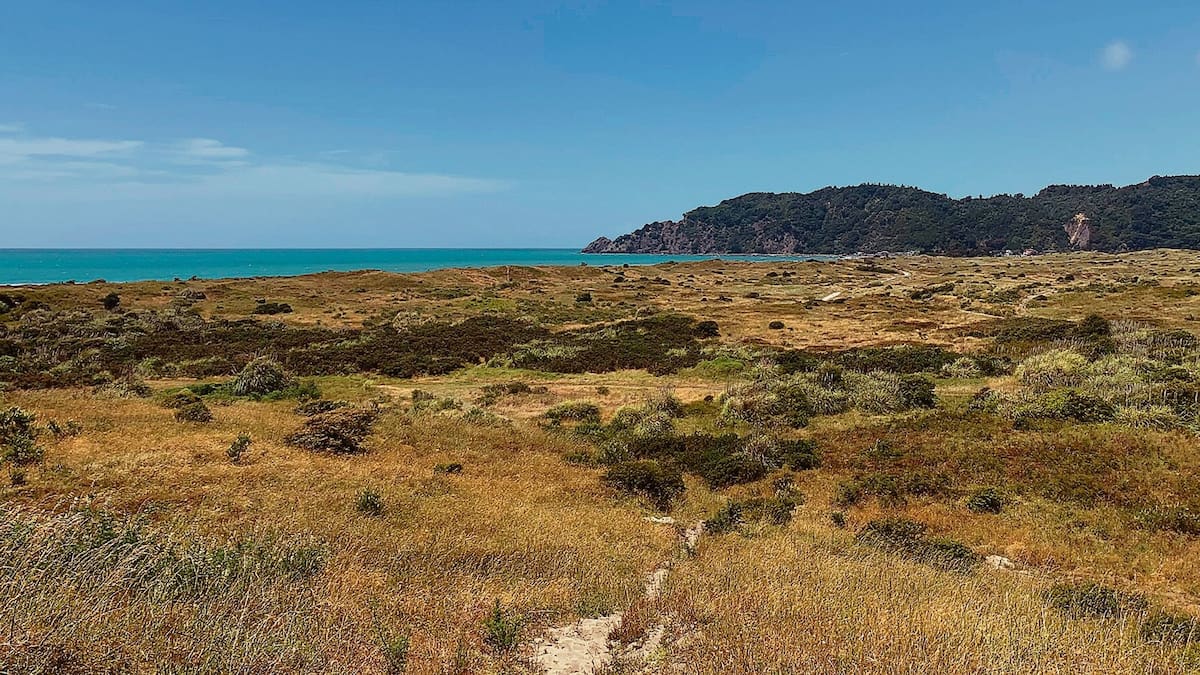
While a 56‑acre (22.6ha) lot at Piripai was vested to Ngāti Awa trustees in 1878 as a native burial reserve, the current trustees maintain that the area where early Māori settlers were buried does not stop at the 56 acres.
“That 56 acres was an arbitrary colonial line,” Hireme said.
Hireme told the court he believed Ōpihi Whanaungakore stretched for 600 acres from Turuturu Roimata (The Statue of Wairaka at The Heads) to Ohuirehe.
It was where the eponymous ancestors of Mātaatua were buried and where their spirits returned from ancestral homelands of Hawaiki when called to come back by karakia and karanga.
“That place is ahu wairua [spirit/soul]. We don’t know how those people can live there,” he said.
The case was heard before a panel headed by Judge Jeff Smith, and including Judge David Cauldwell, and environment commissioners Glenice Paine and Shona Myers.
It involves the 26.9ha Whakatāne District Council-owned block next to the official urupa site. The council entered into a sale and purchase agreement with developer MMS GP in 2017, which became unconditional in 2018.
Because the sale is subject to gaining consent, the sale has not yet settled, however, MMS GP is still contractually bound to the purchase.
Heritage New Zealand granted Archaeological Authority prior to the district council granting consent for the development.
Te Runanga o Ngāti Awa, Ngāi Taiwhakaea and Ōpihi Whanaungakore appealed the Archaeological Authority and a hearing was scheduled for 2022. MMS GP asked for an adjournment for the parties to come to an agreement out of court.
Agreement was reached with the rūnanga for a modified plan using half the land area of the original 240 lot development and including a 300-metre buffer zone between residential developments and the urupa.
Ōpihi Whanaunakore trustees maintained their opposition to the development.
Ōpihi Whanaungakore trustees Hemi Hireme and Rapata Kopae with a photo of Guide Kate, famous for rescuing several people during the Tarawera eruption, who was buried at the urupa after having lived to 100. Photo / Diane McCarthy
Counsel for the trustees, Max Harris, said Heritage New Zealand had made significant errors in granting Archaeological Authority.
He said there were two ways the court could approach the case, either by remitting the decision back to Heritage NZ with the recommendation that it go to a full Māori Heritage Council, or reverse the granting of the authority.
The preferred decision of the trustees was that it be put before the full Māori Heritage Council, which had specialist expertise in safeguarding Māori heritage.
Although there were no known archaeological sites, Harris said Heritage NZ’s internal assessment had identified that the development had the potential to uncover subsurface archaeological artefacts of early Māori settlers, therefore should have been put before the council.
“The [Heritage New Zealand Pouhere Taonga] Act is quite clear when matters need to be referred to the council.”
Even by Heritage NZ’s own criteria, it should have triggered a referral to the council, he said.
Although the application had provided cultural impact statements from Te Rūnanga o Ngāti Awa and Ngāi Taiwhakaea, Ōpihi Whanaungakore Trustees had not been given an opportunity to provide one.
Hireme had not been contacted until he learned of the decision.
Counsel for Heritage NZ Stephanie De Groot said Heritage NZ admitted it had incorrectly recorded that it had received a cultural impact statement from the trustees. It also recorded incorrectly that the parties did not oppose the Archaeological Authority.
Judge Smith said while the parties had indicated they wished to be involved if any discovery of archaeological artefacts or koiwi were discovered during excavation of the site, that could not be interpreted as approval.
De Groot said under the Act, it had no requirement to consult.
The senior archaeologist who carried out the archaeological assessment, Dr Rachel Darmody, gave evidence that she had taken two calls from Hireme wanting to oppose the application and in both cases had escalated these to the appropriate people in the organisation. These had not been acted on.
Heritage NZ acting chief executive Dean Whiting told the court that although he thought Hireme’s latest statement provided greater understanding of the importance of the site to Māori, he did not feel that it would have made a difference to the decision to grant Archaeological Authority.
Counsel for MMS GP Vanessa Hamm drew the court’s attention to the 2002 Ngāti Hokopu ki Hokowhitu vs Whakatāne District Council case pertaining to the same site.
At the time, Te Rūnanga o Ngāti Awa had wanted to situate the Mātaatua meeting house on the site.
In that case, Sir Hirini Mead, then chairman of the rūnanga, defined the extent of the urupa as being within the vested reserve. He had expressed the opinion that it was extraordinary because it’s so large and that most wāhi tapu were small.
Judge Smith accepted colonial surveys of the area may not have been done in consultation with tangata whenua.
“The urupa was determined by a European surveyor and I accept there may have been some errors in that.”
He said some people used the term wāhi tapu for areas that were culturally significant for Māori, but did not fit with the legal definition of the term.
Use of the area as a place for fishing, birding, eeling and other activities did not suggest to him that the entire area was wāhi tapu.
“You couldn’t do that if it was entirely tapu.”
The panel deferred their decision to a later date.
Judge Smith commented that the case was complex and may take some months to deliberate.
– LDR is local body journalism co-funded by RNZ and NZ On Air.