
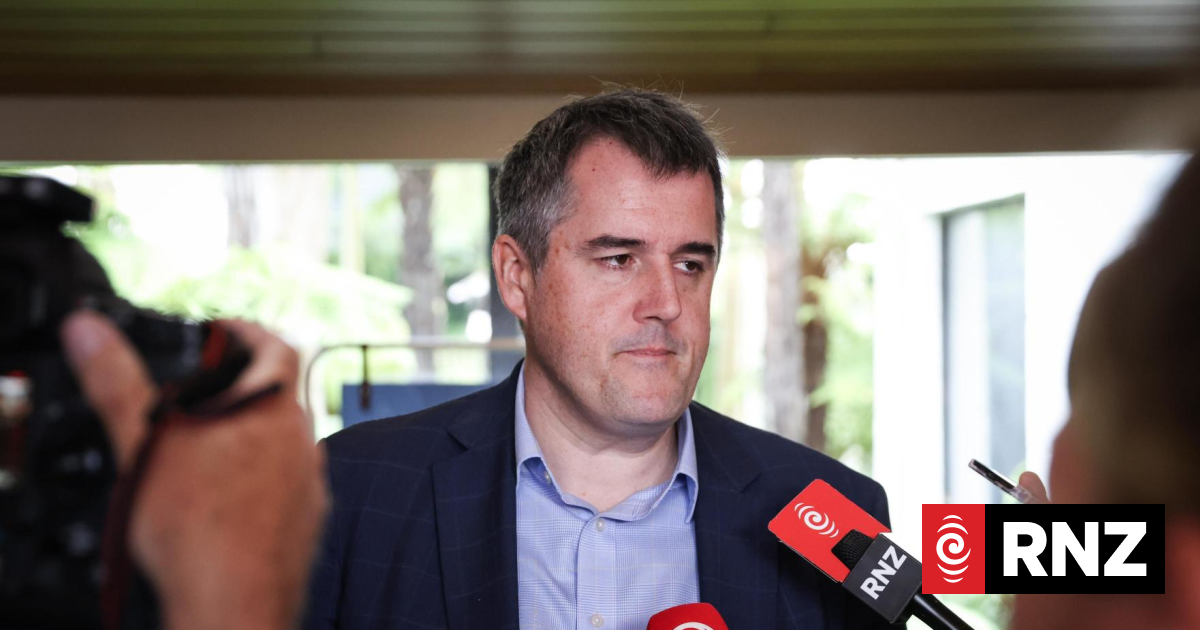
RMA Reform Minister Chris Bishop.
Photo: RNZ / Nathan McKinnon
The government has promised to change a contentious clause in legislation the could leave the door open to a future water tax for farmers.
Federated Farmers called on the coalition to “immediately and categorically rule out” any form of a water tax in its proposed RMA replacement bill yesterday afternoon.
“The government needs to move quickly and strike out any wording that would allow water rights to be auctioned, tendered, levied or taxed,” Federated Farmers RMA reform spokesperson Mark Hooper said.
RMA Reform Minister Chris Bishop initially said no policy decisions had been made around the clause in question before going on to categorically rule it out.
“We can categorically rule out a water tax. That is not, and never has been, government policy. After all, National is the party of lower taxes not more taxes.
“What is currently contained in the Natural Environment Bill are provisions allowing for the potential recovery of costs of managing aspects of a water catchment – to be used in rare and specific circumstances.
“If farmers have concerns about any part of this proposal or parts of it are not right then changes can and will be made during the select committee to ensure this works.
“We are committed to delivering a planning system that works for farmers and growers, so they spend less time burdened with unnecessary paperwork and more time farming.”
Hooper told RNZ the legislation should be written in such a way that made it crystal clear farmers could not now, or in the future, be taxed for water.
“The minister has said categorically that there won’t be a water tax but the next step would be to say, let’s just rule out this particular issue altogether and make sure there is clarity.
“There is scope for debate within the sector as to how we manage water efficiently but the fact that we’ve got this existing debate around, is this a tax, is it an appropriate levy, suggests that there is ambiguity about it.
“One of the guiding principles with this reform was that we would get better clarity, that we would be led down a pathway of legislation that is less litigious because that’s one of the problems that we’re trying to solve with the current RMA.
“So there’s quite a lot of work that needs to be done in order to provide clarity and make sure that there’s not provision in there for future governments to be able to leverage off what’s been put into this legislation and perhaps interpret it in a different way.”
The Natural Environment Bill is currently before Select Committee.
Sign up for Ngā Pitopito Kōrero, a daily newsletter curated by our editors and delivered straight to your inbox every weekday.