
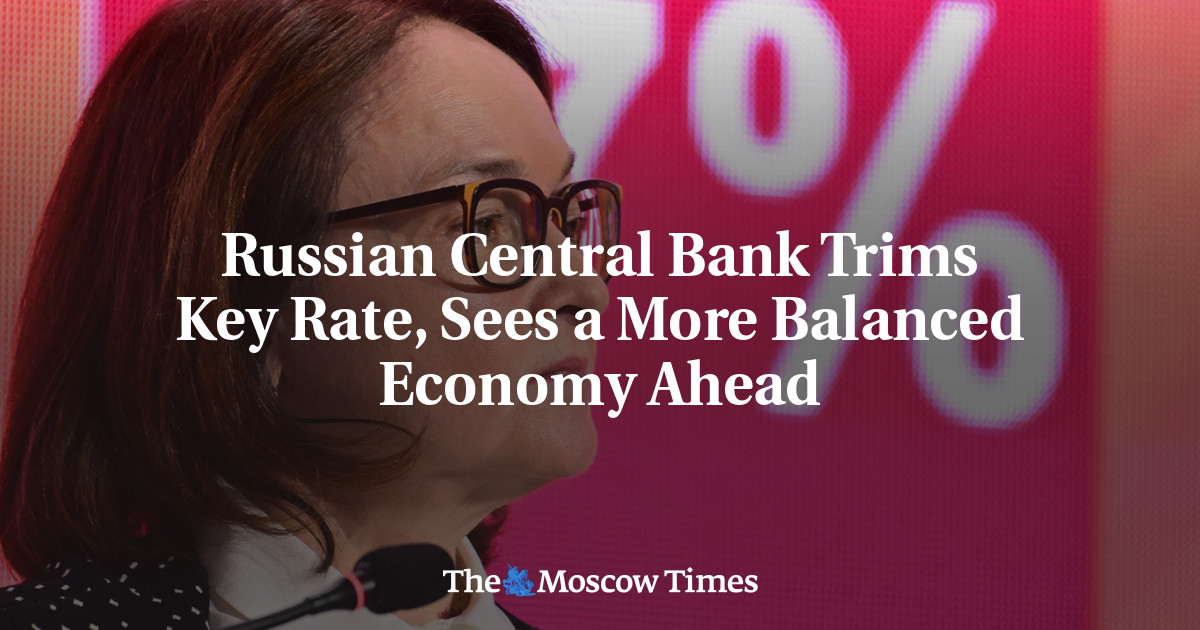
Russia’s Central Bank lowered its key interest rate to 15.5% from 16% at its first rate-setting meeting of the year on Friday, continuing a streak of cuts that saw five reductions last year.
Policymakers said in a statement announcing the decrease that the economy “continues to return to a balanced growth path” despite what they described as a “considerable” but temporary rise in the cost of goods in January after the government increased the value-added tax and expanded the number of small businesses required to pay the levy on consumption.
While the Central Bank said it expects to reduce borrowing costs further this year, it wants to see evidence that inflation is moving closer to its target of 4%. According to the bank, inflation stood 6.3% as of Feb. 9, down significantly from a year ago.
Sofia Donets, chief economist at T-Bank, said policymakers on Friday gave their strongest signal for easing monetary policy since 2023 by keeping the door open for further rate cuts this year.
“For now, this guidance is conditional and tied to how inflation progresses,” Donets said. “Still, it’s a sign that a turning point may be near.”
Russia’s Central Bank has been cautious in lowering the key rate after hiking it to a two-decade high of 21% in September 2024 to curb surging inflation, driven by huge military spending and tightening labor market conditions.
High borrowing costs have stunted investment and led to sluggish economic growth.
Russia saw its GDP increase by just 1% in 2025, President Vladimir Putin said at a government meeting last week.
“But we also know that this slowdown was not simply expected. One could even say it was man-made,” Putin told the gathering of officials. “It was connected with targeted measures to reduce inflation.”
While Russia has dramatically boosted spending on the military, it has also faced falling revenues.
In January alone, Russia’s budget deficit jumped to nearly half of its full-year 2026 target of 3.8 trillion rubles ($49.4 billion).
Russia’s Finance Ministry said oil and gas revenues for January totaled 393.3 billion rubles ($4.29 billion). That was 32% below the planned target and only half the amount recorded for January 2025.
Low global oil prices, higher discounts on Russian crude and a stronger ruble have all contributed to the shortfall.
Meanwhile, there is uncertainty over the continued export of Russian oil to India, which has come under pressure from the Trump administration to end its energy purchases from Moscow.