
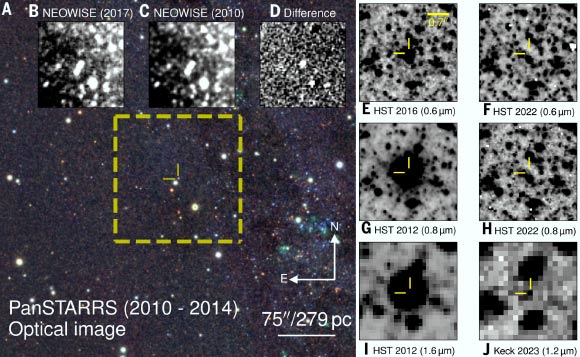
Using archival data from NASA’s NEOWISE mission along with data from other space and ground-based observatories, astronomers identified the clearest observational record yet of a massive star fading and vanishing into a black hole — an event once theorized but rarely seen.
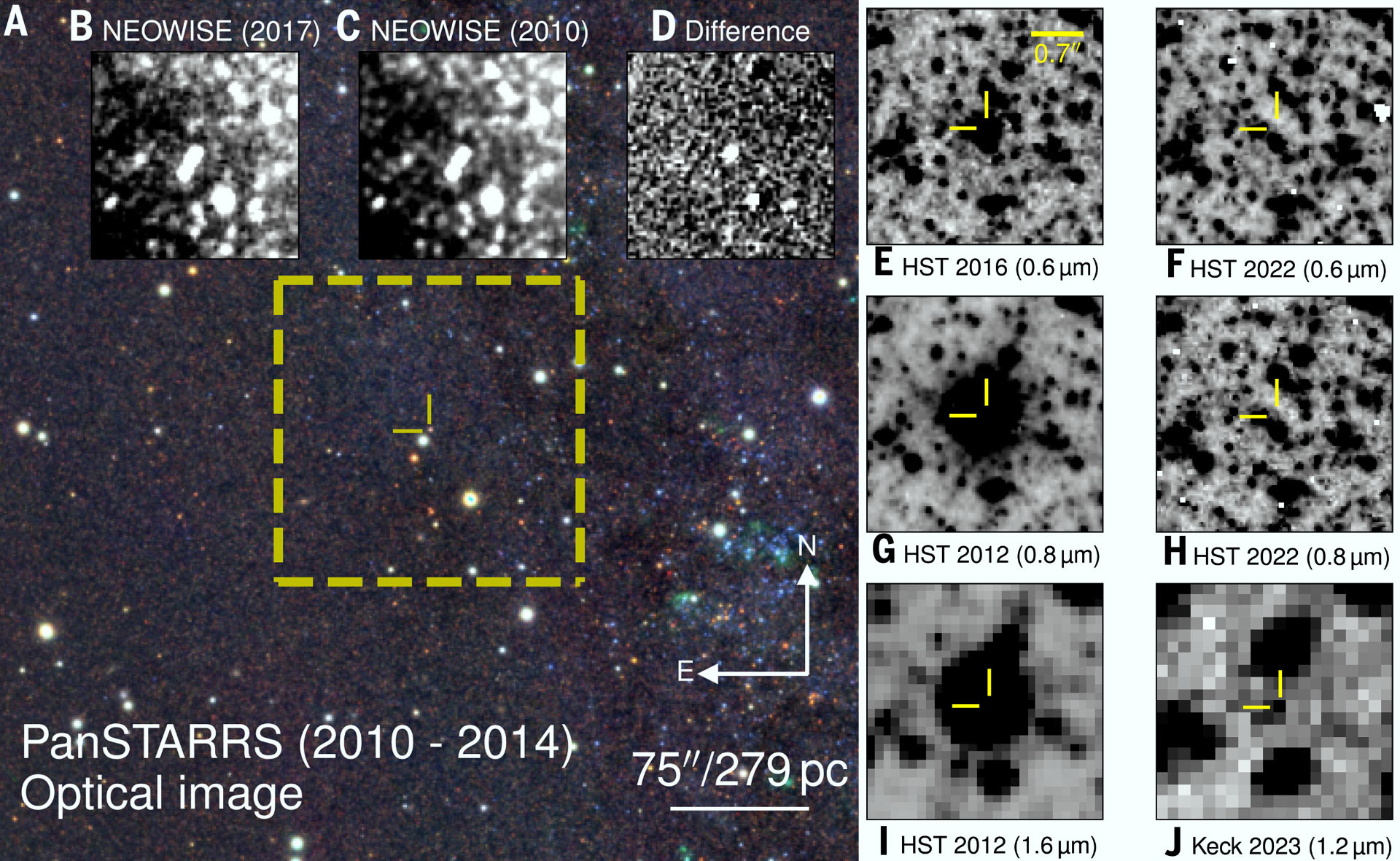
Location and disappearance of M31-2014-DS1. Image credit: De et al., doi: 10.1126/science.adt4853.
Near the end of their lives, massive stars can become unstable and swell in size, producing noticeable changes in brightness over timescales humans can observe.
In many cases, these stars die in brilliant supernovae, which are extremely luminous and easy to detect.
However, not all dying stars explode. Theory suggests that some massive stars fail to produce a successful explosion.
Instead, when the star’s core collapses, its outer material falls back inward, forming a black hole.
Yet such failed supernovae are difficult to detect because they emit weak energy signatures and appear mainly as stars that simply vanish from view.
Using archival, long-term infrared observations from the NEOWISE mission, Columbia University astronomer Kishalay De and his colleagues searched for variable stars in the nearby Andromeda galaxy and discovered an unusual supergiant star, M31-2014-DS1.
In 2014, it brightened in the mid-infrared, then from 2017 to 2022, it faded by factors of around 10,000 in optical light (becoming undetectable) and around 10 in total light.
Follow-up observations with Hubble and large ground-based telescopes revealed only a very faint, red remnant detectible in the near-infrared, suggesting the star is now heavily shrouded in dust — a mere shadow of the luminous supergiant it had been just years before.
The researchers interpreted these observations as evidence for a failed supernova leading to the birth of a stellar-mass black hole.
“The dramatic and sustained fading of this star is very unusual, and suggests a supernova failed to occur, leading to the collapse of the star’s core directly into a black hole,” Dr. De said.
“Stars with this mass have long been assumed to always explode as supernovae.”
“The fact that it didn’t suggests that stars with the same mass may or may not successfully explode, possibly due to how gravity, gas pressure, and powerful shock waves interact in chaotic ways with each other inside the dying star.”
Dr. De and co-authors identified another massive star that may have met the same fate as M31-2014-DS1, NGC 6946-BH1.
This led to an important breakthrough in understanding what had happened to the outer layers that had enveloped the star after it failed to go supernova and collapsed to a black hole.
The overlooked element is convection, a byproduct of the vast temperature differences inside the star.
Material near the star’s center is extremely hot, while the outer regions are much cooler. This differential causes gases within the star to move from hotter to cooler regions.
When the star’s core collapses, the gas in its outer layers is still moving rapidly due to this convection.
Theoretical models show that this prevents most of the outer layers from falling directly in; instead, the innermost layers orbit outside of the black hole and drive the ejection of the outermost layers of the convective region.
The ejected material cools as it moves farther from the hot material around the black hole. This cool material readily forms dust as atoms and molecules combine.
The dust obscures the hot gas orbiting the black hole, warming the dust and producing an observable brightening in infrared wavelengths.
This lingering red glow is visible for decades after the star itself disappears.
“The accretion rate is much slower than if the star imploded directly in,” said Flatiron Institute Andrea Antoni.
“This convective material has angular momentum, so it circularizes around the black hole.”
“Instead of taking months or a year to fall in, it’s taking decades.”
“And because of all this, it becomes a brighter source than it would be otherwise, and we observe a long delay in the dimming of the original star.”
A paper on the findings was published this week in the journal Science.
_____
Kishalay De et al. 2026. Disappearance of a massive star in the Andromeda Galaxy due to formation of a black hole. Science 391 (6786): 689-693; doi: 10.1126/science.adt4853