
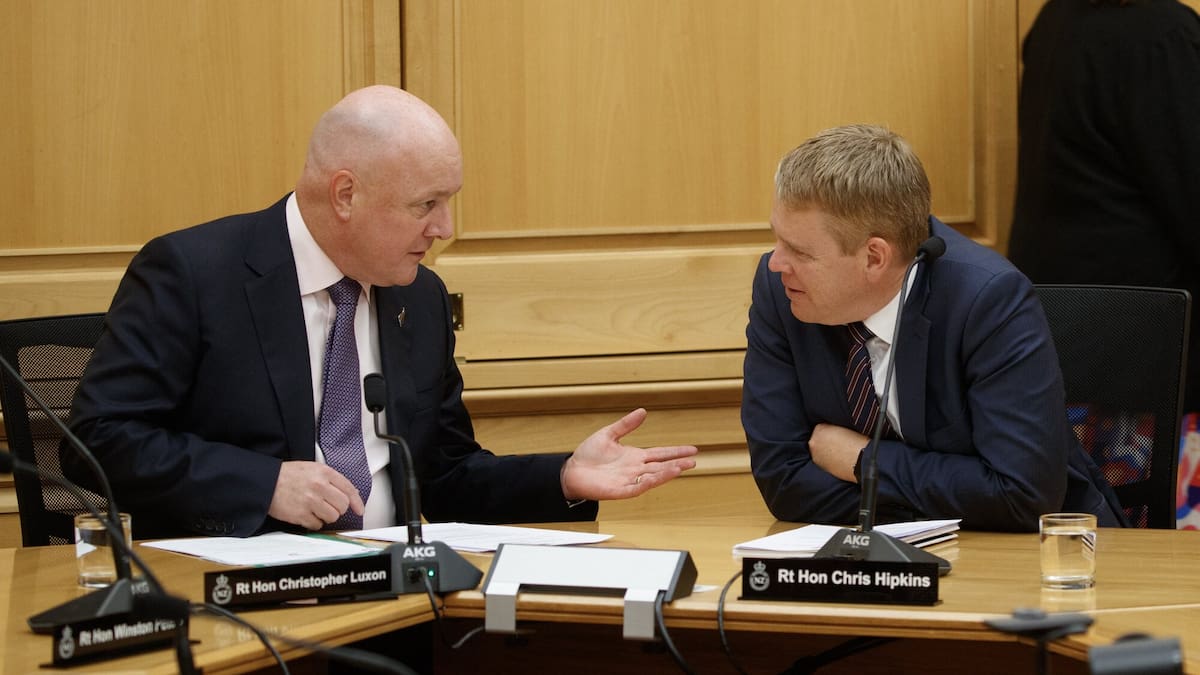
In case you missed it, recent political polling has the two main political parties neck and neck, with Labour leading the Taxpayers’ Union-Curia polling and National ahead according to 1News-Verian. On the preferred Prime Minister question, Christopher Luxon is narrowly ahead of of Chris Hipkins in both polls. The Curia poll shows a hung Parliament; other polling has sometimes still shown the coalition able to govern. But it’s closer than many people thought it would be.
In fact, I’m amazed by how close it is. The collective memory of the electorate it seems, is very very short.
The favoured Prime Minister question is one that I have always considered unusual. The question does not appear alongside any definition of what we actually want in a Prime Minister. And let’s be clear, none of them have been perfect.
In reviewing every Prime Minister of the last 40 years, each one has been very different. They all had strengths and weaknesses. Most, but not all, have at least been competent. And at the most basic level of electorate expectations, people like David Lange, Jim Bolger, Helen Clark, John Key and Bill English, have served us well. For my money, the current PM, who like the others listed above is not perfect, is nevertheless on the way to falling into that category of having done a reasonable job.
Elsewhere, we’ve had some who’ve let us down.
And so the question arises, what is it exactly that we expect from our Prime Minister?
First and foremost I would expect competence. Not competence in media interviews (which have become so important in forming opinions but demonstrate little about capability), but competence in the executive skills to lead a multi-disciplined organisation in a highly complex environment.
Next up, I like to see people with the ability to drive improvement and positive change. In order to do so, they must be able to assemble and lead a team of high-quality people who are capable of running programmes that are critical to the improvement and success of the country.
Lastly, I see the need for someone who is able to represent our country appropriately on the world stage, in international conversations about trade, and who can succinctly represent our interests on the geopolitical matters that affect us.
Interestingly, the list of former PMs above rank well on these criteria. In my opinion, the current PM is showing that he fits those criteria well too.
And yet he can only manage to level peg in the polls with a career politician whose track record, in my opinion, shows no evidence of meeting those criteria.
I was intrigued to see a headline earlier this week, suggesting that Labour leader Hipkins had gone toe to toe with Finance Minister Nicola Willis over “who broke the economy”. It seems the former Prime Minister had challenged the Government on their failure to manage the economy and more particularly, to deliver the recovery.
You might wonder why a recovery was necessary. My belief is it was necessary because of the damage done by the previous Government, a government in which the aforementioned Hipkins was a very senior Cabinet Minister and ultimately, briefly, Prime Minister.
I’ve often thought that most politicians are like layers of kevlar. Lightweight but thick-skinned. In this case I’d add short on memory for completeness.
And so it seems that Kevlar Hipkins has forgotten the mess that he and his colleagues left behind. With his background as a minister and as Prime Minister, he must be in total denial to even line up for the argument with the Finance Minister.
This is the person who, acted variously as Minister of Police, Minister of Education and Minister of Health, during the last Labour Government, a period that saw increased youth crime, worsening school attendance and a health service that dithered with organisational restructuring, abolishing the DHBs and establishing the Māori Health Authority in the aftermath of a pandemic, all while waiting lists lengthened. And let us remember that he was the Minister for Covid-19 Response, which, in my view, was an appalling abuse of political power, from November 2020 until June 2022.
And now he stands at the opposition benches, criticising those who are trying to fix the damage he wrought, and asking to be Prime Minister again.
Let us not forget that that Government, of which Hipkins was a senior and critical member, added almost $100 billion of gross debt to our country’s balance sheet, according to the Treasury, with nothing to show for it. They gave money away so freely that it’s difficult to understand where it went. They gave $1.9b to mental health, but outcomes remain contested. Oversight reports show most funding was spent or committed, but the impact – especially for specialist care – remains debated.
They spent millions of dollars on consultants for transport links, railway lines and cycling bridges, yet failed to deliver a single metre of rail track, while at the same time cancelling much-needed roading projects without explanation.
They preached kindness while running nurses and teachers out of their jobs. And then, when it was all over, had the gall to say they didn’t do those things, and engaged a lawyer to help them avoid in-person testimony in a highly appropriate inquiry.
In my opinion, it’s difficult to assess just how much damage that group of career politicians did to our country in their six years in power. And now they want us to forget all that, and elect them again.
All too often our memories are too short. But it’s time to recover our memories!
I think we now have a government, comprising three political parties who are all positively engaged, who are gradually repairing the damage that was done. Much of the work is slow, difficult and unspectacular, but it is needed and it is happening.
And so, as we line up at the polls on November 7 this year, we will once again be making a decision that is critical to the future of the country. The current Government, scarred and dirty from the work of the last three years, will tell us that they inherited a mess and have made good progress repairing it.
On the other side of the electioneering platform will be the Labour Party and their own coalition partners, coincidentally what I’d describe as the most dysfunctional parties in our current Parliament. You’ll note those parties have kept their heads down over the last few months, hoping that their controversies and inadequacies are forgotten before the election.
They will urge us to forget what happened between 2017 and 2023, and to put our trust in them to restore New Zealand to their own version of paradise.
But it’s not like these parties have refreshed as a result of their 2023 losses. With one exception, the resignation of James Shaw, they are, by and large, the same people who were at the helm in the 2023 election.
We can only surmise that Hipkins’ Labour want a return to the politics that they enjoyed just three years ago. And therein lies the other issue with the political left on the global stage. They do not appear to be interested in making life better for the majority. Instead, they seem to prefer spending our taxes on the international alliances and recognition that might come their way as they support the anti-Israel faction, open borders, diversity, curbed freedoms and supposed climate chaos; issues that have overburdened Europe and that are celebrated by the so-called global elite, one of whom was once their leader.
I wonder how many of those global fads will help our kids to read or reduce our hospital waiting lists. I wonder how they would grow our productivity and enhance our national GDP. Or how those ideologies would enhance our trade with China or India and enable us to improve our quality of life. Or maybe just enable us to build the infrastructure that reduces our daily commute time.
I wonder.
My computer just told me to restore my memory. That might be good advice for all of us.
Bruce Cotterill is a professional director, speaker and adviser to business leaders. He is the author of the book, The Best Leaders Don’t Shout, and host of the podcast, Leaders Getting Coffee. www.brucecotterill.com
Catch up on the debates that dominated the week by signing up to our Opinion newsletter – a weekly round-up of our best commentary.