
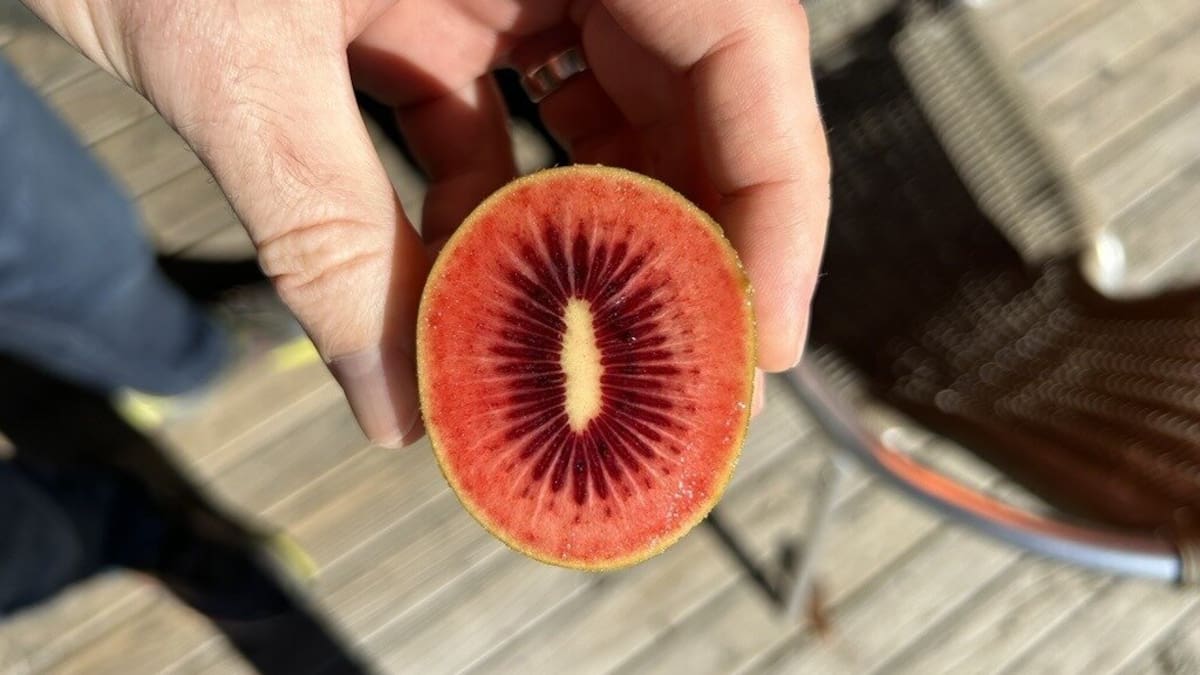
He said 100 hectares of Red80 licence would be made available to growers in 2026, including through a cutover pool for those existing Red19 growers wishing to bid for a licence.
“We’re looking forward to continuing to work with growers to provide our consumers with even more great-tasting and high-quality red kiwifruit, with Red80 expected to reach commercial volumes in 2028, helping deliver strong value for all of our RubyRed Kiwifruit growers.”
The decision to commercialise Red80 follows the doubling of Zespri RubyRed kiwifruit volume in the 2025/26 season, with more than 3 million trays sold across key markets including New Zealand, Singapore, Japan, Mainland China, Taiwan, South Korea and the USA.
Te Brake said the decision reflected Zespri’s commitment to producing new cultivars that would help Zespri maintain its market position as leaders of the kiwifruit category and maximise value for New Zealand growers.
“We have a proud history of innovation, which has set us apart from our competitors, and today’s decision is another example of the ongoing work our industry undertakes to meet the needs of our global consumers and deliver strong value to our growers.”
Competitive category
Te Brake said the kiwifruit category was increasingly competitive, with customers wanting a consistent supply of the full kiwifruit portfolio, whether that was Zespri Green, Zespri SunGold, or Zespri RubyRed.
He said red kiwifruit naturally tended to be shorter-storing than green and gold kiwifruit, so Zespri currently had a limited sales window of around eight weeks.
Zespri chief executive Jason Te Brake.
“Red80 harvests a bit later than our existing Red19 cultivar and stores for longer, with the two varieties working together to keep Zespri RubyRed in front of consumers for longer, building awareness, encouraging habitual purchase, and lifting demand.”
Following the commercialisation of Red19 in 2019, commercial volumes of Zespri RubyRed kiwifruit were first sold in 2022, with the fruit extended to new markets each year to a current presence in 13 around the world.
Te Brake said Zespri RubyRed was a unique, vibrant red kiwifruit with a sweet berry taste and nutritional benefits that set it apart from SunGold and Green.
“Since the variety’s launch, it has attracted new and younger consumers,” he said.
“Our research shows around 30% of people who purchase Zespri RubyRed are new to kiwifruit, so it brings more people into the category and creates additional opportunity for our other products.”
Breeding partnership
The Kiwifruit Breeding Centre was established in October 2021 by Plant & Food Research and Zespri to take their 30-year relationship of successful kiwifruit breeding to the next level.
With about 45 staff, the centre is based in Te Puke, and operates out of Kerikeri, Motueka and Mt Albert.
The centre is jointly funded by Zespri and Plant & Food Research, now part of the Bioeconomy Science Institute, a New Zealand Government-owned Crown Research Institute.
The organisations share royalties from any future commercialised new varieties.
A spokesperson said the Kiwifruit Breeding Centre specialised in developing innovative kiwifruit cultivars through cutting-edge, evidence-based breeding strategies.
“Our process begins with insights from Zespri, identifying global market opportunities for new kiwifruit varieties.
“From there, we define the ideal combination of traits needed to meet Zespri’s high standards – balancing the future needs of consumers, growers, and the supply chain.”
To achieve this, the spokesperson said the Kiwifruit Breeding Centre often needed to generate new knowledge or technologies.
“Once target traits are identified, we tap into our extensive parental population to select the best candidates for crossbreeding.
“Seeds from these crosses are collected, catalogued, and germinated to produce thousands of seedlings – our next generation of potential cultivars.
“Using advanced DNA marker technology, we screen these seedlings early, selecting only those with the most promising genetic profiles.”
Selected seedlings are planted at high density and undergo a rigorous, multi-year evaluation process.
“We assess growth, pest and disease tolerance, and fruit quality using tools like near-infrared scanning and routine quality checks.”