
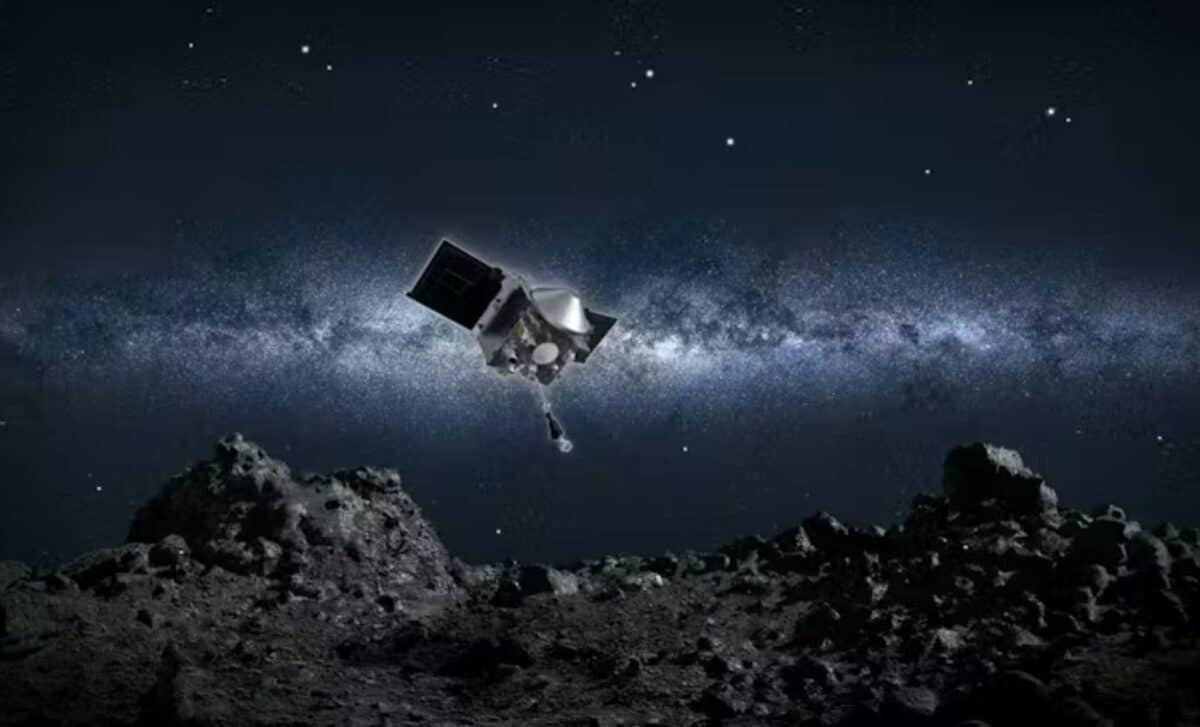
Samples returned from asteroid Bennu contain amino acids that may have formed in icy, radiation-filled environments rather than warm, watery settings. The discovery, published in the Proceedings of the National Academy of Sciences, reshapes how scientists think about the chemical origins of life’s building blocks.
The findings stem from material delivered to Earth in 2023 by NASA’s OSIRIS-REx mission. Earlier analyses confirmed the presence of amino acids in the 4.6-billion-year-old asteroid samples.
For decades, researchers have largely assumed that amino acids in meteorites formed through reactions involving liquid water. The new work, led by scientists at Penn State, suggests that at least some of Bennu’s amino acids followed a different chemical path that unfolded in frozen ice exposed to radiation in the early solar system.
Isotopic Fingerprints Point to An Icy Origin
The team analyzed a tiny portion of Bennu material, less than a teaspoon, using custom-built instruments capable of detecting subtle variations in isotopes, which are differences in atomic mass that serve as chemical tracers.
As stated in the latest research, the scientists focused on glycine, the simplest amino acid. Glycine is a two-carbon molecule and one of the most fundamental components of proteins, which carry out nearly every biological function.
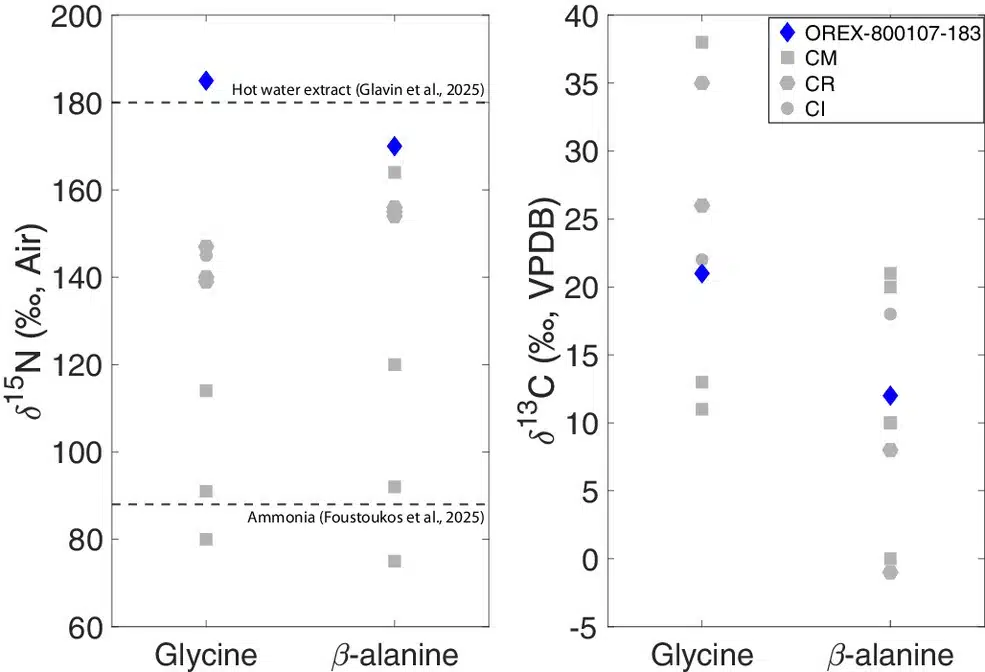 Measured isotopic compositions of key amino acids in asteroid Bennu. Credit: PNAS
The isotopic signatures in Bennu’s glycine did not match what would be expected if the molecule had formed through Strecker synthesis, a process involving hydrogen cyanide, ammonia, aldehydes or ketones, and liquid water. Instead, the measurements suggest formation in frozen ice subjected to radiation in the outer solar system.
“Our results flip the script on how we have typically thought amino acids formed in asteroids,” said Allison Baczynski, assistant research professor of geosciences at Penn State and co-lead author of the paper.
Two Meteorites, Two Chemistries
To better understand Bennu’s chemistry, the team compared its amino acids with those from the Murchison meteorite, which fell in Australia in 1969 and has long served as a reference point for organic compounds in space rocks.
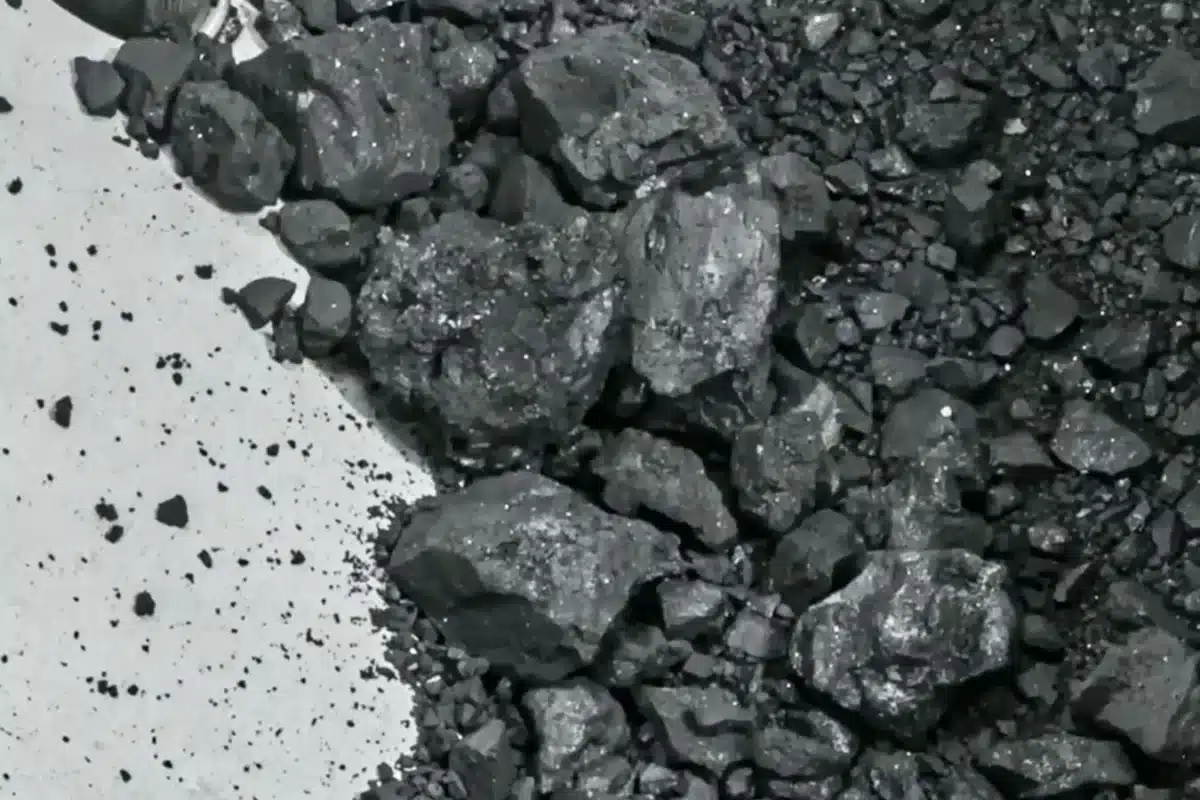 Fragmented debris from asteroid Bennu seen up close after being collected by NASA’s OSIRIS-REx mission. Credit: NASA
According to the Penn State researchers, the amino acids in Murchison show isotopic patterns consistent with formation in environments containing liquid water and relatively mild temperatures. Such conditions may have existed on the meteorite’s parent body and on early Earth. Bennu’s samples, by contrast, display markedly different isotopic characteristics.
“What’s a real surprise is that the amino acids in Bennu show a much different isotopic pattern than those in Murchison,” said Ophélie McIntosh, postdoctoral researcher in Penn State’s Department of Geosciences and co-lead author.
The disparity suggests that the parent bodies of Bennu and Murchison originated in chemically distinct regions of the early solar system.
Molecular Twins Spark New Mystery
The study also identified an unexpected difference in the isotopic composition of mirror-image forms of glutamic acid, another amino acid found in the Bennu samples.
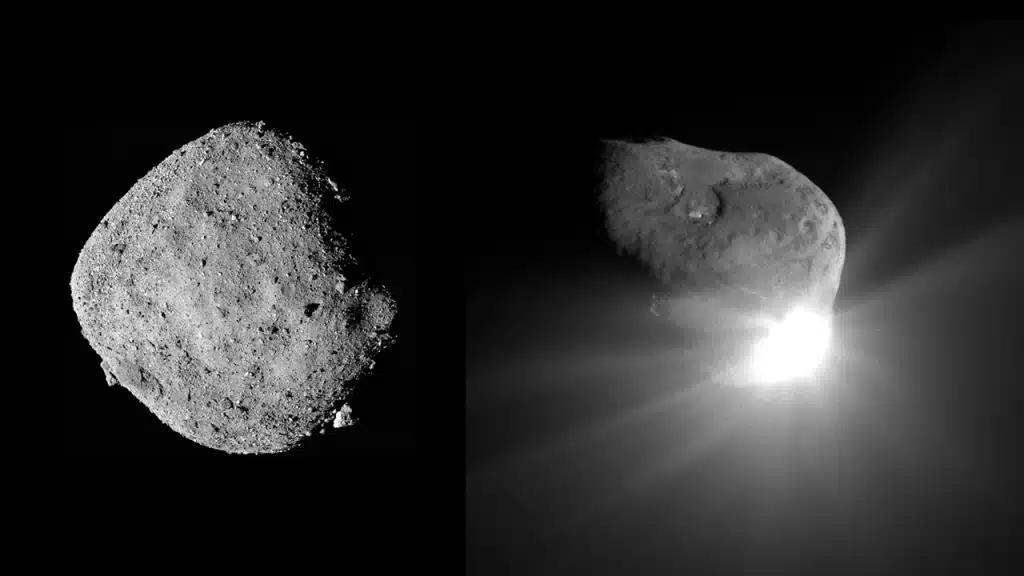 Detailed views of Bennu as seen by NASA’s OSIRIS-REx. Credit: NASA
Amino acids exist in two forms that resemble left and right hands. Scientists have generally assumed that such pairs would share similar isotopic signatures. Yet in Bennu, the two forms of glutamic acid show significantly different nitrogen values.
As the study authors noted, this discrepancy adds another layer of complexity to understanding how organic molecules formed in space.
“We have more questions now than answers,” Baczynski said, noting that future analyses of additional meteorites will seek to determine whether Bennu and Murchison represent two distinct patterns or part of a broader chemical diversity.