
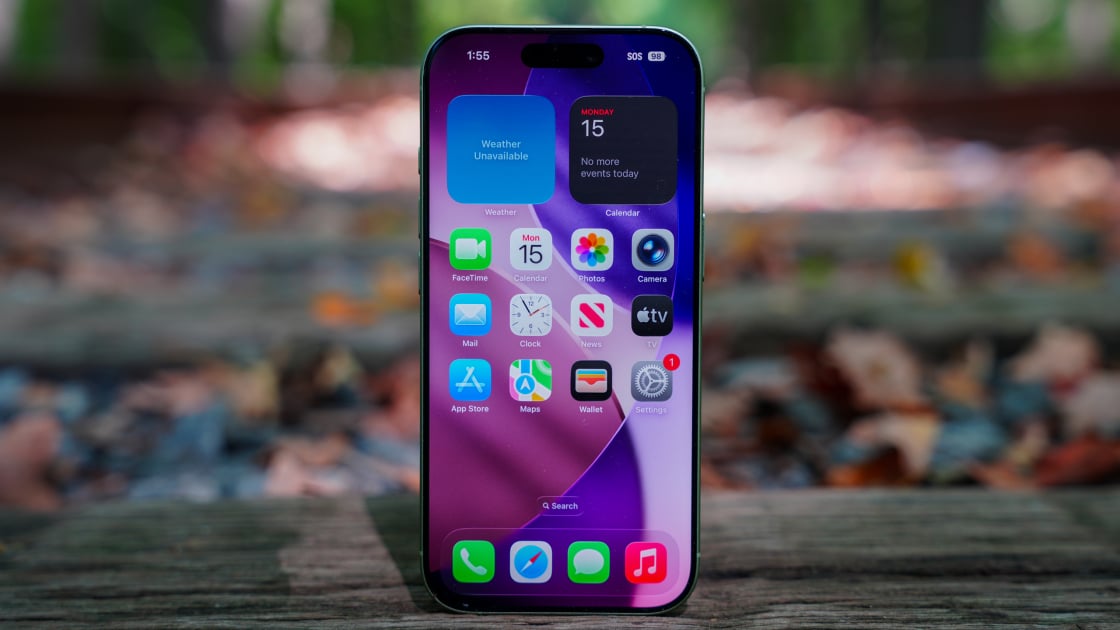
With the iPhone 17, you get two rear cameras and a reimagined front-facing selfie shooter, which is similar to what Apple has used in the past, but with some refinements.

(Credit: Eric Zeman)
Apple has revised the camera app for the iPhone 17 and iOS 26. It’s now somewhat simpler when you first launch it, showing only the photo shutter and video capture buttons. You must swipe the button left or right to access more shooting modes. Some of the settings are buried a bit in new menus. All the same features are there, but they’re arranged differently. Your experience will depend a bit on how often you care to use the more advanced features.
The main 48MP Fusion camera has an aperture of f/1.6 and sensor-shift optical image stabilization. Like the main cameras of the Air, 17 Pro, and Pro Max phones, it shoots a combination of 48MP photos and binned 12MP photos and then combines the data into a final 24MP result. Apple claims this gives you the best detail and light capture. The company has upgraded the ultra-wide camera to the same style of 48MP Fusion camera sensor with an aperture of f/2.2 and a 120-degree field of view. The iPhone 16 has a 12MP ultra-wide camera, so this is a significant boost for the wide-angle shooter.
This combination of cameras allows you to take shots at 0.5x, 1x, 2x, and 4x with “optical” zoom quality. You can use digital zoom out to 10x. The Air is limited to 1x and 2x optical quality, while the Pro models push it out to 8x with optical zoom quality, thanks to the additional telephoto lens.
As always, the iPhone takes terrific photos. And as you can see, my test shots show sharp focus, good exposure, nice color, and a natural look.

Main camera, 2x (Credit: Eric Zeman)

Main camera (Credit: Eric Zeman)

Ultra-wide camera, 0.5x (Credit: Eric Zeman)

Main camera (Credit: Eric Zeman)
The selfie camera is identical across all four new iPhones. It’s an 18MP Center Stage camera with a new square-shaped sensor that lets you take wide or tall photos, no matter how you hold the phone. You can select from four basic shot profiles and then apply portrait and other effects for an incredible range of selfie “lewks.” Selfie fans will appreciate this addition. The front camera takes stellar photos across the board.

Selfie camera, wide landscape (Credit: Eric Zeman)

Selfie camera, narrow landscape (Credit: Eric Zeman)

Selfie camera, wide portrait (Credit: Eric Zeman)

Selfie camera, narrow portrait (Credit: Eric Zeman)
The iPhone 17 includes enough video capture tools to satisfy most casual users. In addition to 4K60 recording in Dolby Vision, the phone supports a wide range of time-shift shooting modes, Action and Cinematic modes for stylized footage, and enough resolution and frame rate combinations to get the exact result you want. The footage I captured with the iPhone 17 looks outstanding. I was pleased with the level of detail I saw, and found the tools more than adequate for everyday videography.
Last, the iPhone 17 gains Dual Capture, which lets you shoot video from the front and rear cameras at the same time. Although Android phones have been able to do this for 10 years or more, it’s a new feature for the iPhone that will likely lead to lots of new content across social media. It worked fine in my tests.