
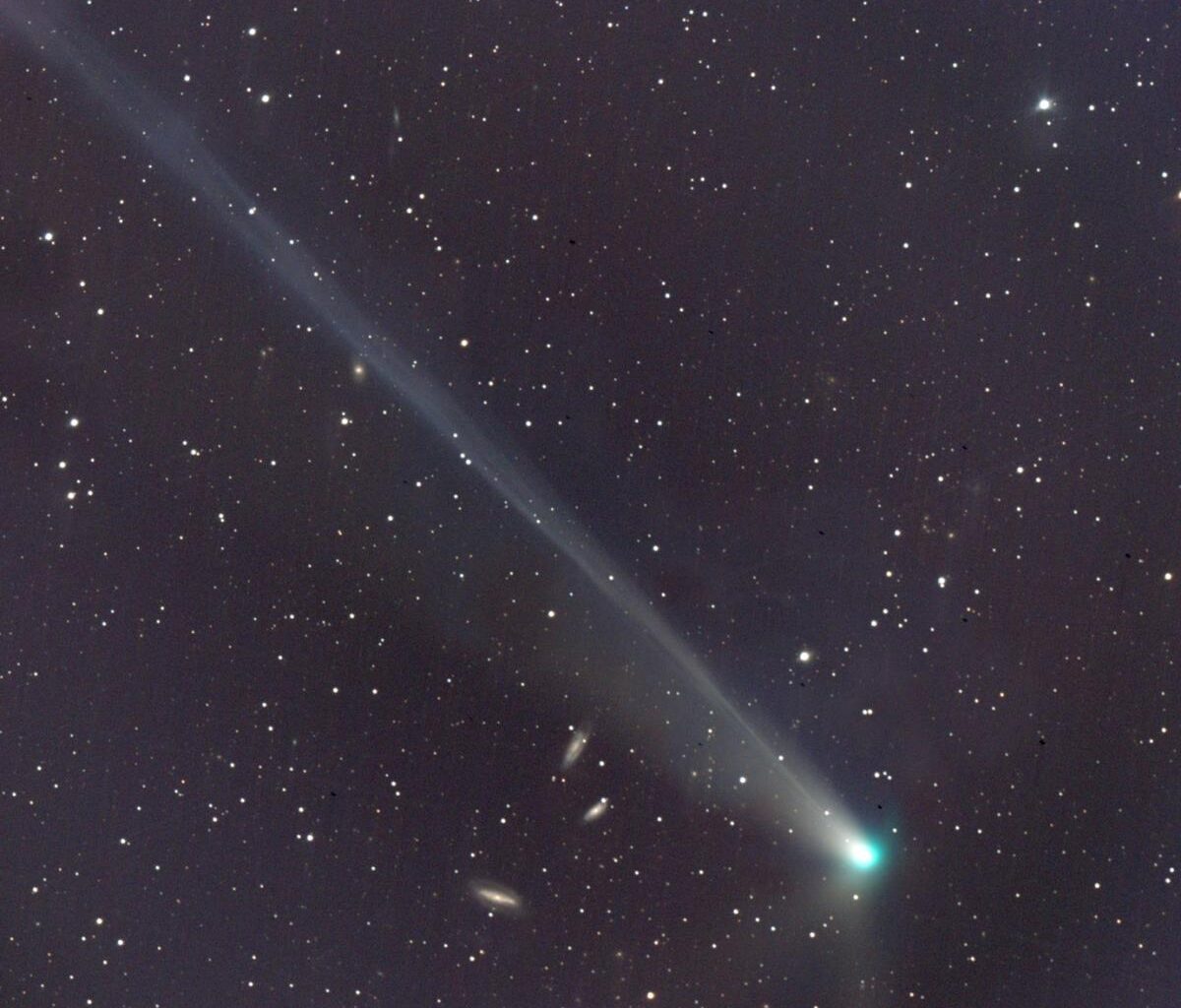
Out here in the Strath Taieri, the nights have started to feel like autumn again — colder, steadier: the sort of air that makes the stars look as though someone has polished them.
Which is how I found myself the other evening, vacuum flask at my elbow and the observatory roof muttering along its rails, waiting for a faint smudge of light to drift past something far grander.
Comet C/2024 E1 isn’t a show-off. You won’t see it blazing over the hills or startling the neighbours. To the naked eye, it’s invisible. But lift a pair of binoculars, and there it is: a soft, ghostly glow, like breath on glass.
Through the telescope, though, it becomes theatrical.
This week, the comet slid past the famous trio of galaxies in Grus — three elegant spirals marooned hundreds of millions of light-years away. They’ve been quietly minding their own business since before the dinosaurs, while this scruffy little visitor from the Oort Cloud barges through the foreground like a tourist with a backpack.
The galaxies are unimaginably distant. The comet, by comparison, is practically in the driveway.
And it shows.
In the image, you can see at least three tails: the broad, creamy dust tail curving gently along its orbit; the straighter, bluish ion tail pushed directly away by the solar wind; and a faint anti-tail effect, a trick of geometry where dust seems to spike sunward. Comets are messy things — less like arrows and more like celestial bad-hair days.
But the real jewel is the coma.
That curious green glow isn’t artistic licence. It’s chemistry. Sunlight breaks apart molecules of carbon compounds — especially diatomic carbon (C₂) — which then fluoresce with that unmistakable emerald tint. It’s the same physics as an old neon sign, just happening in a vacuum at 40 kilometres a second.
A tiny, fragile cloud of gas glowing green against a universe of ancient galaxies.
It feels almost unfair.
The cosmos is doing scale jokes again.
The galaxies are eternal. The comet will be gone in weeks. And yet, for a few nights over Middlemarch, they share the same patch of sky — and we get to watch. Which feels like a rather privileged position, really.