
In an ambitious new proposal, scientists suggest that humanity could soon turn the Sun into a colossal telescope, allowing us to observe distant cosmic objects in ways never before possible. By positioning a spacecraft along the Sun’s gravitational lens, astronomers might magnify images of far-off stars, planets, and even alien surfaces. While the concept is based on Einstein’s theory of general relativity, it still faces daunting technological challenges that could take decades to overcome.
NASA scientists are now investigating whether advanced propulsion systems could make such a mission feasible. The plan would require traveling as far as 650 astronomical units (AU), about 650 times the Earth-Sun distance. While the concept is bold, its potential for space exploration is vast.
Using the Sun for Cosmic Observation
The core idea behind using the Sun as a telescope is rooted in Einstein’s theory of general relativity. Large objects, like stars, curve spacetime, and this curvature bends light traveling near them. This phenomenon, known as gravitational lensing, has been observed when galaxies or black holes magnify light from objects far beyond them. For the Sun to act as a lens, a spacecraft would need to be placed along a specific focal line, an area of space where light from distant objects is naturally magnified.
This natural magnification could allow astronomers to observe cosmic phenomena in greater detail than ever before. According to Von Russel Eshleman, the concept was first proposed in a 1979 research paper. He noted that:
“The gravitational field of the Sun acts as a spherical lens to magnify the intensity of radiation from a distant source along a semi-infinite focal line,” he noted. “A spacecraft anywhere on that line in principle could observe, eavesdrop, and communicate over interstellar distances, using equipment comparable in size and power with what is now used for interplanetary distances.”
He also stated that the Sun’s gravitational field could offer a magnification factor of up to 100 million times for radiation at a wavelength of one millimeter.
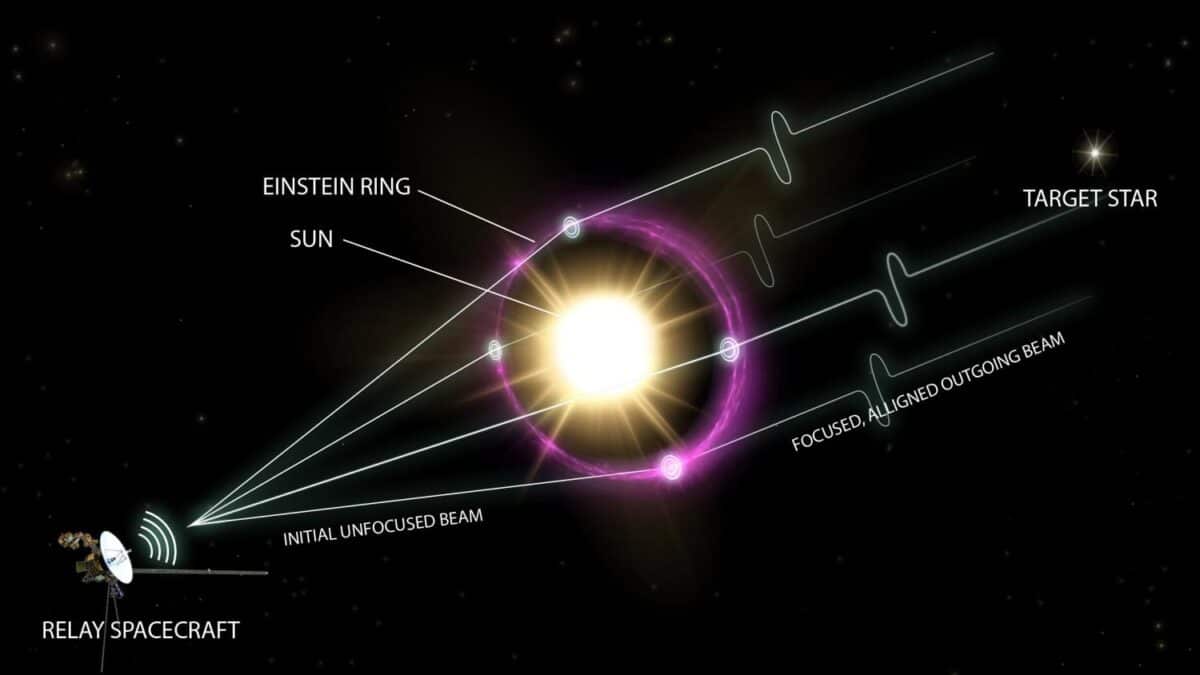 Diagram showing the Sun acting as a gravitational lens to focus beams toward a distant star. Credit: Dani Zemba / Penn State
The Distance Dilemma in Space Travel
While the concept is revolutionary, reaching the Sun’s gravitational lens is no small feat. To take advantage of the magnification, a spacecraft would need to be positioned around 650 AU from the Sun, far beyond the orbit of Pluto. The challenge is immense: Voyager 1, currently the most distant spacecraft, is only around 170 AU from the Sun after nearly 50 years of travel. At that rate, getting to 650 AU could take centuries.
NASA scientists, including Slava G. Turyshev, are exploring advanced propulsion options to make such a mission possible within a reasonable timeframe. Traditional chemical propulsion is simply not powerful enough for this kind of journey. Instead, the team is looking into solar sails and nuclear electric propulsion (NEP).
Solar sails, which rely on sunlight to propel a spacecraft, could reach the desired distance in 25 to 40 years, but they would only be able to carry small payloads. On the other hand, NEP, which uses nuclear power to generate electricity for propulsion, could carry a heavier load and reach the necessary distance in less than 20 years. However, this technology is still in its early stages, and significant progress is needed before such a mission can take off.
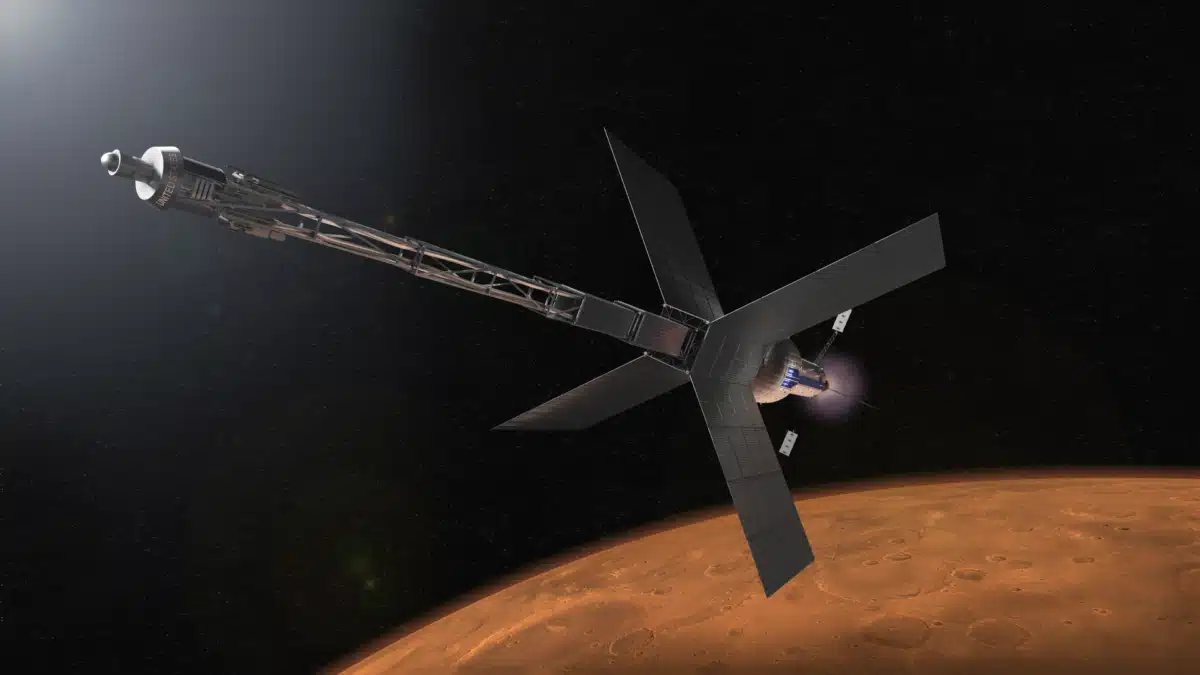 An artist’s rendering of a spacecraft equipped with Nuclear Electric Propulsion (NEP) and solar sails. Credit: NASA